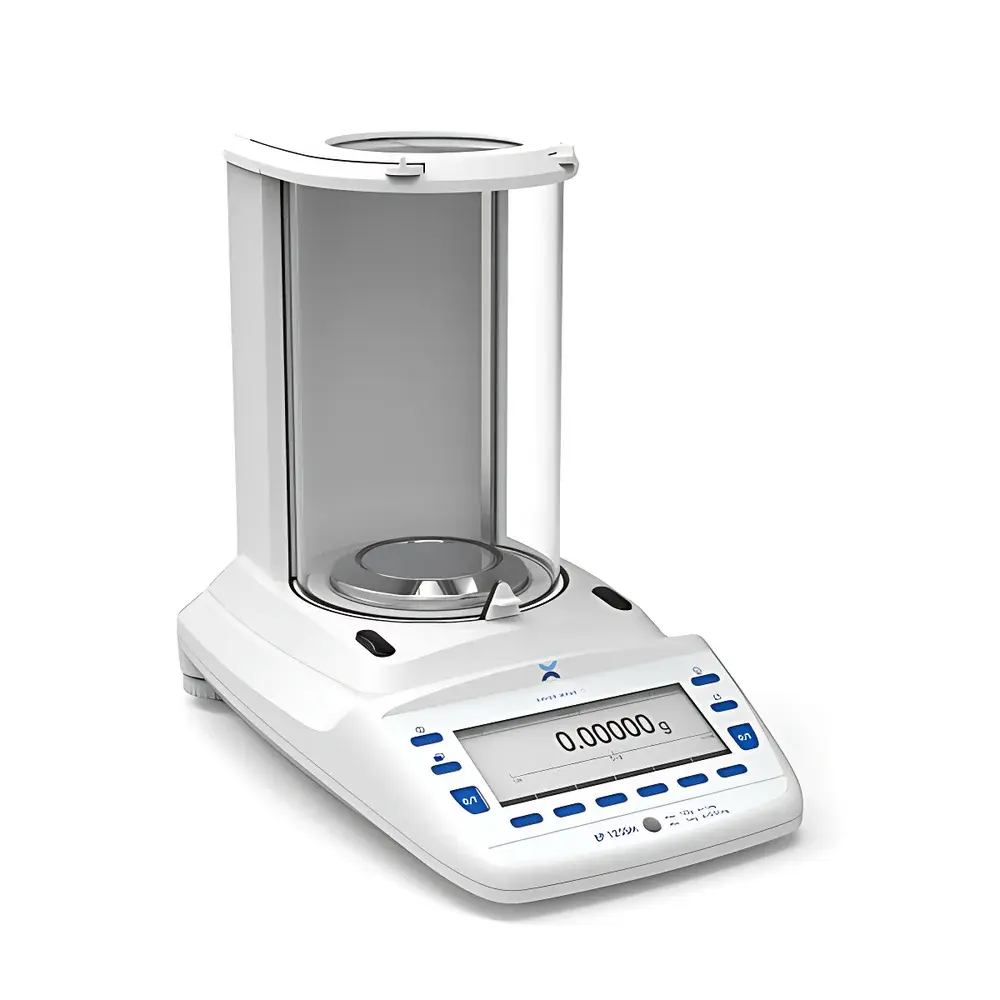
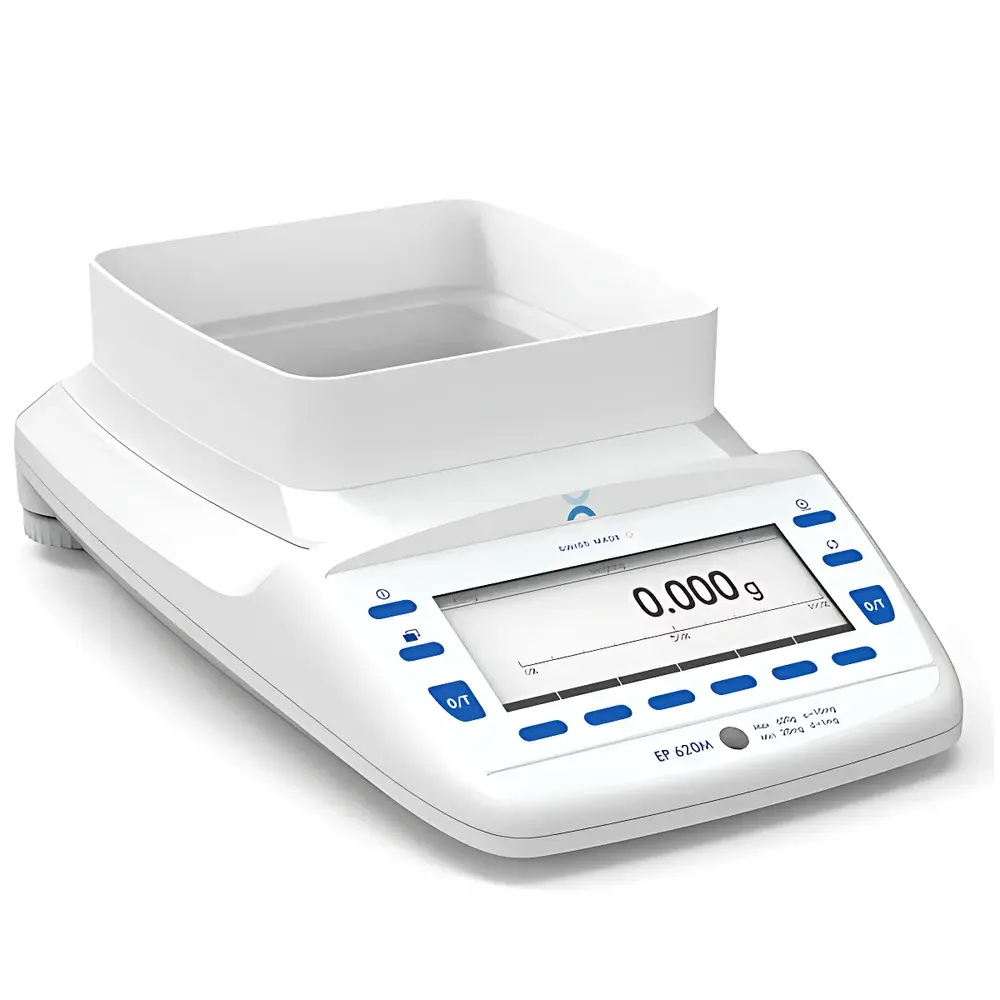
Precisa 360EP Series Ultra-Micro and Analytical Electronic Balance
| Brand | Precisa |
|---|---|
| Origin | Switzerland |
| Model | Precisa 360EP |
| Instrument Type | Ultra-Micro Balance |
| Maximum Capacity | 125 g |
| Readability | 0.01 mg |
| Repeatability | 0.01 mg |
| Calibration | Smart Internal Calibration System (SCS) |
| Compliance | EN 45501 |
| Construction | Monolithic Aluminum Housing |
| Environmental Rating | Optional IP65 |
| Interface | RS232, USB (standard) |
Overview
The Precisa 360EP Series is a high-precision ultra-micro and analytical electronic balance engineered for laboratories requiring trace-level mass measurement with long-term stability and metrological integrity. Built in Switzerland and compliant with EN 45501, the 360EP employs electromagnetic force restoration (EMFR) sensor technology — a principle where sample mass is determined by the precisely controlled current required to restore equilibrium in a magnetic field. This architecture delivers exceptional linearity, minimal drift, and immunity to environmental thermal gradients. The balance features a fully isolated internal cavity design: the weighing chamber, sensor module, and electronics are housed in physically segregated compartments to suppress convective air currents and thermal cross-talk. This structural decoupling ensures rapid stabilization (<3 s typical), high repeatability (≤0.01 mg), and robust resistance to electromagnetic interference — critical for regulated environments such as GLP, GMP, and ISO/IEC 17025-accredited labs.
Key Features
- Monolithic aluminum housing providing mechanical rigidity, corrosion resistance, and EMI shielding
- Smart Internal Calibration System (SCS): fully automated temperature- and time-triggered recalibration; supports manual internal calibration, external calibration with user-defined weights, and full external calibration
- Patented circular draft shield (for 0.01 mg and 0.1 mg models) minimizing footprint while maximizing accessibility and airflow control
- Front-mounted spirit level and tool-free leveling feet for rapid, repeatable installation
- Infrared motion-sensing draft shield doors enabling hands-free operation — reducing contamination risk and operator-induced vibration
- Modular interface architecture: standard RS232 and USB ports; optional hot-swappable modules for Ethernet (wired/wireless), Bluetooth 5.0, RS485, or PS2 connectivity
- IP65-rated enclosure option for use in demanding production or QC environments with dust and incidental moisture exposure
Sample Compatibility & Compliance
The 360EP accommodates diverse sample forms — powders, granules, liquids in tared vessels, small components, and micro-vials — across its 125 g maximum capacity and 0.01 mg readability range. Its sealed sensor chamber and anti-static coating minimize electrostatic interference during low-mass measurements. Regulatory compliance includes full support for 3Q validation (IQ/OQ/PQ), audit-trail-enabled user permission management (with password-protected administrator and operator roles), and built-in real-time clock with timestamping for all critical events (calibrations, weighings, configuration changes). The system meets requirements for FDA 21 CFR Part 11 compliance when paired with validated software (e.g., Precisa LabLink), including electronic signatures, data immutability, and secure archive export. All firmware and calibration records adhere to ISO/IEC 17025 documentation standards.
Software & Data Management
Precisa LabLink software (sold separately) provides full remote control, automated data logging, statistical reporting (mean, SD, CV%, min/max), and customizable certificate generation. The balance stores up to 1,000 weighing records internally with timestamps and user IDs. Data export supports CSV, TXT, and XML formats via USB mass storage mode or serial transmission. The EP model’s graphical LCD display features icon-driven navigation and context-sensitive soft keys — six programmable function keys allow one-touch access to frequently used applications (e.g., MSW, ART, BSET). All settings — including unit preferences, auto-stabilization thresholds, and auto-zero delay — are retained after power cycling.
Applications
- Pharmaceutical R&D and QC: active pharmaceutical ingredient (API) quantification, reference standard preparation, and USP repeatability testing
- Materials science: catalyst loading, nanomaterial dosing, and thin-film mass characterization
- Chemistry labs: gravimetric titration, stoichiometric reagent dispensing, and calibration of pipettes per ISO 8655
- Food & beverage QA: minimum weight control (MWL), recipe formulation, and nutritional labeling compliance
- Environmental testing: filter weighing for PM2.5/PM10 analysis per EPA Method 201A
- Academic research: isotope ratio sample preparation, microgravimetric corrosion studies, and MEMS device mass verification
FAQ
What does “SCS” stand for, and how does it differ from conventional internal calibration?
SCS (Smart Calibration System) continuously monitors ambient temperature and elapsed time since last calibration. It triggers internal recalibration only when predefined thresholds are exceeded — eliminating unnecessary cycles and extending sensor longevity.
Is the 360EP suitable for ISO/IEC 17025 accredited laboratories?
Yes. Its traceable calibration chain, audit-trail functionality, user access controls, and documented uncertainty budgets align with ILAC-G8 and EURACHEM guidelines for accredited mass measurement.
Can the balance perform density determination without external accessories?
Yes. The built-in density application supports both solid and liquid density modes using user-input reference densities and buoyancy correction (BSET) based on air temperature, pressure, and humidity.
What is the purpose of the multi-chamber base design?
It thermally and aerodynamically isolates the EMFR sensor from the load receptor and electronics — preventing heat conduction from the chassis and blocking turbulent airflow that would otherwise induce noise or drift.
How is “minimum sample weight” (MSW) calculated and applied?
MSW is dynamically computed using the balance’s repeatability value (0.01 mg) and user-defined confidence level (typically k=2). The system alerts operators if the net sample mass falls below this statistically validated threshold, ensuring measurement reliability per USP .