
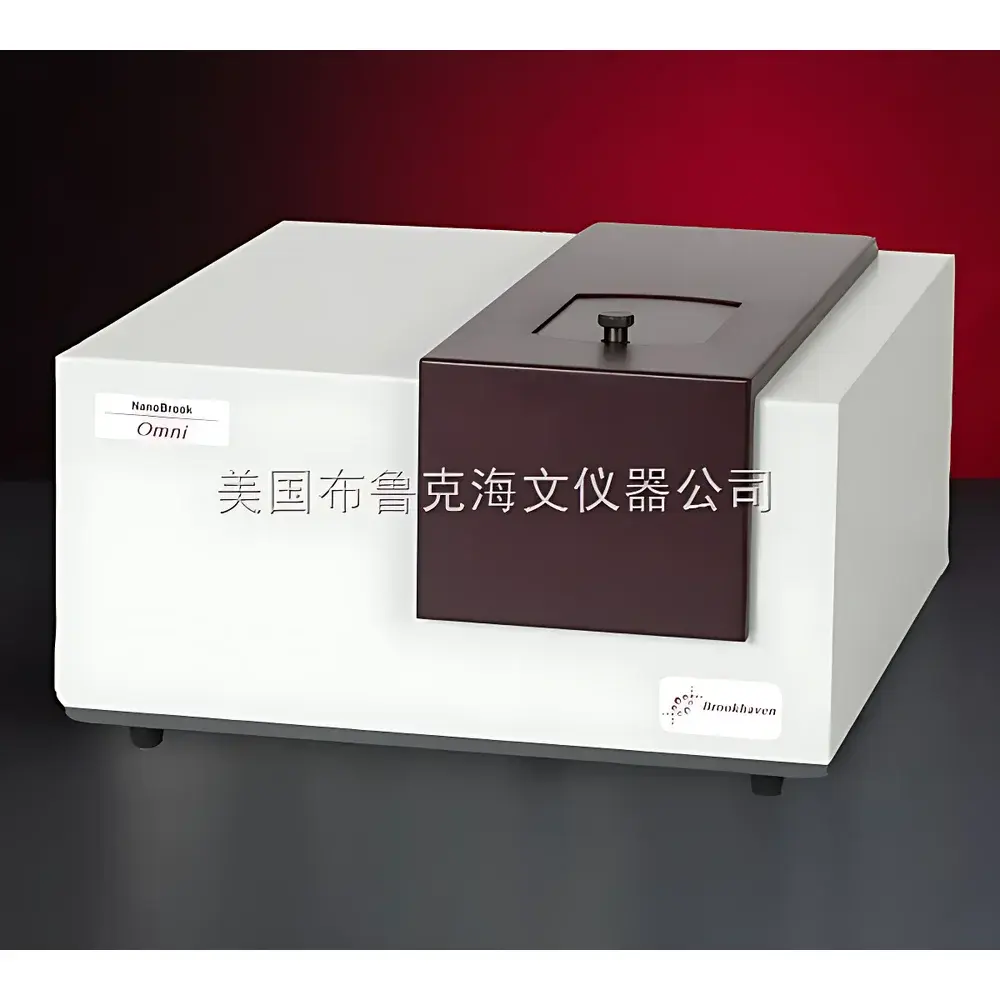
Brookhaven Instruments 90Plus Zeta Zeta Potential and Particle Size Analyzer
| Origin | USA |
|---|---|
| Manufacturer Type | Authorized Distributor |
| Origin Category | Imported |
| Model | 90Plus Zeta |
| Price Range | USD 14,000 – 42,000 |
| Particle Size Range | 0.3 nm – 6 µm |
| Zeta Potential Range | −500 mV to +500 mV |
| Electrophoretic Mobility Range | 1×10⁻¹⁰ – 1×10⁻⁷ m²/V·s |
| Conductivity Range | 0 – 20 S/m |
| Temperature Control | −5 °C to 110 °C (±0.1 °C) |
| Laser Source | 35 mW Solid-State Diode Laser |
| Detection | PMT or APD |
| Correlator | 4×522 physical channels, 4×10¹¹ linear channels |
| Scattering Angles | 15° and 90° |
| Sample Volume (Zeta) | 0.18–1.5 mL |
| Sample Volume (Size) | 1–3 mL |
| Electrode | Open-geometry, palladium-based permanent electrode |
| pH Range | 1–14 |
| Electric Field Strength | 0–3.2 kV/m |
| Software | Particle Solution™ for simultaneous size, zeta, and molecular weight analysis |
Overview
The Brookhaven Instruments 90Plus Zeta is a dual-function electrophoretic light scattering (ELS) and dynamic light scattering (DLS) analyzer engineered for high-precision, reproducible measurement of zeta potential and hydrodynamic particle size in colloidal dispersions. It operates on the fundamental principle of electrophoretic light scattering: when charged particles are subjected to a controlled electric field, their electrophoretic motion induces a Doppler frequency shift in scattered laser light. The instrument captures this spectral shift using advanced heterodyne detection and analyzes it via real-time spectrum drift analysis—eliminating electro-osmotic flow artifacts inherent in conventional capillary-cell designs. This open-cell electrode architecture, combined with temperature-stabilized microfluidics and dual-angle (15°/90°) detection, enables robust characterization across broad conductivity and pH ranges (1–14), including near-isoelectric conditions where multimodal distributions are common.
Key Features
- Open-geometry, palladium-based permanent electrode system—eliminates electrode polarization, cell fouling, and electro-osmotic error without requiring consumable cells or frequent recalibration.
- Dual-angle light scattering detection (15° and 90°) optimized for both low-conductivity biological samples and high-salt industrial formulations.
- Integrated temperature control from −5 °C to 110 °C with ±0.1 °C stability—critical for assessing thermal stability, aggregation onset, and formulation robustness under accelerated conditions.
- High-resolution correlator with 4 independent input channels, 4×522 physical channels, and up to 4×10¹¹ linear correlation channels—enabling adaptive sampling, variable delay times, and cross-correlation for improved signal-to-noise ratio.
- Modular hardware compatibility with optional accessories: BI-ZTU automatic titrator (for pH, conductivity, or additive concentration sweeps), BI-870 dielectric constant meter (for accurate εr input), and BI-SV10 viscometer (for η determination in non-aqueous media).
- Laser source options include 35 mW solid-state diode laser (standard) or 5 mW He–Ne laser (optional)—both compliant with IEC 60825-1 Class 3R safety requirements.
Sample Compatibility & Compliance
The 90Plus Zeta accommodates a wide range of colloidal systems—including liposomes, protein therapeutics, polymeric nanoparticles, ceramic slurries, latex emulsions, pigment dispersions, and food-grade colloids—without dilution or filtration in most cases. Its open-cell design supports viscous, opaque, or high-conductivity samples (up to 20 S/m) that would otherwise fail in closed-cell instruments. The system complies with ISO 13321 (DLS), ISO 22412 (DLS), and ISO 13099-2 (zeta potential by ELS). Data acquisition and reporting meet GLP/GMP traceability requirements: audit trails, electronic signatures, and 21 CFR Part 11–compliant software configuration (via Particle Solution™ v4.x or later) are available upon validation package implementation.
Software & Data Management
Particle Solution™ software provides unified, standards-aligned workflows for size distribution (intensity-, volume-, and number-weighted), zeta potential distribution (including mode, mean, and standard deviation), and molecular weight estimation (via Debye plot or cumulant analysis). All raw correlation functions, power spectra, and migration histograms are stored in vendor-neutral HDF5 format. Batch processing, template-driven report generation (PDF/CSV/XLSX), and customizable pass/fail criteria support routine QC environments. The software includes built-in validation tools for instrument performance verification (e.g., NIST-traceable polystyrene standards), drift correction algorithms, and automatic quality scoring based on count rate, baseline stability, and fit residuals.
Applications
- Biopharmaceutical development: Stability assessment of monoclonal antibodies, mRNA-LNPs, and viral vectors under varying pH and ionic strength; isoelectric point mapping; excipient screening.
- Materials science: Surface charge optimization of ceramic precursors, carbon nanotubes, and metal oxide nanoparticles for dispersion stability in coatings and composites.
- Food & cosmetics: Emulsion and microemulsion characterization; surfactant efficacy evaluation; shelf-life prediction via zeta trend analysis.
- Environmental & industrial colloids: Flocculation behavior of clays and humic substances; charge reversal studies in wastewater treatment formulations.
- Academic research: Fundamental electrophoretic mobility modeling, double-layer thickness estimation (via Henry’s function), and structure–function relationships in soft matter systems.
FAQ
What sample volume is required for zeta potential measurement?
Typical zeta measurements require 0.18–1.5 mL, depending on cell geometry and optical path; minimal-volume adapters are available for precious or low-yield samples.
Can the instrument measure samples with high salt content?
Yes—its open-cell electrode and dual-angle optics enable reliable measurements in conductivities up to 20 S/m, including physiological saline and battery electrolyte formulations.
Is molecular weight determination supported?
Yes—via static light scattering (SLS) coupling or Debye plot analysis of DLS-derived size data, covering 1×10³–2×10⁷ Da for globular and semi-flexible macromolecules.
How is temperature accuracy verified?
Each unit undergoes factory calibration against NIST-traceable platinum resistance thermometers; users may perform in-house verification using certified reference fluids (e.g., ethylene glycol/water mixtures).
Does the system support automated titration experiments?
When integrated with the optional BI-ZTU autotitrator, the instrument executes programmable pH, conductivity, or titrant-concentration ramps while synchronously acquiring zeta and size data at each step.



