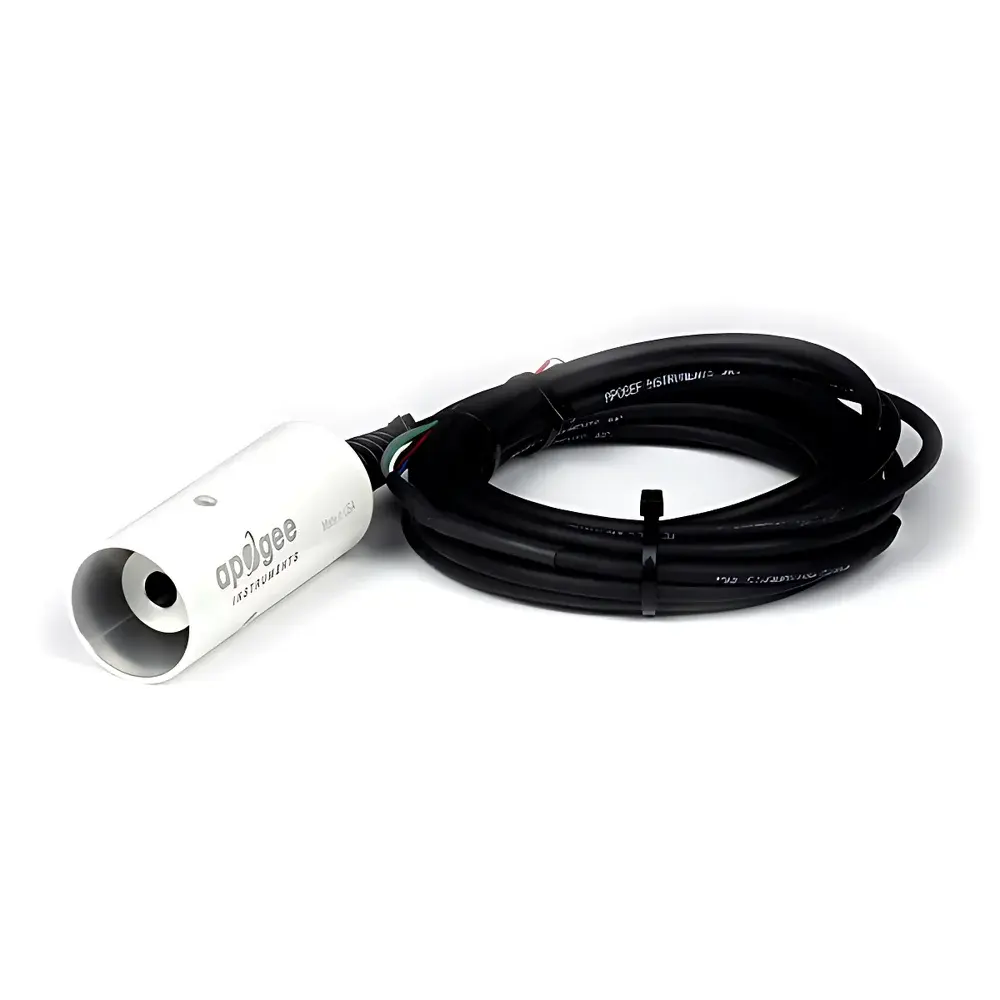
Apogee SI-111 Standard-Field Infrared Radiometer
| Brand | Apogee Instruments |
|---|---|
| Origin | USA (Manufactured in Logan, UT) |
| Model | SI-111 |
| Output Type | Analog Voltage (Non-Amplified) |
| Field of View | 22°30′ |
| Spectral Range | 8–14 µm |
| Measurement Range | −60 °C to +110 °C |
| Calibration Uncertainty | ±0.2 °C (−20 °C to +65 °C) |
| Response Time (95%) | 0.6 s |
| Sensitivity | 60 µV/°C |
| Thermopile Output Range | −3.3 mV to +3.3 mV |
| Thermistor Output Range | 0–2500 mV (excitation-dependent) |
| Excitation Voltage | 2500 mV (typ.) |
| Operating Environment | −55 °C to +80 °C, 0–100% RH (non-condensing) |
| Housing | Marine-grade stainless steel (IP68 connector at sensor head) |
| Dimensions | Ø23 mm × 60 mm |
| Mass | 190 g (incl. 5 m cable) |
| Cable | 5 m, 4-conductor, shielded twisted-pair, TPR jacket (UV-stable, hydrophobic, low-temp flexible) |
| Long-term Drift | <2% per year (with clean germanium window) |
| Warranty | 4 years |
Overview
The Apogee SI-111 is a high-precision, non-contact infrared radiometer engineered for continuous, field-deployable surface temperature measurement across ecological, agricultural, and environmental monitoring applications. It operates on the principle of passive thermal radiation detection within the atmospheric transmission window (8–14 µm), where emitted longwave infrared energy from terrestrial surfaces is captured by a thermopile detector and converted into a linear analog voltage signal. Unlike pyrometers designed for industrial spot-checking, the SI-111 is calibrated traceably to NIST standards and optimized for scientific-grade stability, low drift, and spectral selectivity—ensuring accurate emissivity-corrected surface temperature quantification without active cooling or internal reference blackbody cavities. Its fixed 22°30′ field of view provides a well-defined instantaneous field of view (IFOV) ideal for canopy-scale or pavement-area averaging, while its rugged marine-grade stainless-steel housing and IP68-rated connector enable reliable operation in unsheltered outdoor environments—from arctic tundra to tropical agroecosystems.
Key Features
- Thermopile-based detection with integrated thermistor for simultaneous sensor body temperature compensation—critical for maintaining accuracy under ambient thermal gradients.
- Germanium optical filter (8–14 µm bandpass) mounted directly over the detector, providing inherent spectral selectivity and rejection of solar near-IR interference.
- IP68-rated stainless-steel connector located at the sensor head—enabling rapid, tool-free disconnection for recalibration or replacement without disturbing mounting hardware or cabling infrastructure.
- Low-drift design: <2% annual change in calibration slope when the germanium window remains contamination-free—validated through accelerated aging and field intercomparison studies.
- Robust mechanical architecture: 190 g mass, compact Ø23 mm × 60 mm form factor, and UV-resistant, hydrophobic TPR-jacketed cable rated for −40 °C flexibility and long-term solar exposure.
- Analog voltage output (−3.3 mV to +3.3 mV) scaled to target temperature; thermistor output (0–2500 mV) referenced to user-supplied excitation voltage (typically 2.5 V DC).
Sample Compatibility & Compliance
The SI-111 is compatible with any surface exhibiting emissivity ≥0.90 in the 8–14 µm range—including natural vegetation canopies, bare soil, asphalt/concrete pavements, snowpacks, and freshwater bodies. For quantitative use, users must apply appropriate emissivity correction factors (e.g., 0.97 for green leaves, 0.93–0.96 for dry soil, 0.98 for water) based on literature values or in situ validation. The instrument complies with IEC 60751 (industrial platinum resistance thermometer reference compatibility), meets CE marking requirements for electromagnetic compatibility (EN 61326-1), and adheres to ISO 9060:2018 classification for “spectrally selective” radiometers. While not FDA-regulated, its calibration methodology aligns with ASTM E1256-22 (Standard Test Methods for Radiation Thermometers) and supports GLP-compliant data acquisition when paired with validated DAQ systems featuring audit-trail logging and secure configuration control.
Software & Data Management
The SI-111 requires external signal conditioning and digitization—typically via a data logger supporting differential analog inputs (e.g., Campbell Scientific CR6, Onset HOBO RX3000, or Decagon EM50G). Apogee provides open-format calibration coefficients (slope, offset, thermistor β-value) and documented linearization equations for direct integration into LabVIEW, Python (NumPy/Pandas), MATLAB, or R-based processing pipelines. No proprietary firmware or vendor-locked software is required. When deployed in networked environmental monitoring stations, the sensor’s analog output supports time-synchronized sampling at ≤1 Hz without aliasing, and its low-noise signal (<10 µV RMS) ensures high-resolution resolution (≤0.02 °C) when digitized using 24-bit sigma-delta ADCs. All calibration certificates include NIST-traceable uncertainty budgets compliant with ISO/IEC 17025:2017.
Applications
- Plant ecophysiology: Continuous monitoring of canopy temperature for stomatal conductance estimation, drought stress indexing (e.g., Crop Water Stress Index), and phenological stage tracking.
- Transportation infrastructure: Real-time road surface temperature profiling to support anti-icing decision systems and frost formation prediction models.
- Surface energy balance studies: Partitioning net radiation into sensible and latent heat flux components via dual-sensor setups (e.g., paired with net radiometers and soil heat flux plates).
- Cryosphere monitoring: Snowmelt onset detection and surface temperature gradient analysis across alpine or polar terrain.
- Urban climate research: Spatial mapping of surface temperature heterogeneity across impervious vs. vegetated land cover classes in heat island investigations.
FAQ
Does the SI-111 require periodic recalibration?
Yes. Apogee recommends recalibration every 2 years for critical applications, or annually under harsh environmental exposure (e.g., coastal salt spray, heavy dust loading). Recalibration maintains traceability to NIST SRM 1484 and includes full uncertainty budget reporting.
Can the SI-111 measure air temperature?
No. It measures surface-integrated radiative temperature only. Air temperature must be acquired separately using a ventilated, radiation-shielded Pt100 or thermistor probe.
What is the minimum target size for accurate measurement?
At 1 m distance, the 22°30′ FOV subtends a circular area ~42 cm in diameter. Target size should exceed this by ≥2× to avoid edge effects and ensure >95% energy capture.
Is the sensor compatible with SDI-12 or Modbus protocols?
No—the SI-111 is analog-only. For digital interface, consider the SI-411 (SDI-12 version) or third-party signal-conditioning modules with protocol conversion.
How does ambient temperature affect accuracy?
The integrated thermistor enables real-time detector-body temperature compensation. Calibration uncertainty specifications assume proper compensation; deviations >±20 °C between target and sensor body require application-specific correction per Apogee’s published thermal gradient correction tables.