
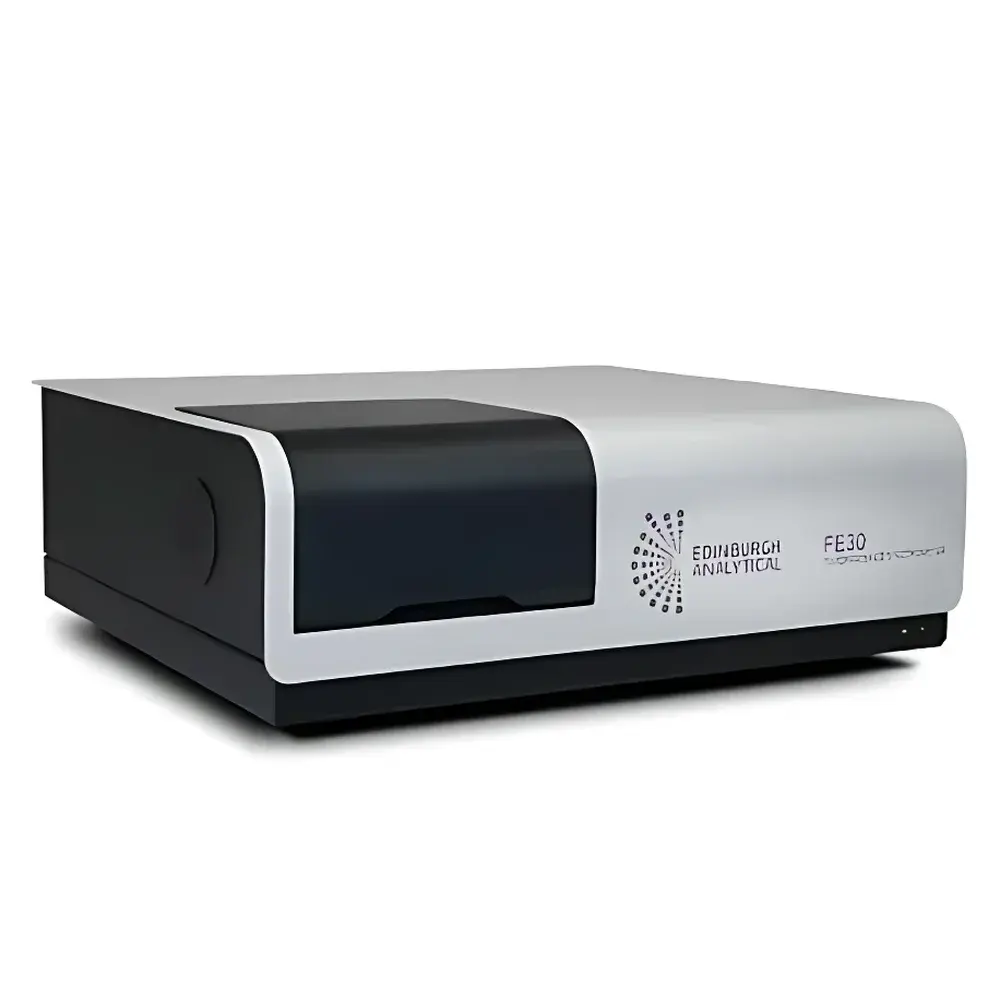
Edinburgh Analytical FE30 High-Performance Steady-State Fluorescence Spectrophotometer
| Brand | Edinburgh Analytical |
|---|---|
| Origin | Shanghai, China |
| Manufacturer Type | Authorized Distributor |
| Instrument Type | Steady-State Fluorescence Spectrometer |
| Wavelength Range | 200–900 nm |
| Excitation Source | Xenon Arc Lamp |
| Monochromator | Grating-Based |
| Slit Width | Adjustable (Multiple Bandwidths) |
| Spectral Resolution | 1.0 nm |
| Wavelength Accuracy | ±2.0 nm |
| Signal-to-Noise Ratio (S/N) | 15,000:1 |
| Maximum Scan Speed | 60,000 nm/min |
| Software | Spectracle™ |
Overview
The Edinburgh Analytical FE30 is a high-performance steady-state fluorescence spectrophotometer engineered for precision molecular fluorescence characterization in research and quality control laboratories. It operates on the principle of photoluminescence excitation and emission detection: a high-intensity xenon arc lamp provides broad-spectrum excitation light, which is monochromated via a precision grating-based optical system before illuminating the sample; emitted fluorescence is then dispersed and detected using a second grating monochromator and a low-noise PMT detector. This dual-monochromator architecture ensures high stray-light rejection, excellent spectral fidelity, and robust quantification across the full 200–900 nm range—covering deep UV through near-infrared regions critical for conjugated polymers, quantum dots, biological fluorophores, and environmental analytes. Designed for reproducibility under routine operation, the FE30 meets core requirements for method validation in GLP-compliant environments and supports trace-level detection where signal integrity and baseline stability are paramount.
Key Features
- High-energy continuous xenon arc lamp delivering stable, broadband excitation from 200 nm to over 900 nm without spectral gaps or intensity roll-off
- Dual-grating monochromator design with motorized, software-controlled slit adjustment—enabling precise selection of spectral bandwidth (e.g., 0.5, 1.0, 2.0, 5.0 nm) to balance resolution and signal throughput
- Optimized optical path with reflective optics and low-stray-light baffling, achieving a measured signal-to-noise ratio of 15,000:1 (at water Raman peak, 350 nm excitation)
- Ultra-fast wavelength scanning up to 60,000 nm/min—enabling rapid kinetic profiling, multi-sample screening, and real-time monitoring of time-dependent fluorescence decay components in quasi-steady-state conditions
- Rugged mechanical platform with thermally stabilized optics mount and vibration-damped housing, minimizing drift during extended acquisitions
- Modular front-panel interface supporting optional accessories including temperature-controlled cuvette holders (−10 °C to +100 °C), solid-sample stages, integrating spheres, and fiber-optic probes
Sample Compatibility & Compliance
The FE30 accommodates standard 10 mm square quartz cuvettes, microvolume cells (down to 50 µL), capillary cells, and solid samples via dedicated holders. Its optical configuration supports both front-face and right-angle fluorescence geometries, enabling accurate measurement of highly absorbing or scattering samples—including colloidal nanomaterials, turbid biological suspensions, and thin-film semiconductor layers. The instrument complies with ISO 17025 general requirements for testing laboratories and supports audit-ready operation per FDA 21 CFR Part 11 when paired with Spectracle™ software’s electronic signature and audit trail modules. All firmware and calibration routines adhere to ASTM E275 and E1317 standards for fluorescence instrumentation performance verification.
Software & Data Management
Spectracle™ is a Windows-based, workflow-driven acquisition and analysis platform developed specifically for fluorescence spectroscopy. It features intuitive method templates for common assays (e.g., quantum yield, FRET efficiency, excitation-emission matrix (EEM) mapping, synchronous scanning), automated background subtraction, multi-curve overlay with normalization options, and export to CSV, ASCII, and JCAMP-DX formats. Raw data files include embedded metadata (instrument ID, date/time stamp, operator ID, calibration status), and all processing steps are logged with timestamped audit trails. Spectracle™ supports LIMS integration via OPC UA and includes built-in tools for generating IQ/OQ documentation packages required for regulated laboratory deployment.
Applications
- Quantitative and qualitative analysis of organic fluorophores, lanthanide complexes, and fluorescent proteins in pharmaceutical development and QC
- Characterization of photophysical properties (quantum yield, Stokes shift, lifetime proxies) in OLED materials, perovskite nanocrystals, and carbon quantum dots
- Environmental monitoring of polycyclic aromatic hydrocarbons (PAHs), dissolved organic matter (DOM), and heavy metal ion sensors via fluorescence quenching assays
- Structural probing of protein folding/unfolding, ligand binding, and conformational dynamics using intrinsic tryptophan fluorescence
- Industrial pigment and dye formulation assessment, including photostability testing under controlled irradiation protocols
FAQ
Is the FE30 capable of time-resolved fluorescence measurements?
No—the FE30 is a steady-state instrument optimized for intensity-based spectral acquisition. For lifetime-resolved analysis, Edinburgh Analytical recommends the FS5 or LifeSpec series with TCSPC or phase-modulation capabilities.
Does the FE30 support automatic wavelength calibration?
Yes—Spectracle™ includes a built-in mercury-argon emission line reference module for daily wavelength verification and auto-calibration against NIST-traceable lines at 253.7, 365.0, 404.7, 435.8, and 546.1 nm.
Can the FE30 be integrated into an automated lab environment?
Yes—it offers RS-232, USB, and Ethernet interfaces with full SCPI command set support, enabling remote control and synchronization with robotic liquid handlers or environmental chambers via third-party automation platforms.
What maintenance is required for the xenon lamp?
The lamp has a rated lifetime of ≥1,000 hours; Spectracle™ tracks cumulative usage and alerts users prior to end-of-life. Replacement is user-performed with alignment-free mounting and automatic intensity normalization post-installation.





