
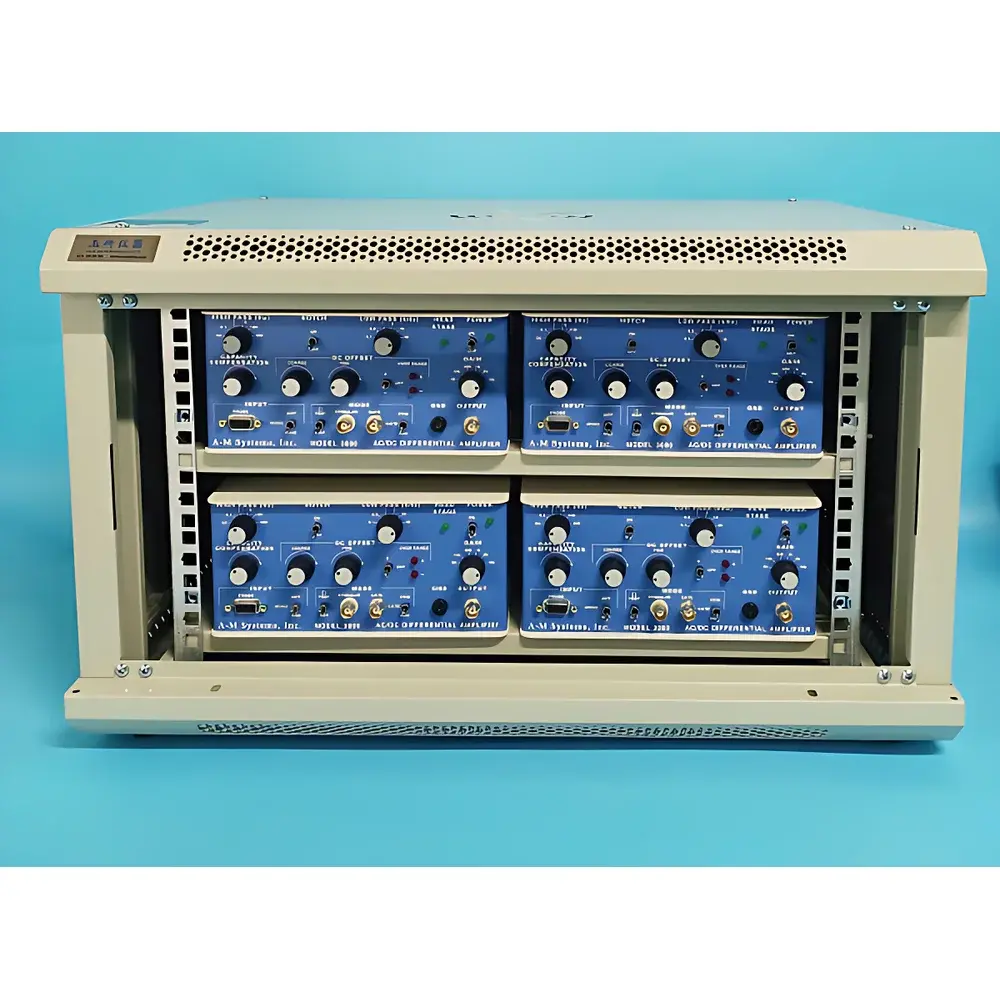
AM Systems Model 3000 / 1800 / 1700 / 3500 Microelectrode Amplifier System
| Brand | AM Systems |
|---|---|
| Origin | Shanghai, China |
| Manufacturer | YUYANBIO |
| Type | AC/DC Differential Amplifier |
| Input Impedance | 10¹¹–10¹⁵ Ω |
| Gain Range | 2–20,000 (Model 3500), 50–10,000 (Model 3000), 100–10,000 (Models 1800 & 1700) |
| Noise | 0.1 fA/√Hz (current noise), 1.0–1.8 µV p-p (10 Hz–10 kHz) |
| Capacitance Compensation | 4–50 pF |
| Filter Options | Adjustable high-pass (0.3 Hz–500 Hz), low-pass (100 Hz–20 kHz), 50/60 Hz notch |
| DC Offset Compensation | ±250 mV |
| Output Range | ±8 V |
| Enclosure | 3U rackmount (Model 3500, 16-channel compatible) |
| Software Control | USB-based Windows GUI with MATLAB® and LabVIEW® SDKs |
| Compliance | GLP/GMP-ready architecture with audit-trail-capable parameter logging |
Overview
The AM Systems Microelectrode Amplifier Series comprises precision AC/DC differential amplifiers engineered for extracellular electrophysiological recording in neuroscience, neurophysiology, and biomedical research laboratories. These instruments operate on the principle of high-impedance voltage measurement via differential input stages optimized for minimal current draw—critical when interfacing with glass micropipettes (≥10 MΩ) or metal microelectrodes (e.g., tungsten, platinum-iridium). The core architecture employs discrete FET-input operational amplifiers with guarded feedback paths to suppress leakage currents and maintain signal fidelity across wide bandwidths. Designed for low-noise, high-fidelity acquisition, each model supports both recording and stimulus delivery modes (where applicable), enabling closed-loop experimental paradigms such as evoked potential mapping, spike-triggered stimulation, and real-time feedback control. The series is widely deployed in academic core facilities, pharmaceutical preclinical labs, and contract research organizations conducting in vitro slice recordings, in vivo single-unit monitoring, EEG/EKG signal conditioning, and peripheral nerve electrophysiology.
Key Features
- Ultra-high input impedance (up to 1015 Ω) minimizes loading effects on high-resistance microelectrodes and preserves signal amplitude integrity.
- Programmable gain (2× to 20,000×) and multi-stage analog filtering—including user-selectable high-pass (0.3 Hz–500 Hz), low-pass (100 Hz–20 kHz), and 50/60 Hz notch filters—enable precise spectral shaping for diverse biological signals.
- Capacitance neutralization (4–50 pF) compensates for electrode capacitance and cable parasitics, essential for stable high-gain operation without oscillation.
- Dual-mode functionality (Recording/Stimulus) with TTL-synchronized triggering ensures temporal alignment between stimulus onset and neural response acquisition.
- Integrated DC offset compensation (±250 mV) allows baseline stabilization during long-duration experiments without manual potentiometer adjustment.
- Rack-mountable 3U chassis (Model 3500) supports up to 16 channels in a single enclosure, facilitating scalable multielectrode array (MEA) or multi-site recording configurations.
- Real-time parameter logging with timestamped notepad entries satisfies GLP and GMP documentation requirements for regulated preclinical studies.
Sample Compatibility & Compliance
The amplifier series is validated for use with standard borosilicate or quartz glass micropipettes (filled with 3 M KCl or NaCl), tungsten, stainless steel, and Pt/Ir microelectrodes. It meets electromagnetic compatibility (EMC) requirements per IEC 61326-1 for laboratory equipment and operates within Class I, Division 2 safety guidelines. All models support FDA 21 CFR Part 11-compliant data acquisition workflows when used with the optional Model 3500 Control Software and enabled audit-trail logging. Calibration traceability follows ISO/IEC 17025 principles through factory-provided calibration certificates, and filter cutoff frequencies are verified per ANSI/IEEE Std 1057 for analog-to-digital system characterization.
Software & Data Management
The Model 3500 includes native Windows-based control software delivered via USB 2.0 interface. This application provides full remote configuration of gain, filter settings, stimulation parameters, channel blanking, and reference bus assignment. Parameter files—including complete amplifier state definitions—are saved in XML format with unlimited versioning and metadata tagging. The software implements deterministic timestamping (microsecond resolution) for all setting changes and user annotations, generating tamper-evident logs suitable for regulatory submission. Native drivers and SDKs for MATLAB® and LabVIEW® enable integration into custom acquisition pipelines, including real-time spike sorting, closed-loop optogenetic control, and automated threshold detection. Export formats include CSV, HDF5, and NWB 2.0 for interoperability with Python-based analysis ecosystems (e.g., Neo, SpikeInterface).
Applications
- In vitro hippocampal or cortical brain slice recordings under submerged or interface chamber conditions.
- In vivo single-unit extracellular recordings from awake, behaving rodents using chronically implanted microwire arrays.
- Peripheral nerve compound action potential (CAP) measurements during pharmacological challenge studies.
- Electrocorticography (ECoG) and depth electrode signal conditioning in large-animal models.
- High-impedance patch-clamp headstage preamplification in two-electrode voltage clamp (TEVC) setups.
- Biomedical device validation requiring low-noise biopotential signal conditioning per ISO 14155 and IEC 60601-2-26 standards.
FAQ
What is the difference between AC-coupled and DC-coupled recording modes?
AC coupling blocks DC offset and slow drifts using a high-pass filter (typically ≥0.1 Hz), ideal for action potential detection. DC coupling preserves subthreshold membrane potential fluctuations and slow synaptic events; it requires active offset compensation to avoid amplifier saturation.
Can these amplifiers be used with commercial data acquisition systems?
Yes—output signals are analog ±8 V, TTL-compatible, and fully synchronized via external trigger inputs. Integration with National Instruments DAQ, Spike2, or Plexon MAP systems is routinely implemented in peer-reviewed publications.
Is remote control possible over Ethernet or Wi-Fi?
The standard interface is USB 2.0. Ethernet or TCP/IP control is not natively supported but can be achieved via third-party USB-to-Ethernet bridges compliant with CDC ACM class drivers.
How often does calibration need to be performed?
Factory calibration is valid for 12 months under normal laboratory conditions. Annual recalibration is recommended for GLP-regulated environments, with full traceability to NIST-traceable voltage and frequency standards.
Are replacement probes or electrode holders available?
AM Systems offers a range of compatible micromanipulator adapters, Faraday cage mounts, and grounded electrode holders. Custom mechanical interfaces can be fabricated upon request with dimensional specifications.



