
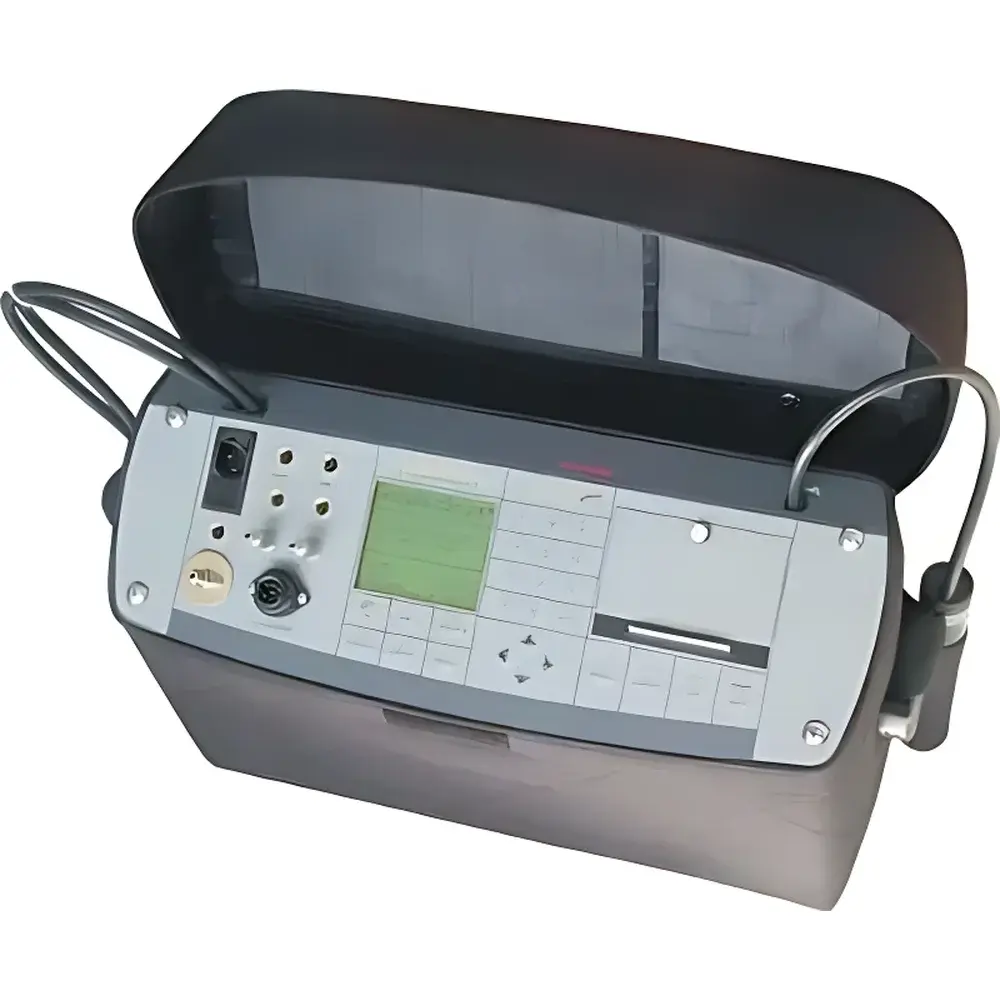
GA-60 Portable Flue Gas Analyzer
| Origin | Austria |
|---|---|
| Type | Imported Instrument |
| Model | GA-60 |
| Sensor Configuration | Standard 5 electrochemical sensors + optional IR sensors (CO₂, CH₄, N₂O) and additional electrochemical sensors (H₂S, H₂) |
| Flow Rate | 1.63 L/min (Bacharach-compliant) |
| Data Storage | 256 MB (~1 million records) |
| Display | 320 × 240 pixel backlit LCD |
| Printer | 57 mm thermal dot-matrix with graphics |
| Power | Rechargeable 12 V / 2.2 Ah lead-acid battery (10 h charge, ~6 h operation) or 110/220 V AC, 50–60 Hz |
| Dimensions | 500 × 410 × 180 mm |
| Weight | 9.5 kg |
| Operating Temperature | 10–50 °C |
| Storage Temperature | −20–55 °C |
| Humidity | 5–90 % RH (non-condensing) |
| Pressure Resolution | 1 Pa (differential), 0.1 hPa (ambient, optional) |
| Temperature Channels | Up to 8 (4 thermocouples + 4 thermistors, optional) |
Overview
The GA-60 Portable Flue Gas Analyzer is an engineered field instrument designed for precise, real-time combustion emission monitoring in industrial boilers, cogeneration units, incinerators, and heating systems. Built on a dual-sensor architecture—integrating electrochemical detection for O₂, CO, NO, NO₂, SO₂ and optional H₂S/H₂, with non-dispersive infrared (NDIR) technology for CO₂, CH₄, and N₂O—the GA-60 delivers trace-level gas quantification compliant with EN 15267, DIN 51622, and OENORM M 7133 standards. Its measurement methodology follows standardized flue gas conditioning principles: integrated Peltier-based gas drying, heated probe sampling (300 mm standard, customizable lengths), particulate filtration (5 µm + 20 µm stages), and cross-sensitivity compensation algorithms calibrated per sensor drift profile. All volumetric concentrations are reported at standardized dry, 0% O₂ reference conditions unless otherwise specified—enabling direct comparison against EU IED (Industrial Emissions Directive) and EPA Method 3A compliance thresholds.
Key Features
- Dual-path CO measurement channel: Independent electrochemical sensor with automatic air-purge activation upon programmable threshold exceedance—ensuring uninterrupted multi-gas analysis during high-CO events.
- Modular sensor architecture: Base configuration includes five electrochemical cells; expandable by up to two additional electrochemical and three NDIR modules—supporting site-specific regulatory requirements without hardware replacement.
- Integrated combustion diagnostics engine: Real-time calculation of Lambda (excess air ratio), η (combustion efficiency), qA (heat loss), TI (CO/CO₂ toxicity index), and mass-normalized emissions (mg/Nm³, mg/Nm³@3% O₂, mg/Nm³@6% O₂) per EN 14181 and ISO 12039.
- High-fidelity physical parameter acquisition: Simultaneous measurement of flue gas temperature (−10 to 1000 °C, Type K thermocouple), ambient temperature (−10 to 100 °C, thermistor), differential pressure (±25 hPa, DMS bridge), and flow velocity (1–50 m/s, Pitot tube, optional).
- Bacharach smoke number testing: Onboard pump-controlled flow regulation (1.63 L/min) with algorithmic opacity correlation—fully aligned with ASTM D2156 and ISO 10842 procedures.
- Robust data integrity framework: Full audit trail with timestamped calibration logs, sensor stability diagnostics, and automated O₂/CO₂ span verification at startup and during operation.
Sample Compatibility & Compliance
The GA-60 is validated for use across heterogeneous combustion matrices—including natural gas, light fuel oil, biomass, coal derivatives, and waste-derived fuels. Its heated sampling train (probe and line) prevents condensate formation in high-moisture exhaust streams, while the Peltier dryer maintains dew point ≤5 °C under continuous operation. All gas measurements adhere to metrological traceability per ISO/IEC 17025-accredited calibration protocols. The analyzer supports full GLP/GMP data governance: electronic signatures, user-access levels, and 21 CFR Part 11–compliant audit logs via optional software configuration. Regulatory alignment includes EN 14181 QAL1 certification readiness, EPA PS-11 equivalency for CO/NOx/SO2, and conformity with TA-Luft (Germany) and BImSchV emission reporting formats.
Software & Data Management
The GA-60 interfaces with Windows-based GA-Soft v4.x application via RS-232C (or USB-RS232 adapter). Software functions include remote configuration of averaging intervals (2–180 s), extended logging schedules (10 s–30 min), fuel database management (10 preloaded DIN/OENORM fuel profiles + user-defined entries), and dynamic cross-interference correction tables. Data export supports CSV, XML, and PDF report generation—with embedded metadata (GPS coordinates, operator ID, calibration certificate IDs). Internal storage retains 256 MB of time-stamped raw and derived values (including all 22 calculated parameters), with automatic overwrite protection and SD card backup capability (optional). Firmware updates are performed over serial link with checksum validation.
Applications
- Periodic stack testing for regulatory compliance (e.g., EU IED Annex V, US Clean Air Act Title V)
- Boiler tuning and energy optimization audits per ISO 5167 and EN 12952
- Waste-to-energy plant emission verification (dioxin precursor screening via CO/N₂O/CH₄ ratios)
- R&D combustion studies requiring simultaneous multi-species kinetics (e.g., NOx reduction efficiency vs. lambda sweep)
- Pre-commissioning flue gas commissioning tests and post-maintenance performance validation
- Mobile environmental inspection teams conducting multi-site surveys under variable ambient conditions
FAQ
Does the GA-60 meet EPA Method 3A requirements for CO and NOx?
Yes—when configured with certified electrochemical sensors and operated within specified temperature/pressure ranges, its performance meets Method 3A accuracy criteria (±5 ppm or ±5% of reading) for CO and NOx in stationary source exhaust.
Can the instrument perform continuous unattended monitoring for 24 hours?
No—it is a portable, operator-assisted analyzer intended for spot-check and short-term survey use. Continuous operation requires external power and is limited by battery capacity (~6 h); extended logging does not imply autonomous deployment.
Is calibration traceable to NIST or PTB standards?
All factory calibrations are traceable to PTB (Physikalisch-Technische Bundesanstalt) reference gases; end-user field calibration kits include certificates with uncertainty budgets per ISO 6141.
What is the maximum allowable flue gas moisture content for reliable operation?
With active Peltier drying and heated probe, the GA-60 handles inlet moisture up to 25 vol% without condensation-induced error—verified per EN 15267-3 Annex C test protocol.
How is sensor cross-sensitivity managed for NO2 in high-CO environments?
Embedded firmware applies real-time correction coefficients derived from co-location testing per ISO 12039 Annex F, compensating for CO interference on NO2 electrochemical response within ±3% of true value.







