
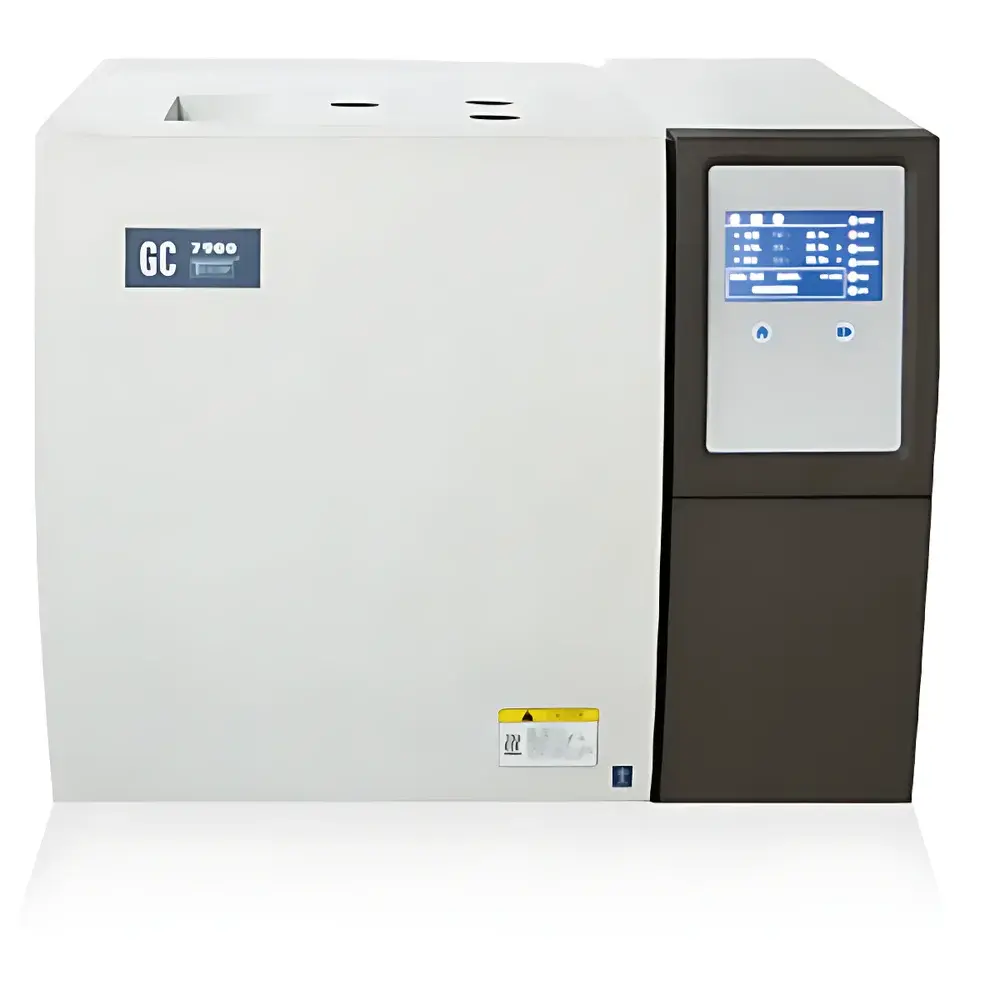
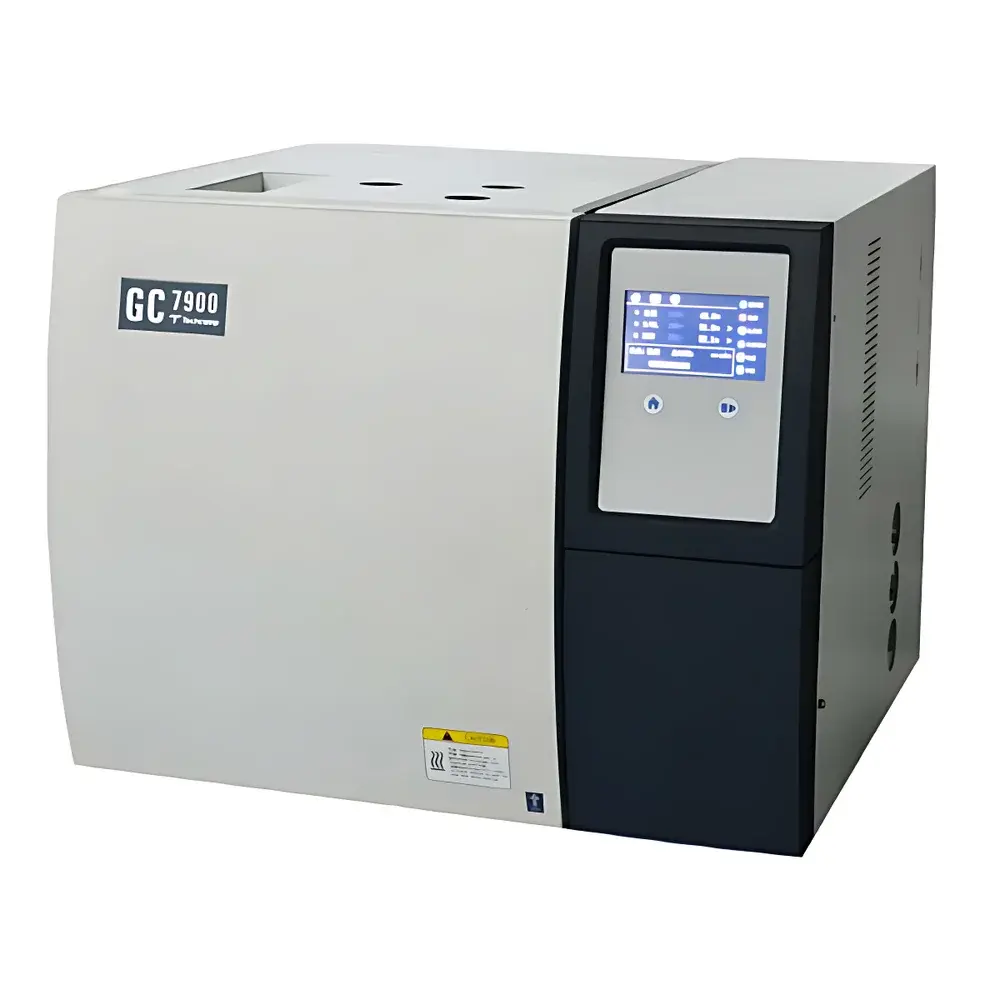
Techcomp GC7900 Benzene-Series Specific Gas Chromatograph with PID Detector
| Brand | Techcomp |
|---|---|
| Origin | Shanghai, China |
| Manufacturer Type | Direct Manufacturer |
| Instrument Type | Laboratory Gas Chromatograph |
| Application Scope | General-Purpose (Benzene-Series & TVOC Analysis) |
| Oven Temperature Range | 5°C above ambient to 400°C |
| Oven Ramp Rate | 0.1–39°C/min |
| Oven Cooling Rate | 50°C/min |
| Injector Maximum Operating Temperature | 400°C |
| Detector | Photoionization Detector (PID) |
| Benzene LOD | 1 ppb |
| Flow Monitoring | Digital Electronic Pressure & Flow Display |
| Software | TVOC-Specific Reverse-Controlled Workstation with Automated Quantitation & Reporting |
Overview
The Techcomp GC7900 Benzene-Series Specific Gas Chromatograph is a dedicated laboratory-scale analytical system engineered for high-sensitivity quantification of aromatic hydrocarbons—including benzene, toluene, ethylbenzene, xylenes (BTEX), and related volatile organic compounds (VOCs)—in complex environmental matrices. Unlike general-purpose GC systems, the GC7900 integrates a calibrated photoionization detector (PID) optimized for ionization energies below 10.6 eV, enabling selective and highly responsive detection of unsaturated and aromatic compounds without interference from saturated aliphatics or permanent gases. Its separation mechanism relies on capillary column chromatography under precisely controlled temperature-programmed conditions, where analytes are volatilized in a heated split/splitless injector, resolved via differential partitioning in a polar or mid-polarity stationary phase (e.g., DB-624 or equivalent), and detected with sub-ppb sensitivity. Designed for regulatory-compliant analysis, the system meets method requirements aligned with EPA TO-17, ISO 16000-6, and GB/T 18883–2022 for indoor air quality assessment, as well as HJ 583–2010 and HJ 644–2013 for water and soil VOC analysis.
Key Features
- Dedicated benzene-series configuration: Pre-optimized hardware and method templates for BTEX and C6–C10 aromatics, minimizing method development time.
- PID detector with 10.6 eV lamp: Delivers two orders of magnitude higher sensitivity for benzene compared to standard flame ionization detectors (FID), achieving a verified limit of detection (LOD) of 1 ppb for benzene under standard injection conditions (1 mL air sample, 0.25 µL liquid standard).
- Thermally stable oven architecture: Aluminum-block heating with dual-zone temperature control ensures ±0.1°C isothermal stability and reproducible ramp profiles across the full 5°C above ambient to 400°C operating range.
- Real-time electronic flow and pressure monitoring: Integrated mass flow sensors provide digital readouts for carrier gas (N2 or He) flow rate and inlet pressure—critical for retention time reproducibility and method transferability.
- High-speed thermal management: 50°C/min cooling rate enables rapid cycle times (<12 min per run for full BTEX separation), supporting high-throughput batch analysis in QA/QC laboratories.
- Robust injector design: Split/splitless inlet rated to 400°C, compatible with both direct liquid injection and thermal desorption tubes (with optional TD interface), ensuring compatibility with EPA Method 325 and ISO 16017-1 workflows.
Sample Compatibility & Compliance
The GC7900 accommodates gaseous samples (ambient air, workplace air, stack emissions), aqueous extracts (purge-and-trap, headspace), and solid-phase microextraction (SPME) desorptions. It supports validated sampling protocols per ISO 16000-22 (indoor air), EN 14662 (water), and Chinese national standards HJ 583–2010 (air) and HJ 644–2013 (soil). The instrument’s firmware and workstation software support audit trails, user access levels, and electronic signatures compliant with GLP and GMP environments. Data integrity adheres to principles outlined in FDA 21 CFR Part 11 when deployed with appropriate IT validation and procedural controls.
Software & Data Management
The included TVOC-specific reverse-control workstation provides full instrument parameter automation—including oven programming, injector timing, detector gain, and data acquisition rate—as well as built-in calculation modules for TVOC summation (per ISO 16000-29), individual BTEX calibration curve generation (linear/non-linear), and report export in PDF, CSV, and XML formats. All raw chromatograms and processing parameters are stored with timestamps and operator IDs. The software architecture supports LIMS integration via ASTM E1384-compliant ASCII export and ODBC connectivity for centralized laboratory data aggregation.
Applications
- Indoor air quality (IAQ) monitoring: Quantitative analysis of benzene and total VOCs in residential, commercial, and automotive cabin environments.
- Drinking water and groundwater assessment: Detection of regulated aromatic contaminants at trace levels per WHO and EU Drinking Water Directive thresholds.
- Occupational hygiene testing: Workplace exposure evaluation against OSHA PELs and ACGIH TLVs for benzene and xylene isomers.
- Environmental site investigation: Screening and confirmation of petroleum hydrocarbon contamination in soil vapor and leachate samples.
- Product emissions testing: VOC profiling of building materials, adhesives, coatings, and consumer goods per CA Section 01350 and GREENGUARD certification protocols.
FAQ
Is the GC7900 compatible with EPA Method TO-17 for air sampling?
Yes—the system supports thermal desorption autosamplers and is validated for use with sorbent tubes (e.g., Tenax TA/Carbotrap) when paired with an appropriate TD unit.
Can the PID detector be replaced with an FID or ECD for multi-analyte screening?
No—the GC7900 is a fixed-configuration system with integrated PID; detector interchangeability is not supported. For multi-detector flexibility, consider the Techcomp GC7980 platform.
Does the workstation support automatic peak integration for overlapping BTEX isomers?
Yes—retention time locking and spectral deconvolution algorithms enable robust resolution and integration of ortho-, meta-, and para-xylene peaks on mid-polarity columns.
What carrier gases are recommended for optimal PID performance?
Nitrogen is preferred for its stable baseline and compatibility with PID lamp lifetime; helium may be used but requires careful optimization to avoid quenching effects.
Is remote instrument monitoring available?
The GC7900 supports Ethernet-based remote status viewing and basic parameter adjustment via secure HTTP interface; full remote control requires local network authentication and IT-administered firewall configuration.
Related Products




