YIG/GGG Epitaxial Thin Film on Gadolinium Gallium Garnet Substrate
| Brand | Hefei Kejing |
|---|---|
| Origin | Anhui, China |
| Manufacturer Type | Authorized Distributor |
| Origin Category | Domestic |
| Model | YIG/GGG Epitaxial Thin Film |
| Pricing | Upon Request |
| Lattice Constant | 12.376 Å ± 0.01 Å |
| Saturation Magnetization | 1500–1750 Gs |
| Film Thickness | 1–12 µm |
| Ferromagnetic Resonance Linewidth (ΔH) | 0.5–2.0 Oe |
| Packaging | Vacuum-sealed in Class 100 clean bags inside Class 1000 cleanroom environment or individual wafer cassette packaging |
Overview
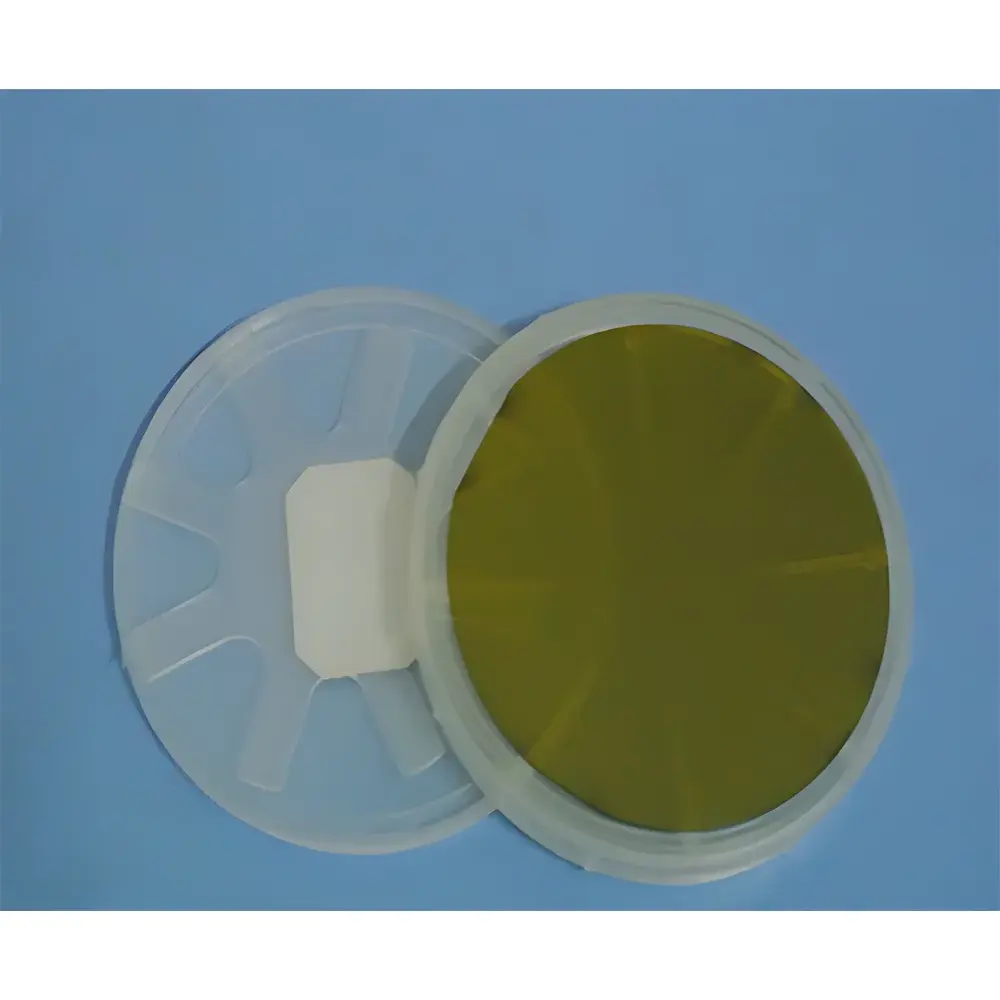
The YIG/GGG epitaxial thin film is a single-crystal magnetic insulator heterostructure engineered for high-frequency microwave and magnonic device applications. Comprising a yttrium iron garnet (Y3Fe5O12, YIG) layer grown lattice-matched on a gadolinium gallium garnet (Gd3Ga5O12, GGG) substrate, this structure leverages the near-ideal lattice match (Δa/a < 0.1%) to achieve atomically ordered, low-defect-density epitaxy. The GGG substrate provides thermal and mechanical stability while maintaining minimal interfacial strain—critical for preserving YIG’s intrinsic low magnetic damping (α ≈ 10−5) and narrow ferromagnetic resonance linewidth. This material system serves as the foundational platform for spin-wave propagation studies, broadband isolators, circulators, magnetostatic wave (MSW) filters, and emerging magnon-based logic and memory prototypes.
Key Features
- High-quality epitaxial growth via liquid-phase epitaxy (LPE) or pulsed laser deposition (PLD), ensuring stoichiometric control and atomic-layer smoothness (RMS roughness < 0.2 nm over 5 × 5 µm)
- Precisely controlled film thickness ranging from 1 µm to 12 µm—tunable to support specific cutoff frequencies and spin-wave dispersion regimes
- Low ferromagnetic resonance linewidth (ΔH = 0.5–2.0 Oe at X-band, 9.5 GHz), indicating exceptional crystalline perfection and minimal two-magnon scattering
- Saturation magnetization (Ms) within 1500–1750 Gs—consistent with bulk YIG values and validated by vibrating sample magnetometry (VSM) and ferromagnetic resonance (FMR) spectroscopy
- Lattice constant of 12.376 Å ± 0.01 Å—certified via high-resolution X-ray diffraction (HR-XRD) θ–2θ and rocking curve analysis
- Standard 3-inch (76.2 mm) diameter wafers with 0.5 mm substrate thickness—compatible with standard sputtering, etching, and lithography toolsets used in RF/microwave fabrication lines
Sample Compatibility & Compliance
These YIG/GGG wafers are fabricated and handled exclusively in certified Class 1000 cleanrooms, with final packaging performed in Class 100 laminar flow hoods. Each wafer undergoes post-growth inspection including optical microscopy (defect density < 1 cm−2), surface profilometry, and HR-XRD verification. While not subject to IEC or ISO certification per se—as a research-grade substrate component—the product conforms to widely adopted laboratory handling protocols aligned with SEMI F47 (cleanroom packaging standards) and ASTM F1879 (specification for semiconductor-grade substrates). Traceability documentation includes batch-specific XRD reports, Ms calibration curves, and ΔH measurement records. For regulated R&D environments (e.g., defense-funded projects or DoD-contracted labs), full audit-ready manufacturing logs—including furnace temperature profiles, ambient O2 partial pressure during growth, and post-anneal cooling rates—are available upon request.
Software & Data Management
As a passive epitaxial material platform—not an instrument—the YIG/GGG film does not incorporate embedded firmware or proprietary software. However, its metrological characteristics are fully interoperable with industry-standard characterization platforms: data from VSM (Lake Shore 8400 series), FMR spectrometers (Keysight N5247A with magnetic field accessories), and time-resolved magneto-optical Kerr effect (TR-MOKE) systems (e.g., PulseTech or Toptica setups) are natively exportable in CSV, HDF5, or MATLAB-compatible formats. All supplied wafers include a digital Certificate of Conformance (CoC) containing calibrated reference parameters, which integrates seamlessly into laboratory electronic lab notebook (ELN) systems compliant with 21 CFR Part 11 requirements when paired with institutional digital signature workflows.
Applications
- Microwave non-reciprocal components: integrated YIG-based circulators and isolators operating from S-band through K-band
- Spin-caloritronic and spin-Seebeck effect experiments requiring low-damping, insulating spin transport channels
- Coherent magnonics: excitation and detection of propagating spin waves in patterned YIG waveguides
- Heterostructure integration: hybrid interfaces with heavy-metal layers (Pt, Ta) for spin-orbit torque studies or with 2D materials (graphene, TMDs) for proximity-induced magnetism
- Quantum transduction platforms: coupling between microwave photons and magnons in cavity magnonics architectures
- Calibration standards for magnetic imaging techniques such as magnetic force microscopy (MFM) and scanning NV-center magnetometry
FAQ
What substrate orientations are available?
Standard orientation is (111) GGG; (100) orientation is available upon custom order with minimum batch size of 5 wafers.
Can the films be patterned or etched post-delivery?
Yes—YIG exhibits well-established dry etch compatibility with Ar/CHF3 inductively coupled plasma (ICP) reactors. Etch rates and selectivity versus GGG are documented in published literature (e.g., J. Appl. Phys. 125, 151402, 2019).
Is post-deposition annealing required before use?
No—films are delivered in fully optimized, post-growth annealed condition. Additional annealing may degrade interface quality and is not recommended unless specified for a particular integration process.
Do you provide film stress measurements?
Yes—curvature-based stress data (±5 MPa resolution) obtained via laser scanning profilometry is included in the CoC for orders ≥10 wafers.
Are La:YIG variants available?
Yes—lanthanum-doped YIG (La:YIG) with nominal doping levels of 0.1–0.5 at.% La is offered as a standard variant under model code LaYIG/GGG, with corresponding adjustments to Ms and ΔH.
Related Products