
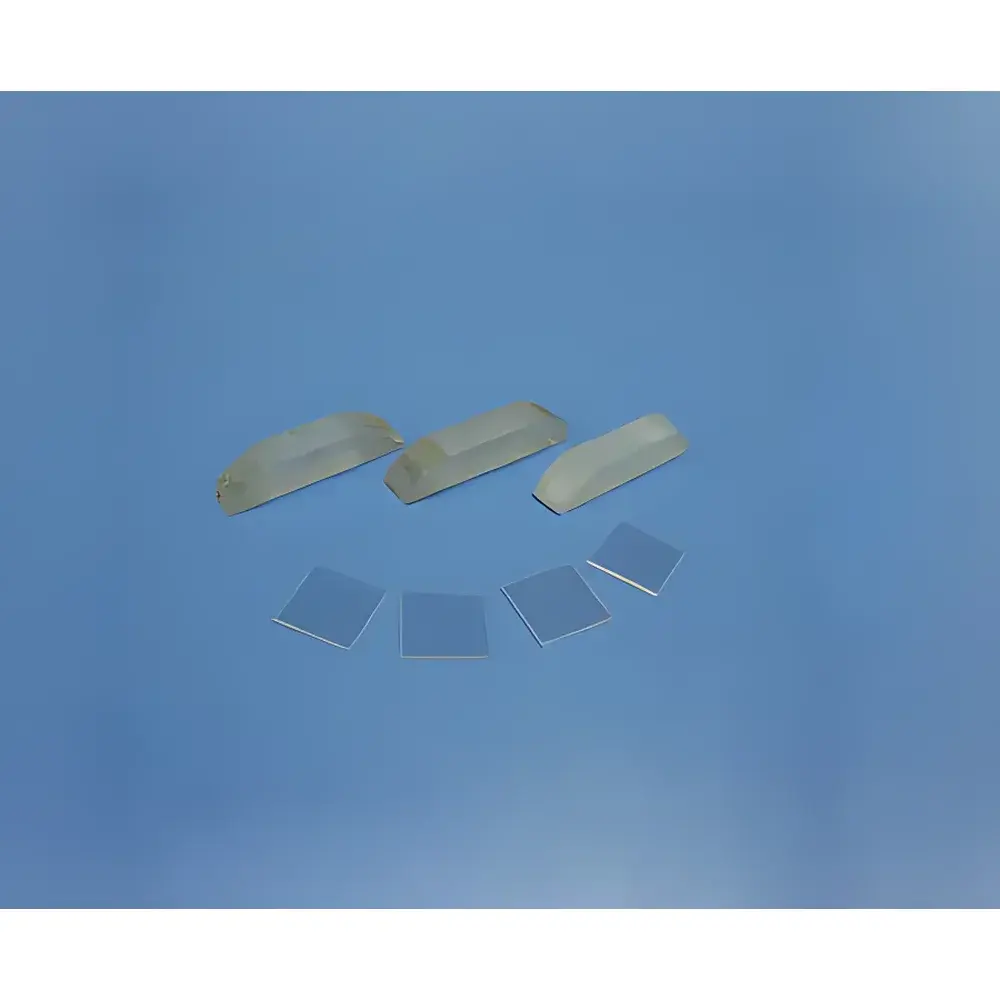
LiGaO2 Lithium Gallate Single Crystal Substrate Wafers
| Brand | Hefei Kejing |
|---|---|
| Origin | Anhui, China |
| Manufacturer Type | Authorized Distributor |
| Origin Category | Domestic (China) |
| Model | LiGaO₂ |
| Pricing | Upon Request |
| Crystal System | Orthorhombic |
| Lattice Constants | a = 5.406 Å, b = 5.012 Å, c = 6.379 Å |
| Growth Method | Czochralski (CZ) |
| Density | 4.18 g/cm³ |
| Melting Point | 1600 °C |
| Vickers Hardness | ~7.5 GPa |
| Surface Finish | Epi-ready polished (single- or double-side polished) |
| Standard Orientations | <001>, <100> |
| Standard Dimensions | 10 × 10 × 0.5 mm |
| Packaging | Class 1000 cleanroom assembled, sealed in Class 100 clean bags |
Overview
Lithium gallate (LiGaO₂) single crystal substrates are high-performance dielectric wafers engineered for advanced thin-film epitaxy, surface acoustic wave (SAW) device fabrication, and electrochemical sensor development. As a wide-bandgap (≈4.8 eV), chemically stable oxide with orthorhombic symmetry, LiGaO₂ exhibits low dielectric loss, high thermal stability, and lattice compatibility with functional oxides such as ZnO, GaN, and perovskite-type ferroelectrics. Its crystalline structure—characterized by well-defined lattice parameters (a = 5.406 Å, b = 5.012 Å, c = 6.379 Å)—enables precise strain engineering and atomic-layer-controlled heteroepitaxy. Grown via the Czochralski method under controlled oxygen partial pressure, these substrates deliver exceptional structural homogeneity, minimal dislocation density (<1 × 10⁵ cm⁻²), and absence of twinning or inclusions—critical prerequisites for reproducible QCM electrode deposition and high-sensitivity mass sensing applications.
Key Features
- Ultra-low surface roughness: RMS < 0.2 nm over 5 × 5 µm AFM scan area, verified by atomic force microscopy
- Epi-ready finish: Chemomechanically polished to optical-grade flatness (total thickness variation < 1 µm), compatible with MBE, PLD, and sputtering processes
- Thermal robustness: Stable up to 1600 °C in inert or oxidizing atmospheres; coefficient of thermal expansion (CTE) ≈ 8.2 × 10⁻⁶ K⁻¹ (25–800 °C)
- High mechanical integrity: Vickers hardness of 7.5 GPa ensures resistance to chipping and scratching during handling and clamping in QCM cells
- Controlled orientation options: Standard and cuts with ±0.5° miscut tolerance; custom orientations available upon specification
- Traceable quality assurance: Each wafer batch includes XRD rocking curve FWHM data (< 0.15° for (002) reflection), Raman spectroscopy confirmation of phase purity, and SEM/EDS verification of stoichiometry
Sample Compatibility & Compliance
LiGaO₂ substrates are routinely employed in quartz crystal microbalance (QCM) systems for real-time, label-free monitoring of interfacial phenomena—including polymer film growth, biomolecular adsorption kinetics, and corrosion inhibitor layer formation. Their low intrinsic dissipation factor (tan δ 15,000) operation. All wafers comply with ISO 14644-1 Class 5 (ISO Class 5 / Federal Standard 209E Class 100) cleanroom packaging protocols. Certificate of Analysis includes ICP-MS trace metal screening (Al, Fe, Cu, Ni < 1 ppb) and surface contamination data per SEMI F57-0201 standards. Compatible with ASTM E1250 (standard practice for calibration of QCM sensors) and supports GLP-compliant experimental workflows when integrated into validated QCM-D platforms.
Software & Data Management
While LiGaO₂ substrates themselves are passive components, their performance is fully leveraged within modern QCM instrumentation ecosystems—including Biolin Scientific QSense, Sartorius Octet QCM, and Stanford Research Systems SR780-based systems. These platforms support time-resolved frequency (Δf) and dissipation (ΔD) tracking with sub-Hz resolution, automated baseline correction, and Sauerbrey or Voigt-model fitting. Raw sensorgrams and metadata (temperature, flow rate, buffer composition) are exportable in CSV and HDF5 formats, ensuring interoperability with Python (SciPy, Pandas), MATLAB, or LabVIEW-based analysis pipelines. Audit trails, user access logs, and electronic signatures align with FDA 21 CFR Part 11 requirements when deployed in regulated environments.
Applications
- Epitaxial growth of piezoelectric ZnO and AlN films for next-generation MEMS resonators
- Model substrate for studying interfacial water structure and ion hydration dynamics via QCM-D
- Support matrix for immobilization of redox-active enzymes (e.g., glucose oxidase, horseradish peroxidase) in amperometric biosensors
- Template for atomic-layer deposition (ALD) of high-k dielectrics (e.g., HfO₂, Al₂O₃) in gate-stack engineering
- In situ electrochemical impedance spectroscopy (EIS) studies of solid electrolyte interphase (SEI) evolution in Li-ion battery research
- Surface functionalization platform for SPR and QCM co-analysis in protein–ligand binding assays
FAQ
What is the typical surface resistivity of LiGaO₂ substrates?
LiGaO₂ is an insulating oxide with bulk resistivity >10¹² Ω·cm at room temperature; surface resistivity depends on ambient humidity and surface termination but remains >10¹⁰ Ω/sq under standard lab conditions (23 °C, 40% RH).
Can these substrates be used in ultra-high vacuum (UHV) environments?
Yes—LiGaO₂ demonstrates negligible outgassing below 10⁻¹⁰ mbar after 24 h bake-out at 200 °C; residual gas analysis confirms absence of H₂O, CO, and hydrocarbon peaks.
Is post-purchase annealing recommended before thin-film deposition?
Annealing at 600–800 °C in O₂ for 30–60 min is recommended to remove adventitious carbon and restore stoichiometric surface termination, particularly prior to MBE or PLD.
Do you provide orientation verification reports with each shipment?
Yes—each lot includes a certified X-ray diffraction report confirming Miller indices, full-width-at-half-maximum (FWHM) of key reflections, and rocking curve asymmetry metrics.
Are custom thicknesses available beyond 0.5 mm?
Yes—thicknesses from 0.3 mm to 1.0 mm are available with ±0.02 mm tolerance; minimum order quantity applies for non-standard dimensions.
Related Products





