
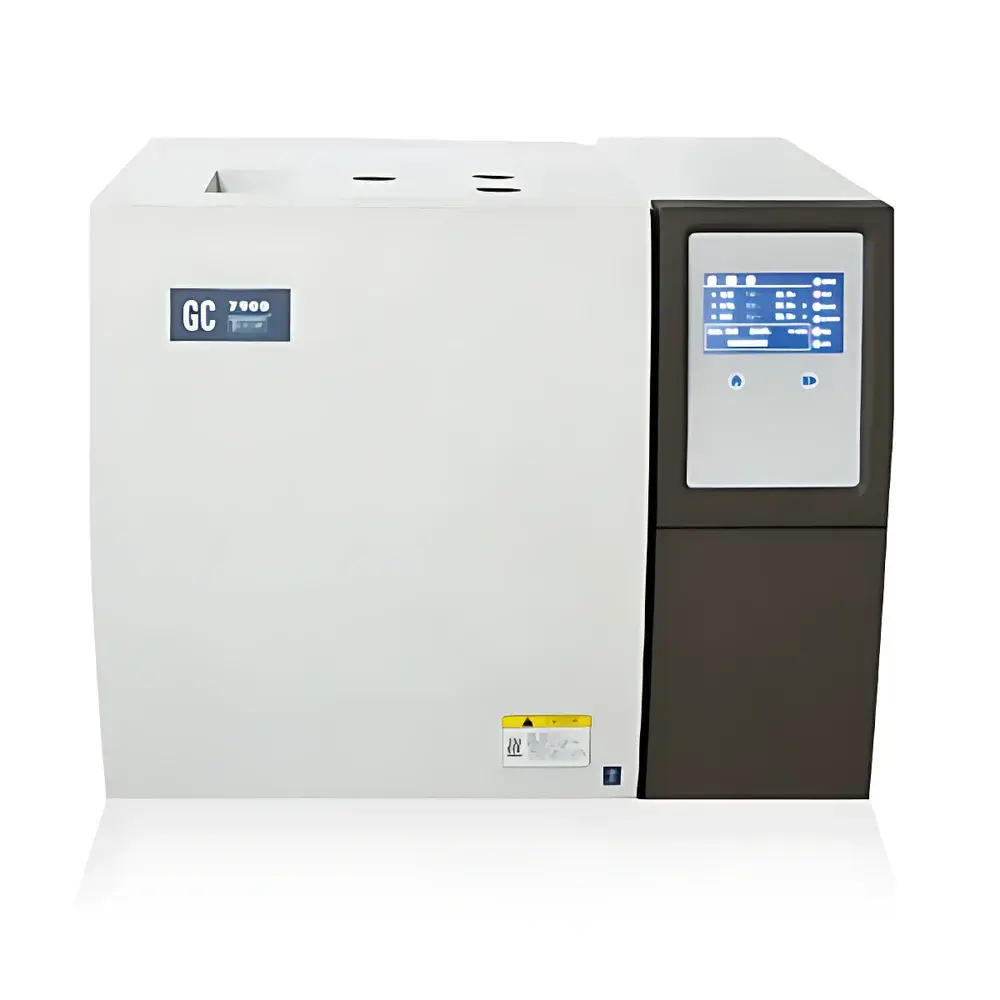
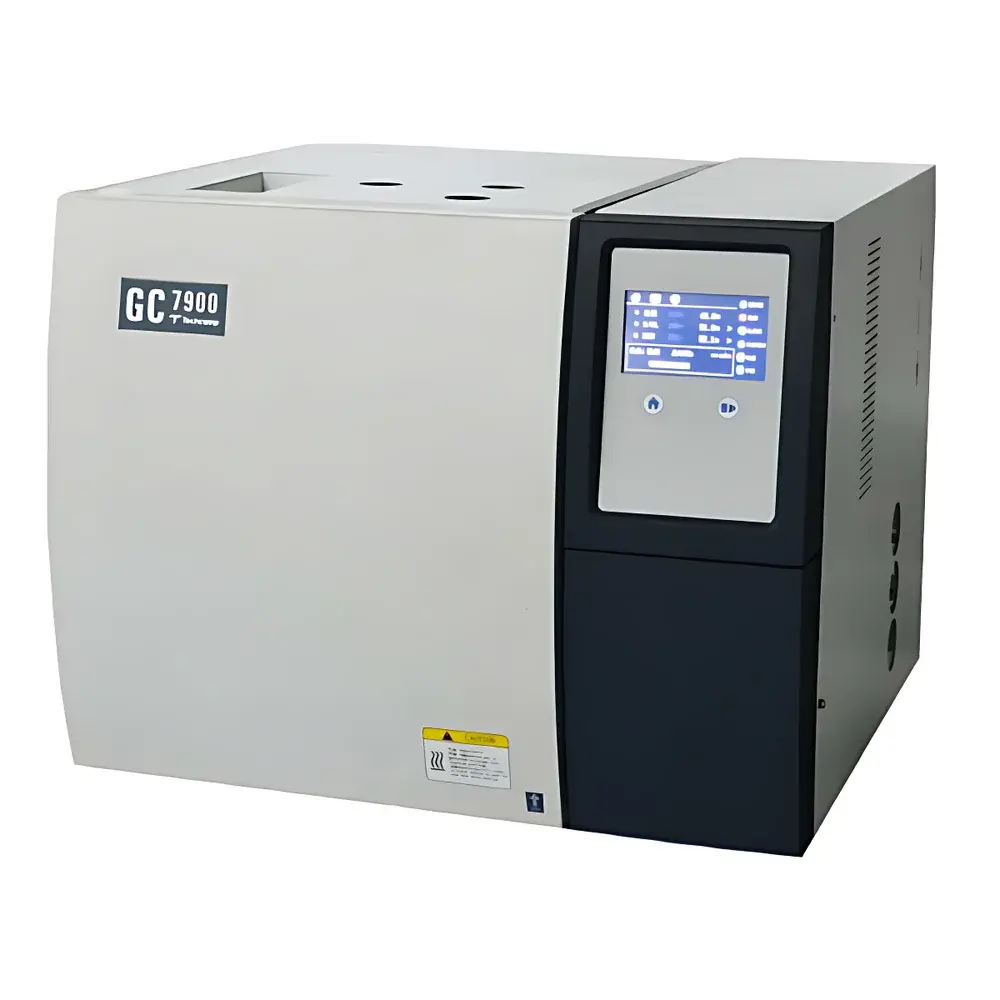
Techcomp GC7900 Dedicated Non-Methane Hydrocarbons (NMHC) Gas Chromatograph
| Brand | Techcomp |
|---|---|
| Origin | Shanghai, China |
| Manufacturer Type | Direct Manufacturer |
| Instrument Type | Laboratory Gas Chromatograph |
| Application Field | Petrochemical Industry |
| Oven Temperature Range | 5 °C above ambient to 400 °C |
| Ramp Rate | 0.1–39 °C/min |
| Cooling Rate | 50 °C/min |
| Injector Maximum Operating Temperature | 400 °C |
| Programmable Temperature Ramping | 9-step |
| Column | Specified NMHC Separation Column (O₂/CH₄ Resolution Optimized) |
| Detector Options | FID, TCD, ECD, FPD, NPD, PID, Micro-TCD |
| Simultaneous Detector Capacity | Up to 3 |
| Analog Outputs | 3 channels |
| Digital Output | 1 RS-232/USB port |
| Display | Large Backlit LCD with Real-Time Dual-Chromatogram View |
| Control Interface | Touch-Sensitive Keypad |
| Electronic Pressure Control (EPC) | Optional for Split/Splitless Inlet |
| Septum Purge | Integrated for Ghost Peak Suppression |
Overview
The Techcomp GC7900 Dedicated Non-Methane Hydrocarbons (NMHC) Gas Chromatograph is a purpose-engineered laboratory gas chromatograph designed to meet the stringent analytical requirements of environmental monitoring and petrochemical process control—specifically for regulatory-compliant determination of total hydrocarbons (THC), methane (CH₄), and non-methane hydrocarbons (NMHC) in ambient air, stack emissions, and refinery off-gas streams. Built upon the modular GC7900 platform, this configuration implements a validated valve-switching injection system coupled with a high-resolution, oxygen/methane-selective capillary column and a flame ionization detector (FID) optimized for linear dynamic range and low detection limits (sub-ppb level for CH₄ under standard conditions). The instrument operates on the principle of selective separation via gas-phase partitioning in a temperature-programmed capillary column, followed by quantitative detection using ionization current proportional to carbon mass flow. Its architecture complies with core methodological foundations outlined in EPA Method 25A, ISO 12039:2000, and HJ 38–2017 (China’s NMHC standard), supporting trace-level quantification with high reproducibility (<2% RSD for replicate injections) and robust baseline stability over extended run times.
Key Features
- Valve-based dual-loop injection system enabling single-injection, simultaneous quantification of total hydrocarbons and methane—eliminating manual re-injection and inter-run calibration drift.
- Thermally stabilized oven with 9-stage programmable ramping, precise ±0.1 °C temperature control, and rapid cooling (50 °C/min) for high-throughput analysis cycles.
- Dedicated NMHC separation column engineered to resolve O₂ from CH₄ at sub-ambient retention times, preventing oxygen-induced co-elution artifacts and ensuring accurate THC integration.
- Integrated catalytic oxidation module (optional or factory-installed) that converts all non-methane hydrocarbons to CO₂ prior to FID measurement—critical for achieving stoichiometric equivalence in NMHC calculation (NMHC = THC − CH₄).
- Electronic pressure/flow control (EPC)-capable split/splitless inlet with septum purge function to suppress ghost peaks arising from septum bleed or column bleed accumulation.
- Modular detector bay accommodating up to three detectors simultaneously; standard configuration includes one high-sensitivity FID calibrated per ASTM D6348 and USP , with optional TCD or PID for multi-analyte verification.
- Real-time dual-channel chromatogram display on a 7-inch capacitive touchscreen LCD, with intuitive keypad navigation and parameter entry without PC dependency.
Sample Compatibility & Compliance
The GC7900 NMHC system is validated for gaseous samples collected in evacuated canisters (SUMMA®-type), Tedlar® bags, or continuous stream interfaces compliant with EN 13649-1 and EPA Compendium Method TO-15. It supports direct injection of air, natural gas, flare gas, and refinery vent streams without pre-concentration. All hardware and firmware configurations adhere to GLP data integrity principles: audit trail logging, user access levels (admin/operator), electronic signatures, and raw data immutability—fully compatible with FDA 21 CFR Part 11–compliant LIMS integration when paired with Techcomp’s ChromaLink Pro software suite. Calibration protocols follow ISO/IEC 17025:2017 requirements for traceable gas standards (NIST-traceable CH₄ in air, certified at 1–100 ppmv).
Software & Data Management
ChromaLink Pro workstation provides full instrument control, sequence management, peak integration (with customizable baselines and retention time locking), and automated NMHC calculation per regulatory formulas. Data files are stored in vendor-neutral .cdf format (compatible with OpenLab CDS and Chromeleon), with embedded metadata including method version, operator ID, calibration history, and system suitability test results. The software supports automatic generation of EPA-compliant reports (e.g., Form 7500-1), batch validation summaries, and trending dashboards for QC metrics such as %RSD, retention time shift, and response factor drift. Audit trails record every parameter change, integration edit, or report export with timestamp and user attribution.
Applications
- Continuous emission monitoring (CEM) of NMHC from petrochemical crackers, reformers, and storage tanks per China’s GB 31570–2015 and US EPA NSPS Subpart Ja.
- Method validation and routine testing in third-party environmental laboratories accredited to CNAS CL01 (ISO/IEC 17025).
- Process gas analysis in hydrogen production units where methane slip must be quantified against purity specifications.
- Leak detection and repair (LDAR) program support, including screening of fugitive emissions from valves, flanges, and compressors.
- Research applications involving hydrocarbon speciation kinetics, catalyst deactivation studies, and VOC oxidation mechanism modeling.
FAQ
Does the GC7900 NMHC system comply with EPA Method 25A?
Yes—the valve switching sequence, column selectivity, FID response linearity, and calibration verification procedures are fully aligned with EPA Method 25A requirements for stationary source testing.
Can the system quantify individual VOCs in addition to NMHC?
With optional detector configurations (e.g., FID + PID) and appropriate column selection, the platform supports targeted VOC analysis per EPA TO-17; however, NMHC-dedicated operation prioritizes speed and regulatory compliance over speciated profiling.
Is catalytic oxidation included as standard equipment?
The catalytic converter module is factory-integrated in the NMHC-dedicated configuration to ensure stoichiometric conversion efficiency >99.9% across the 0–100 ppmv NMHC range.
What data security features are implemented for regulated environments?
Full 21 CFR Part 11 compliance is achieved through role-based access control, electronic signature capture, immutable audit trails, and encrypted database storage—all configurable within ChromaLink Pro.
How is column lifetime maintained during high-O₂ sample analysis?
The dedicated NMHC column employs oxygen-tolerant stationary phase chemistry and is protected by an upstream molecular sieve guard column; routine maintenance intervals are specified at 500 injections or 6 months, whichever occurs first.
Related Products




