
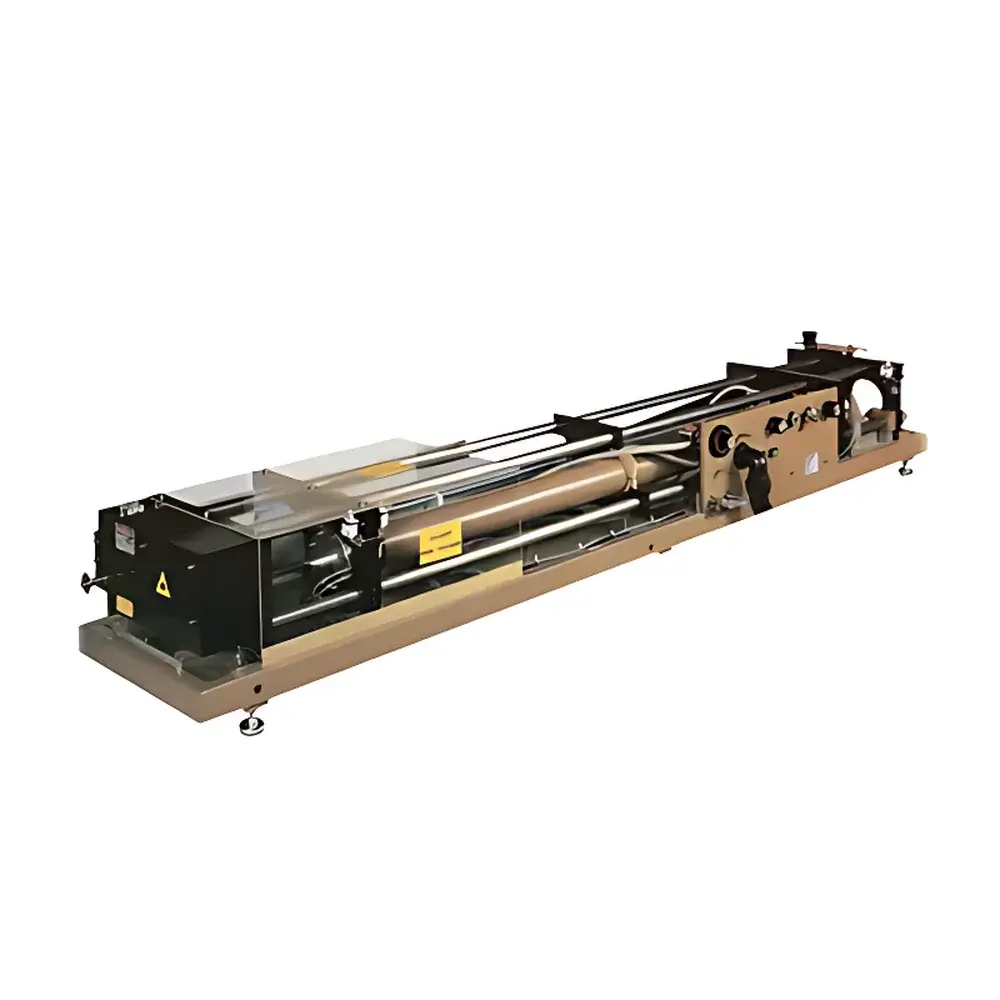
Edinburgh Instruments FIR/THz Gas Laser System
| Brand | Edinburgh Instruments |
|---|---|
| Origin | United Kingdom |
| Manufacturer Type | Original Equipment Manufacturer (OEM) |
| Product Category | Imported Instrument |
| Model Series | FIR-295, FIR-395, FIRL100 |
| Core Technology | CO₂-laser-pumped molecular gas laser |
| Wavelength Range | 40 µm – 1.22 mm (0.25–7.5 THz) |
| Output Power | ≥150 mW (PL5-pumped), ≥500 mW (PL6-pumped) at selected lines (e.g., 118.8 µm, 184.3 µm) |
| Construction | Invar-stabilized resonator frame, hollow metallic waveguide, dichroic output coupler |
| Cooling | Integrated water-cooling system |
| Vacuum Level | High-vacuum operation (<10⁻⁵ mbar) |
| Compliance | Designed for laboratory-based THz research under ISO/IEC 17025-aligned environments |
Overview
The Edinburgh Instruments FIR/THz Gas Laser System is a high-stability, CO₂-laser-pumped molecular far-infrared (FIR) and terahertz (THz) source engineered for precision spectroscopic and diagnostic applications. Operating on the principle of optically pumped molecular gas lasing—primarily in methanol (CH₃OH), deuterated methanol (CD₃OD), and other rotational transition media—the system delivers coherent, narrow-linewidth radiation across the 40 µm to 1.22 mm spectral range (0.25–7.5 THz). Unlike solid-state or photoconductive THz emitters, this gas-based architecture provides intrinsic frequency stability, high spectral purity, and scalable output power via optimized pump coupling and vacuum-resonator design. The platform is not a broadband emitter but a discrete-line, tunable source: wavelength selection is achieved through precise control of gas pressure, temperature, and cavity length, enabling reproducible access to over 100 well-characterized rotational transitions. Its mechanical architecture—built around low-expansion Invar frames and rigid waveguide alignment—ensures long-term mode stability essential for interferometric measurements and plasma diagnostics.
Key Features
- Hollow metallic waveguide transmission path minimizing propagation loss and mode distortion in the FIR regime
- Invar-stabilized dual-cavity resonator (FIR-395) with five independent low-thermal-drift support structures for sub-micron cavity length repeatability
- Dichroic output coupler optimized for simultaneous high reflectivity at CO₂ pump wavelengths (9–11 µm) and high transmission at FIR/THz output lines
- Motorized and manual cavity length adjustment with micron-resolution piezoelectric actuators and calibrated micrometer stages
- Integrated closed-loop water cooling system maintaining thermal equilibrium across laser head, gas cell, and pump coupling optics
- High-vacuum sealed enclosure (base pressure <10⁻⁵ mbar) with bake-out capability to ensure gas purity and minimize collisional broadening
- Modular integration architecture: FIR-295 (standalone oscillator), FIR-395 (dual-channel differential configuration), and FIRL100 (fully integrated CO₂ + FIR system)
Sample Compatibility & Compliance
The system is designed for use with standard rotational-transition gases—including CH₃OH, CD₃OD, D₂O, NH₃, and HCN—loaded via controlled vapor delivery into the sealed waveguide cavity. No sample interaction occurs within the laser itself; rather, the emitted FIR/THz beam serves as a probe for external samples placed in collimated or focused beam paths. All models comply with CE marking requirements for laboratory laser equipment (EN 60825-1:2014) and incorporate interlock-ready vacuum and cooling interfaces compatible with centralized lab safety systems. While not certified for GMP manufacturing, the FIRL100 and FIR-395 configurations support GLP-compliant operation when paired with audit-trail-capable data acquisition software and calibrated power meters traceable to NPL or NIST standards.
Software & Data Management
Edinburgh Instruments provides LabVIEW-based control software supporting synchronized tuning of cavity length, gas pressure, and pump laser parameters (via RS-232 or Ethernet interface to PL-series CO₂ lasers). The software logs timestamped operational metadata—including cavity voltage, vacuum pressure, coolant temperature, and pump power—with optional export to CSV or HDF5 formats. For regulatory environments, third-party SCADA platforms (e.g., EPICS, MATLAB Production Server) may be integrated to meet 21 CFR Part 11 requirements for electronic records and signatures. Firmware updates are delivered via secure HTTPS download with SHA-256 checksum verification. No cloud connectivity is embedded; all control and data remain on-premise by default.
Applications
- Plasma density and magnetic field diagnostics via FIR interferometry and polarimetry (e.g., tokamak edge measurement at 118.8 µm or 184.3 µm)
- High-resolution rotational spectroscopy of transient species and isotopologues in combustion and atmospheric chemistry studies
- Calibration reference source for Fourier-transform infrared (FTIR) spectrometers operating beyond 20 cm⁻¹
- Time-domain THz spectroscopy pump-probe setups where narrow-linewidth, high-power CW sources improve signal-to-noise ratio
- Material characterization of low-energy excitations in superconductors, topological insulators, and 2D materials
- Non-destructive evaluation (NDE) of dielectric composites and pharmaceutical tablet coatings using coherent THz imaging
FAQ
What gases are supported, and how are they introduced into the laser cavity?
Standard gases include methanol (CH₃OH), deuterated methanol (CD₃OD), and water vapor (D₂O). They are introduced via calibrated stainless-steel vapor manifolds with needle valves and capacitance manometers; gas loading is performed under vacuum prior to sealing.
Is the FIRL100 truly turnkey, or does it require external infrastructure?
The FIRL100 integrates the PL5 CO₂ pump laser and FIR oscillator in one chassis but requires external chilled water (15–25°C, ≥3 L/min), 230 VAC/50 Hz power, and a dedicated exhaust line for CO₂ laser purge gas.
Can the FIR-395’s dual outputs be phase-locked?
No—phase locking is not implemented. The two cavities operate independently but with matched thermal and mechanical stability to enable intensity-ratio referencing in differential absorption measurements.
What vacuum maintenance is required during routine operation?
The system maintains high vacuum passively for >6 months per fill; annual regeneration of the non-evaporable getter (NEG) pump is recommended for optimal long-term performance.
Are calibration certificates provided with each unit?
Yes—each system ships with a factory calibration report listing measured output power at ≥3 certified lines (e.g., 118.8 µm, 184.3 µm, 253.5 µm), traceable to NPL FIR radiometry standards.




