
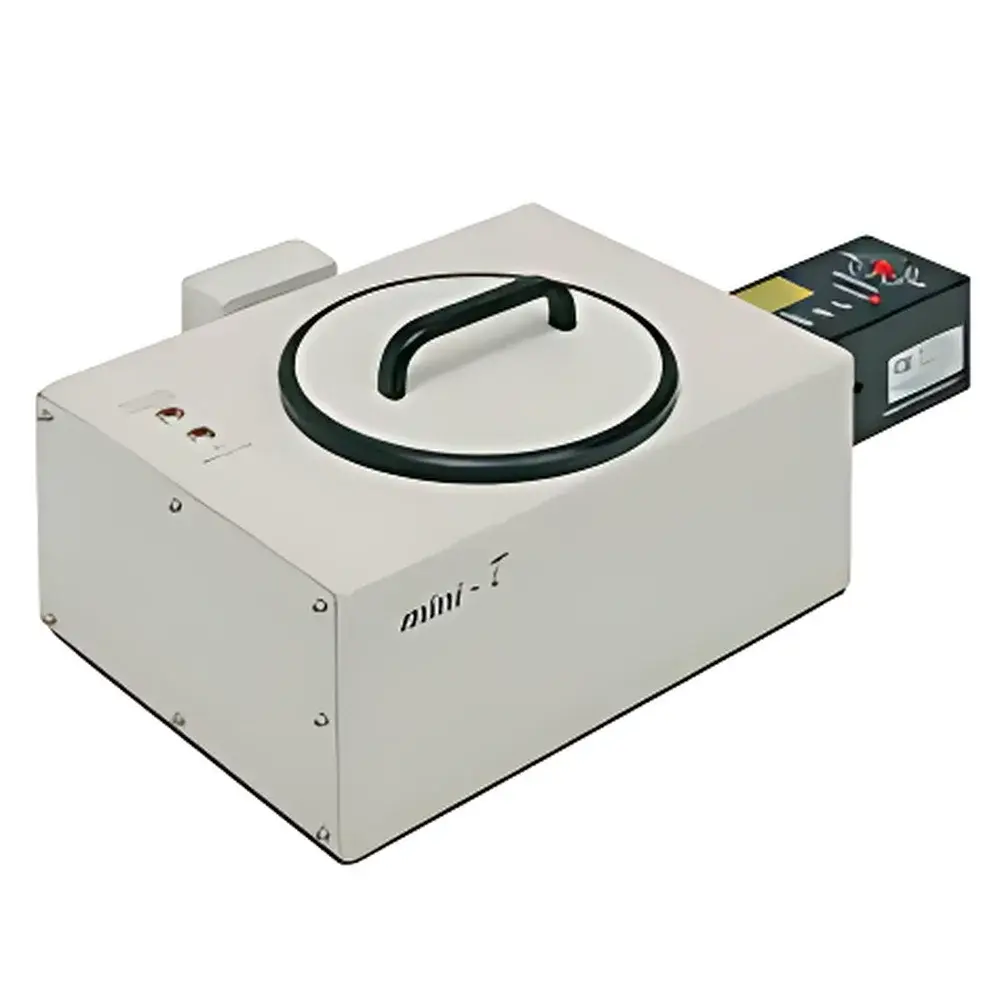
Edinburgh Instruments Mini-Tau Compact Time-Resolved Fluorescence Spectrometer
| Brand | Edinburgh Instruments |
|---|---|
| Origin | United Kingdom |
| Manufacturer Type | Original Equipment Manufacturer (OEM) |
| Product Category | Imported Instrument |
| Model | Mini-Tau |
| Spectral Dispersion | Interference Filter-Based |
| Instrument Type | Steady-State and Time-Resolved Fluorescence Spectrometer |
| Slit Width (Spectral Bandpass) | 0–60 nm |
| Spectral Resolution | 50 nm |
| Signal-to-Noise Ratio | 3000:1 |
| Wavelength Accuracy | ±5 nm |
Overview
The Edinburgh Instruments Mini-Tau is a compact, cost-optimized time-resolved fluorescence spectrometer engineered for quantitative nanosecond-to-microsecond lifetime measurements using time-correlated single-photon counting (TCSPC). Unlike grating-based systems, the Mini-Tau employs a filter-based optical architecture—leveraging interchangeable interference filters mounted on a motorized filter wheel—to isolate emission bands with high out-of-band rejection and minimal stray light. Its TCSPC core relies on a high-speed timing electronics module (TC900 PCIe card) synchronized with ultrafast excitation sources, enabling photon arrival time histograms with picosecond-level timing resolution. The system is purpose-built for laboratories requiring robust, reproducible lifetime data without the complexity or cost of full-spectrum transient spectrometers. It supports both steady-state intensity acquisition and multi-exponential decay analysis, making it suitable for routine photophysical characterization in academic research, materials science, and quality control environments where trace-level luminescence kinetics are critical.
Key Features
- Integrated TCSPC architecture with TC900 timing card and T900 acquisition software—enabling histogram binning down to 1 ps per channel and lifetime fitting with χ² minimization algorithms
- Modular excitation source platform: includes a 405 nm picosecond pulsed laser diode (FWHM < 50 ps) as standard; optional sub-nanosecond LEDs or wavelength-tunable ps LDs (e.g., 375–640 nm) can be integrated via SMA-coupled fiber ports
- Dual-mode detection: selectable blue-sensitive (GaAsP) or red-enhanced (InGaAs/InP) single-photon avalanche diodes (SPADs), each with active cooling and dark count rates < 100 cps at −20 °C
- Thermostatted sample compartment with integrated Pt100 temperature probe and inlet/outlet ports for external water bath circulation (±0.1 °C stability over 1 h)
- Motorized filter wheel accommodating up to 6 interference filters (standard set: 450, 500, 550, 600, 650, and 700 nm ±5 nm bandwidth); filter selection synchronized with acquisition triggers
- Compact footprint (35 × 25 × 18 cm) and vibration-isolated optical baseplate compatible with benchtop integration in shared instrumentation facilities
Sample Compatibility & Compliance
The Mini-Tau accommodates standard 1 cm quartz cuvettes (pathlength 1–10 mm), solid-state thin films (via front-face geometry), and microvolume samples (down to 50 µL) using optional capillary holders. All optical paths conform to ISO 17025 calibration traceability requirements when operated with certified reference standards (e.g., quinine sulfate in 0.1 M H2SO4, fluorescein in 0.1 M NaOH). Data acquisition and processing comply with GLP principles: T900 software provides full audit trail logging (user actions, parameter changes, file exports), electronic signatures, and exportable .csv/.txt decay datasets for third-party analysis. While not FDA 21 CFR Part 11 validated out-of-the-box, the system architecture supports validation packages upon request for regulated QC/QA workflows.
Software & Data Management
T900 software provides real-time histogram display, live decay curve fitting (mono-, bi-, and tri-exponential models), IRF deconvolution, and global analysis across multiple wavelengths or temperatures. All raw TCSPC histograms are stored in binary .ptu format (PicoQuant-compliant), ensuring long-term readability and compatibility with industry-standard tools such as DAS6, FluoFit, or custom Python/Matlab scripts. Export options include ASCII time-intensity matrices, fitted parameters (τi, αi, χ²), and residual plots. Batch processing mode enables unattended sequential measurement of up to 96 samples via programmable stage control (optional).
Applications
- Photophysics of organic emitters (OLED materials, conjugated polymers, AIEgens)
- Luminescent metal complexes (Ir, Ru, Eu, Tb compounds) for sensor development
- Time-gated fluorescence assays in bioconjugation studies (e.g., antibody-labeled lanthanide chelates)
- Quenching kinetics analysis (Stern–Volmer, dynamic vs. static mechanisms)
- Temperature-dependent lifetime mapping in polymer phase transitions
- Educational labs: hands-on TCSPC methodology training with accessible hardware and intuitive software interface
FAQ
What is the minimum measurable lifetime with the Mini-Tau?
The system achieves an instrument response function (IRF) width of < 80 ps using the 405 nm laser and GaAsP detector, enabling reliable resolution of lifetimes ≥ 25 ps under optimal signal conditions.
Can I upgrade from filter-based to monochromator-based dispersion later?
No—the Mini-Tau’s optical design is fixed-filter only; for scanning capability, Edinburgh Instruments recommends the FS5 or LP980 platforms.
Is the T900 software compatible with Windows 11 and 64-bit systems?
Yes—T900 v4.2+ supports Windows 10/11 (64-bit) and requires .NET Framework 4.8 and Visual C++ 2019 redistributables.
Does the system support polarization-resolved lifetime measurements?
Not natively; polarized excitation/detection requires external Glan-Taylor prisms and manual alignment—this configuration falls outside standard Mini-Tau specifications.
What maintenance is required for long-term TCSPC performance?
Annual verification of laser pulse width, detector dark count rate, and timing offset drift is recommended; Edinburgh Instruments offers factory calibration services with NIST-traceable references.




