Amersham DIGE Unit LF24 Vertical Electrophoresis System
| Brand | Cytiva |
|---|---|
| Origin | United Kingdom |
| Model | Amersham DIGE Unit LF24 |
| Gel Dimensions | 255 × 186 × 1 mm |
| External Dimensions | 277 × 217 × 7 mm |
| Max. Simultaneous Gels (Electrophoresis) | 2 |
| Max. Simultaneous Gels (Transfer) | 2 |
| Max. Voltage | 800 V |
| Max. Current | 400 mA |
| Max. Power | 100 W |
Overview
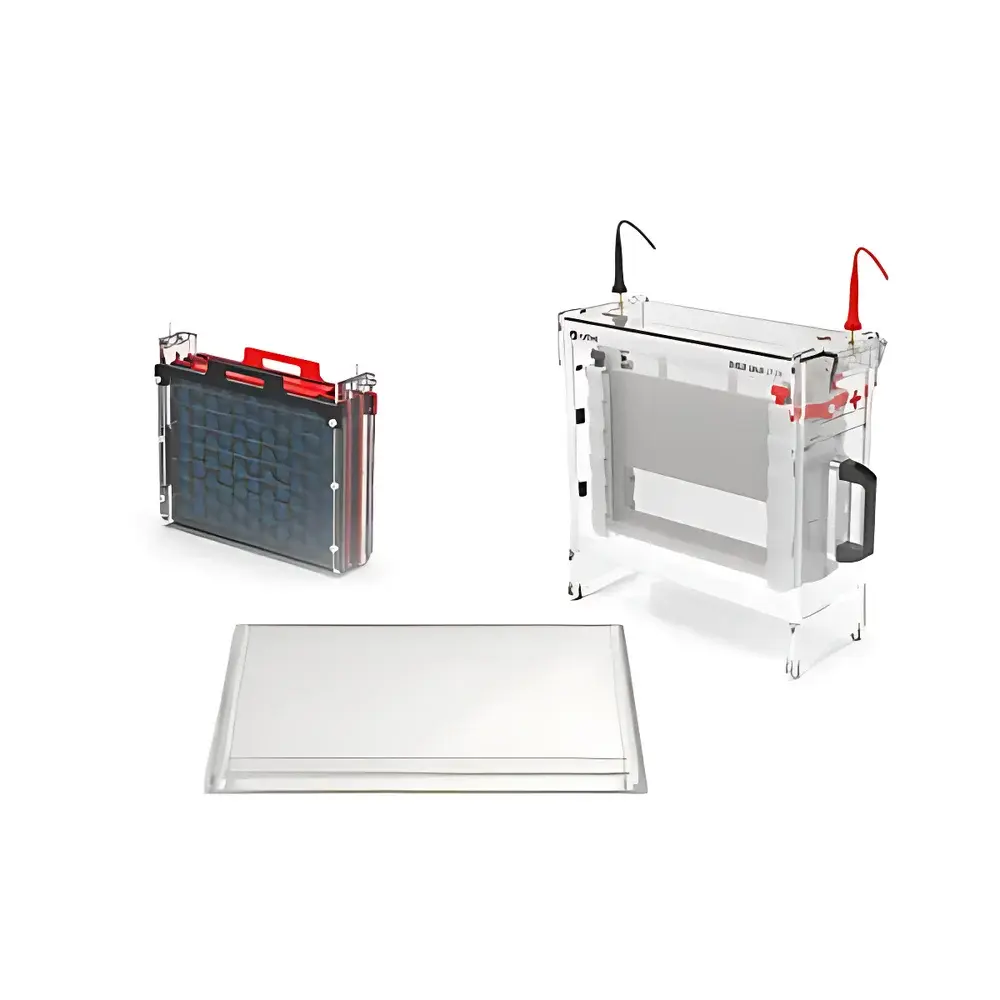
The Amersham DIGE Unit LF24 Vertical Electrophoresis System is a high-precision, large-format electrophoresis platform engineered specifically for two-dimensional polyacrylamide gel electrophoresis (2D-PAGE) and fluorescence-based differential in-gel electrophoresis (DIGE) workflows. Designed and manufactured by Cytiva (formerly GE Healthcare Life Sciences) in the United Kingdom, this system implements standard vertical slab-gel electrophoresis principles—utilizing electric field-driven migration of charged biomolecules through a polyacrylamide matrix under controlled thermal and buffer conditions. Its architecture supports both first-dimension isoelectric focusing (IEF) compatibility and second-dimension SDS-PAGE separation with high reproducibility across replicate gels. The LF24 configuration accommodates full-size immobilized pH gradient (IPG) strips ranging from 7 cm to 24 cm, enabling flexible experimental design while maintaining stringent alignment fidelity between parallel gels—a critical requirement for quantitative DIGE analysis.
Key Features
- Large-format dual-gel capability: Simultaneously runs two 255 × 186 × 1 mm gels, maximizing throughput without compromising resolution or inter-gel consistency.
- Modular design: Integrates interchangeable electrophoresis and electroblotting modules, supporting seamless transition between separation and transfer steps within a single platform.
- Precision-machined electrode assembly: Ensures uniform electric field distribution across the entire gel surface, minimizing edge effects and band distortion.
- Thermally stable cassette system: Constructed from chemically resistant polymers with optimized buffer chamber geometry to mitigate Joule heating during high-voltage runs (up to 800 V).
- Robust power handling: Rated for continuous operation at up to 400 mA current and 100 W power output, suitable for extended second-dimension electrophoresis protocols.
- Standardized IPG strip compatibility: Accepts 7 cm, 11 cm, 13 cm, 18 cm, and 24 cm Immobiline DryStrip gels; allows side-by-side placement of three 7 cm strips or two 11 cm strips per gel.
Sample Compatibility & Compliance
The LF24 system is validated for use with standard acrylamide/bis-acrylamide formulations, SDS-containing running buffers, and common protein staining reagents including Coomassie Brilliant Blue, silver nitrate, and fluorescent dyes (e.g., Cy2/Cy3/Cy5) used in DIGE workflows. It complies with ISO 13485–aligned manufacturing practices and meets general laboratory safety standards for Class II electrical equipment (IEC 61010-1). While not a regulated medical device, its operational parameters and documentation support GLP-compliant environments when integrated into validated SOPs. The system’s dimensional repeatability and voltage/current stability facilitate adherence to ASTM E2917–22 (Standard Practice for Validation of Analytical Methods Used in Clinical Laboratories) where method validation includes electrophoretic separation steps.
Software & Data Management
The Amersham DIGE Unit LF24 operates as a hardware platform requiring external power supply control (e.g., Cytiva Ettan DALTsix or external programmable power supplies). It does not include embedded firmware or proprietary software but is fully compatible with industry-standard imaging and analysis pipelines—including ImageQuant TL, Delta2D, and Progenesis SameSpots—for post-electrophoresis quantification and statistical comparison. All gel dimensions, run parameters, and module configurations are documented in Cytiva’s technical manuals (Document No. 28-9577-28), supporting audit-ready recordkeeping. When deployed in regulated settings, integration with LIMS or ELN systems can be achieved via manual parameter logging aligned with FDA 21 CFR Part 11 requirements for electronic records and signatures.
Applications
- High-resolution 2D-PAGE for proteomic profiling of complex biological samples (e.g., cell lysates, tissue homogenates, serum/plasma fractions).
- DIGE-based comparative analysis of protein expression differences across treatment groups, time points, or disease states.
- Validation of recombinant protein purity and post-translational modification patterns.
- Method development for orthogonal separation techniques prior to LC-MS/MS identification.
- Training and teaching laboratories requiring robust, repeatable vertical electrophoresis infrastructure.
FAQ
Is the LF24 compatible with standard SDS-PAGE running buffers?
Yes—the system uses conventional Tris-glycine or Bis-Tris SDS buffer systems and requires no proprietary chemistry.
Can I run mini-gels or non-standard gel formats in the LF24?
No—the cassette dimensions and electrode spacing are optimized exclusively for 255 × 186 mm gels; alternative formats require dedicated mini- or midi-electrophoresis units.
Does the unit include a built-in power supply?
No—it is a passive electrophoresis chamber designed for use with external programmable power supplies meeting the specified voltage/current limits.
What maintenance is required for long-term performance?
Routine cleaning of glass plates, sealing gaskets, and electrode contacts with deionized water and mild detergent is recommended after each use; periodic inspection of buffer chamber seals ensures consistent thermal management.
Is technical support available outside the UK?
Yes—Cytiva provides global application support through regional technical specialists and an online knowledge base accessible via cytiva.com/support.