
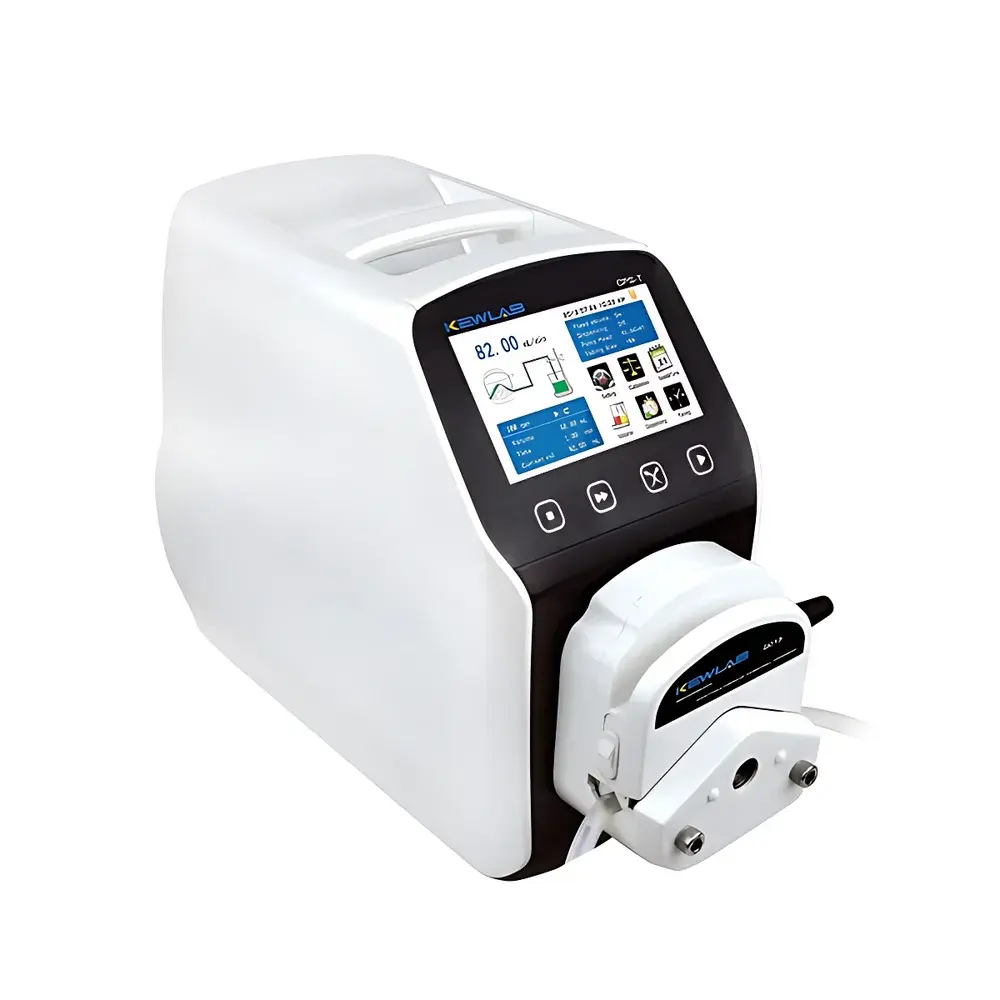
KEWLAB CPS-T150 Peristaltic Pump
| Brand | KEWLAB |
|---|---|
| Model | CPS-T150 |
| Pump Type | Peristaltic Pump |
| Flow Rate Range | 0.007–570 mL/min |
| Speed Range | 0.1–150 rpm (0.01 rpm resolution) |
| Display | 4.3-inch industrial-grade TFT color LCD |
| Pressure Rating | 0.1 MPa (for tubing wall thickness 0.86–1.0 mm) / 0.1–0.27 MPa (for tubing wall thickness 1.6–2.4 mm) |
| External Control Input | 0–5 V (standard), optional 0–10 V or 4–20 mA |
| Communication Interface | RS232 / RS485 |
| Power Supply | AC 220 V ±10% / 50–60 Hz or AC 110 V ±10% / 50–60 Hz |
| Dimensions (L×W×H) | 261.4 × 157.3 × 236.9 mm |
| Power Consumption | <50 W |
| Operating Environment | 0–40 °C, <80% RH |
| Ingress Protection | IP31 |
| Enclosure Material | UV-resistant ABS engineering plastic |
| PCB Protection | Triple-conformal coating (dust-, moisture-, static-, and corrosion-resistant) |
Overview
The KEWLAB CPS-T150 Peristaltic Pump is an engineered solution for precise, contamination-free fluid handling in analytical laboratories, bioprocessing workflows, and quality control environments. Based on the peristaltic principle—where rollers compress flexible tubing to generate positive displacement—the CPS-T150 delivers repeatable volumetric transfer without exposing internal components to the process fluid. This design inherently eliminates cross-contamination risks and avoids the need for valves, seals, or wetted metal parts, making it ideal for shear-sensitive, abrasive, or sterile applications. Its microprocessor-controlled stepper motor ensures stable rotational output across the full speed range (0.1–150 rpm), with 0.01 rpm resolution enabling fine-grained flow tuning. The pump is designed for integration into automated systems and supports both standalone operation and external control via analog voltage or current signals.
Key Features
- 4.3-inch industrial-grade TFT color LCD with real-time animated flow visualization and simultaneous display of setpoints, actual flow rate, elapsed time, and system status.
- Three operational modes: volume-based dispensing (定量计量), time-based volume delivery (定时定量), and time-triggered start/stop (定时启停), supporting protocol-driven workflows in QC labs and R&D settings.
- Intelligent calibration algorithm with live flow compensation—enables on-the-fly adjustment of flow rate without interrupting pump operation, improving long-term dosing accuracy under variable tubing wear or temperature drift.
- Robust mechanical architecture featuring a streamlined ABS housing with UV-stabilized coating for durability under ambient laboratory lighting and routine cleaning agents.
- Triple-conformal coated PCBs providing certified resistance to dust, humidity, electrostatic discharge, and chemical exposure—enhancing reliability in non-ideal environmental conditions (e.g., humid cleanrooms or shared instrumentation bays).
- Flexible power compatibility: accepts dual-voltage input (AC 110 V or 220 V, 50/60 Hz), facilitating deployment across global laboratory infrastructures without hardware modification.
Sample Compatibility & Compliance
The CPS-T150 accommodates standard silicone, Viton®, or Tygon® tubing with inner diameters ranging from 0.5 mm to 6.4 mm, supporting flow rates from 0.007 mL/min (microfluidic precision) up to 570 mL/min (bulk transfer). Pressure capability is specified per tubing wall thickness per ISO 8536-4 and ASTM D1418 guidelines, ensuring safe operation within material limits. While not certified for GMP manufacturing environments out-of-the-box, its traceable speed control, non-invasive fluid path, and RS232/RS485 interface support integration into validated systems compliant with FDA 21 CFR Part 11 when paired with appropriate audit-trail software. The IP31 rating confirms protection against vertically falling water droplets and solid objects >2.5 mm—suitable for benchtop use in ISO Class 7/8 laboratories.
Software & Data Management
The pump supports bidirectional serial communication (RS232/RS485) for remote parameter configuration, real-time monitoring, and event logging. When integrated with LabVIEW, Python (PySerial), or custom SCADA platforms, users can script multi-step dispensing protocols, synchronize with spectrophotometers or pH meters, and export timestamped flow logs for GLP-compliant record retention. Firmware updates are performed via USB-to-serial adapter, and all configuration changes—including calibration offsets—are stored in non-volatile memory with write-protection logic to prevent accidental overwrite.
Applications
- Automated sample introduction in HPLC, IC, and ICP-MS systems requiring pulseless, low-shear delivery.
- Controlled reagent addition in titration or enzymatic assay platforms where volumetric consistency directly impacts endpoint detection.
- Media perfusion in cell culture bioreactors and organ-on-chip devices demanding stable, bubble-free flow over extended durations.
- Calibration standard delivery in metrology labs performing gravimetric flow verification per ISO/IEC 17025 requirements.
- Chemical feed systems in environmental testing (e.g., EPA Method 300.0) where corrosion resistance and tubing replaceability are critical.
FAQ
What tubing sizes are compatible with the CPS-T150?
The pump supports tubing with inner diameters from 0.5 mm to 6.4 mm; optimal performance is achieved using tubing meeting ISO 3308 specifications for dimensional consistency.
Can the CPS-T150 be integrated into a LIMS or ELN environment?
Yes—via RS232/RS485 serial interface and ASCII command protocol, enabling direct data capture and instrument control within validated digital lab ecosystems.
Is the pump suitable for sterile applications?
It is not autoclavable, but the single-use tubing path and absence of internal fluid contact make it compatible with aseptic techniques when paired with gamma-irradiated, USP Class VI-certified tubing.
Does the CPS-T150 meet electromagnetic compatibility (EMC) standards?
It complies with EN 61326-1:2013 for laboratory equipment, including emission and immunity requirements for conducted/radiated disturbances.
How often does the pump require recalibration?
Under stable operating conditions and consistent tubing batches, recalibration is recommended every 6 months or after tubing replacement cycles exceeding 200 hours of cumulative runtime.



