
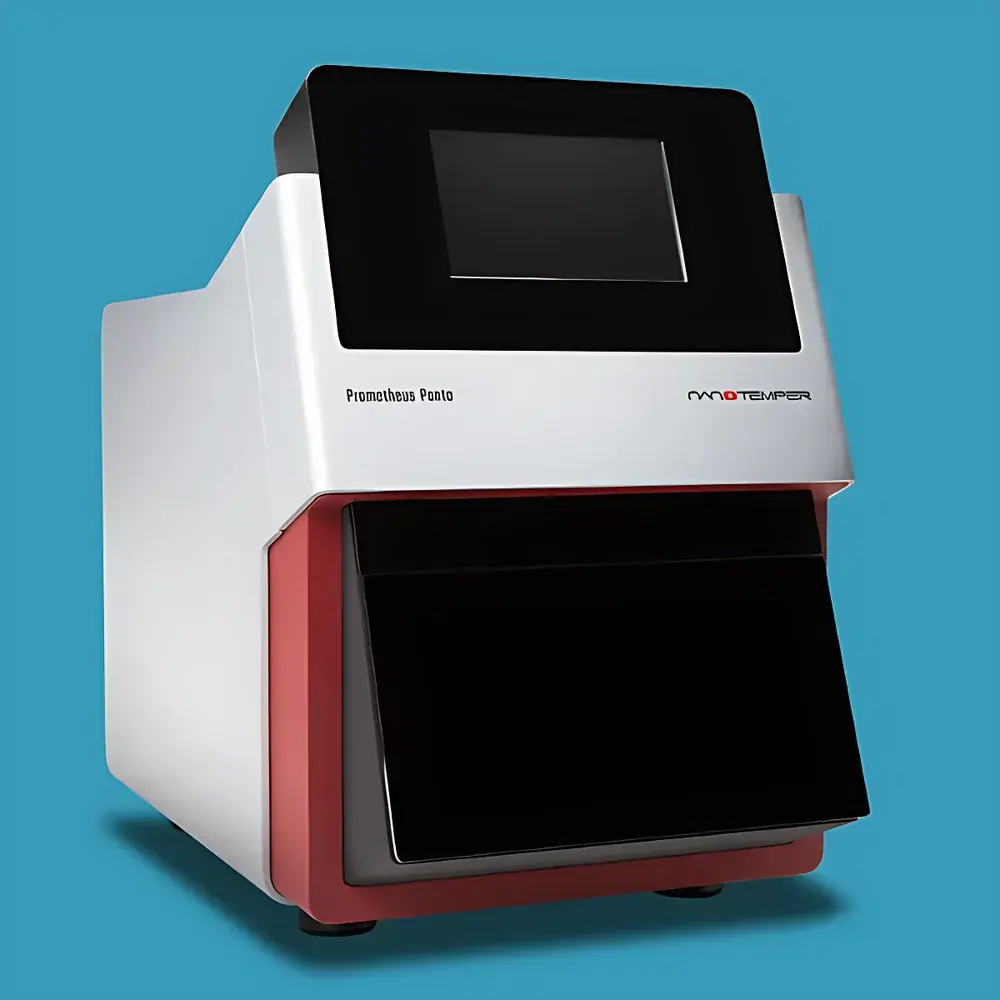
NanoTemper Prometheus Panta Protein Stability Analyzer with Integrated oDSF, DLS, SLS and Backreflection Modules
| Brand | NanoTemper |
|---|---|
| Origin | Germany |
| Manufacturer | NanoTemper Technologies GmbH |
| Product Type | Imported Instrument |
| Model | oDSF Prometheus Panta |
| Principle | Orthogonal Differential Scanning Fluorimetry (oDSF), Dynamic Light Scattering (DLS), Static Light Scattering (SLS), Backreflection Detection |
| Sample Volume | 10 µL |
| Temperature Control Range | 15–110 °C |
| Sample Format | Single capillary or capillary array |
| Dimensions | 35 cm (W) × 51 cm (H) × 52 cm (D) |
Overview
The NanoTemper Prometheus Panta Protein Stability Analyzer is an engineered platform for high-resolution, multi-parametric biophysical characterization of proteins and biologics under native conditions. It integrates four orthogonal detection modalities—orthogonal Differential Scanning Fluorimetry (oDSF), Dynamic Light Scattering (DLS), Static Light Scattering (SLS), and Backreflection—in a single instrument architecture. Unlike conventional thermal shift assays relying on extrinsic dyes, oDSF leverages intrinsic tryptophan and tyrosine fluorescence to monitor conformational unfolding in real time across a controlled temperature ramp (15–110 °C). Simultaneously, DLS reports hydrodynamic radius distribution, SLS correlates scattering intensity with molecular weight and oligomeric state, and Backreflection detects early-stage aggregation via changes in light reflection at the air–liquid interface within the capillary. This concurrent acquisition enables correlation of structural transitions (Tm, Tagg, ΔH), size evolution, and mass-weighted scattering behavior—providing a unified stability fingerprint essential for rational formulation development, biosimilar comparability studies, and target engagement assessment in drug discovery.
Key Features
- Multi-modal, label-free detection: oDSF quantifies thermal denaturation without exogenous dyes; DLS and SLS operate in solution phase without dilution or filtration; Backreflection identifies sub-visible aggregates prior to turbidity onset.
- Minimal sample consumption: Requires only 10 µL per measurement, loaded via passive capillary action—eliminating pumps, valves, and fluidic maintenance.
- Native-state compatibility: Fully compatible with detergents (e.g., DDM, CHAPS), high-viscosity formulations, and membrane protein complexes solubilized in native-like environments.
- Modular scalability: Base system supports oDSF; DLS, SLS, and Backreflection modules can be added independently or concurrently, enabling phased investment aligned with workflow maturity.
- Automated integration ready: Designed for robotic integration via standard API and physical mounting interfaces, supporting unattended operation in high-throughput screening (HTS) environments.
Sample Compatibility & Compliance
The Prometheus Panta accommodates diverse sample types including monoclonal antibodies, Fc-fusion proteins, enzymes, intrinsically disordered proteins, and detergent-solubilized membrane proteins such as Mycobacterium tuberculosis elongation factor EF-Tu. Its capillary-based geometry ensures minimal surface adsorption and eliminates carryover—critical for low-abundance targets and precious clinical candidates. The system complies with GLP/GMP-aligned data integrity requirements: audit trails, electronic signatures, and user-access controls are implemented per 21 CFR Part 11 guidelines when used with NanoTemper’s certified software suite. All measurements adhere to principles outlined in ICH Q5C (stability testing of biotechnological products) and support submissions referencing ASTM E2927-18 (standard guide for thermal analysis of proteins).
Software & Data Management
Control and analysis are performed using Prometheus Control Software v3.x, a validated desktop application supporting automated method templates, batch processing, and multi-parameter overlay visualization. Raw fluorescence, scattering, and backreflection signals are stored in vendor-neutral HDF5 format with embedded metadata (temperature, time, instrument ID, user, timestamp). Export options include CSV, PDF, and PNG for integration into LIMS or statistical platforms (e.g., JMP, Python pandas). The software implements baseline correction algorithms optimized for oDSF curve fitting (first-derivative peak detection for Tm, sigmoidal fitting for transition cooperativity), DLS autocorrelation deconvolution (CONTIN algorithm), and SLS molar mass estimation via Debye plot extrapolation. Data traceability meets ALCOA+ criteria (Attributable, Legible, Contemporaneous, Original, Accurate, Complete, Consistent, Enduring, Available).
Applications
- Formulation screening of mAbs and bispecifics under varying pH, excipient, and ionic strength conditions
- Predictive stability assessment for long-term storage (real-time and accelerated)
- Biosimilar structural comparability against reference products across thermal and chemical stress profiles
- Buffer optimization during protein purification and refolding workflows
- Detergent screening for membrane protein stabilization (e.g., GPCRs, transporters, bacterial EF-Tu)
- Thermal Shift Assay (TSA) for fragment and small-molecule ligand binding—validated in published studies targeting M. tuberculosis EF-Tu with compounds including osimertinib
- Early aggregation propensity evaluation in pre-formulation development
FAQ
Does the Prometheus Panta require calibration standards for oDSF measurements?
No—oDSF relies on intrinsic protein fluorescence and does not require external fluorophore calibration. Instrument optical alignment is verified during startup using internal reference LEDs and photodiode checks.
Can DLS and SLS be acquired simultaneously with oDSF?
Yes—each module operates independently but synchronously within the same thermal ramp, enabling true multi-parametric correlation at every temperature point.
Is the system suitable for measuring proteins in complex biological matrices (e.g., cell lysates)?
While optimized for purified samples, successful oDSF measurements have been reported in clarified lysates containing ≤10% (v/v) host cell protein, provided background fluorescence and light scattering are characterized and subtracted.
What regulatory documentation is available for GMP environments?
NanoTemper provides IQ/OQ protocols, 21 CFR Part 11 validation packages, and a full set of instrument specifications compliant with ISO/IEC 17025 for accredited laboratories.
How is data security ensured during remote instrument access?
Remote sessions use TLS 1.2+ encrypted connections; no raw data is stored on cloud servers; all communication occurs via authenticated client-server architecture with configurable firewall rules.




