
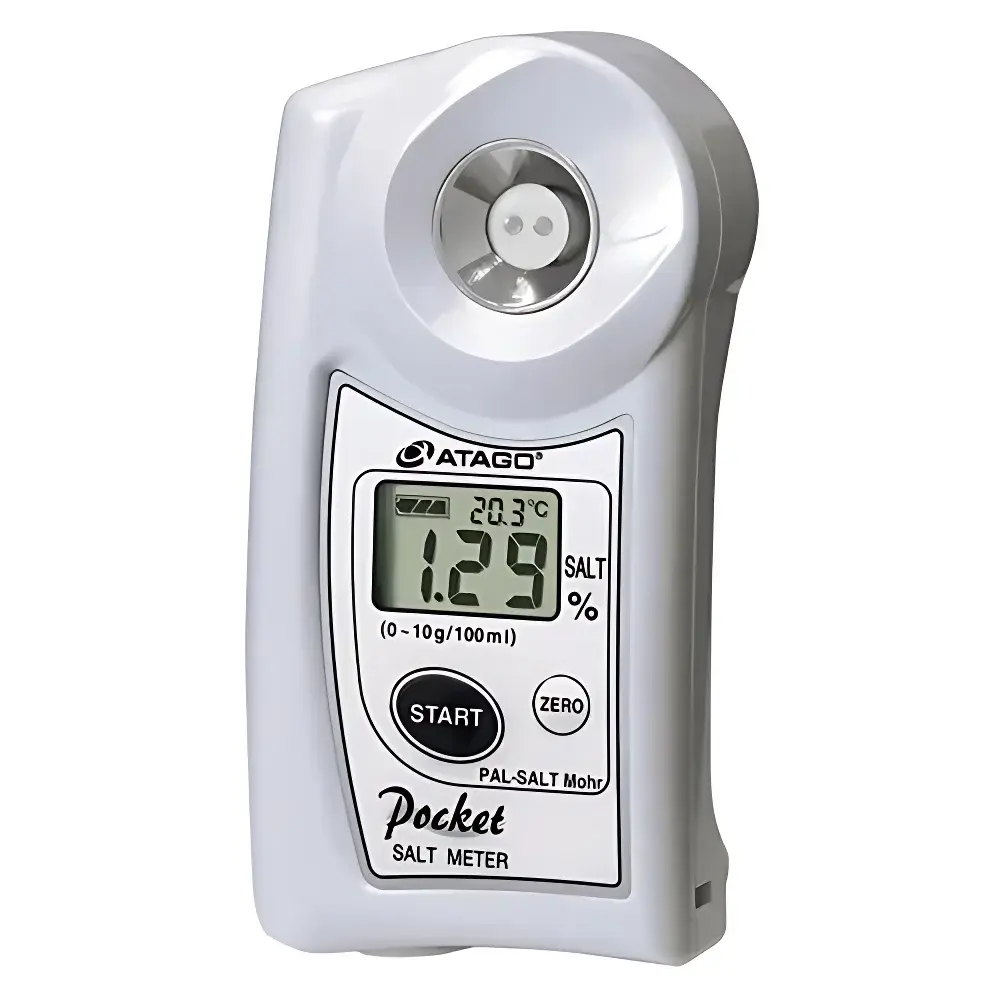
ATAGO PAL-SALT Mohr Digital Salinometer (g/100mL) with Titanium Electrode
| Brand | ATAGO |
|---|---|
| Origin | Japan |
| Model | PAL-SALT Mohr |
| Measurement Principle | Conductivity-based |
| Range | 0.00–10.0% (g/100mL) NaCl |
| Resolution | 0.01% (0.00–2.99%), 0.1% (3.0–10.0%) |
| Accuracy | ±0.05% (0.00–0.99%), ±5% rel. (1.01–10.0%) |
| Sample Volume | ≥0.6 mL |
| Measurement Time | 3 s |
| Temp. Range (Sample) | 5–100°C |
| Ambient Temp. | 10–40°C |
| Dimensions | 55(W)×31(D)×109(H) mm |
| Weight | 100 g (body only) |
| IP Rating | IP65 |
| Power | 2 × AAA batteries |
Overview
The ATAGO PAL-SALT Mohr Digital Salinometer is a compact, handheld conductivity-based instrument engineered for rapid, field-deployable quantification of sodium chloride concentration in aqueous solutions — expressed as mass per 100 mL (g/100mL). Unlike optical refractometers or titration-based methods, this device employs a corrosion-resistant titanium electrode pair to measure solution conductivity, which correlates directly with ionic strength under controlled temperature conditions. The instrument applies built-in temperature compensation (based on the known thermodynamic behavior of NaCl solutions) to deliver stable readings across a wide operational range (5–100°C sample temperature). Designed for routine quality control in food processing, aquaculture, pharmaceutical buffer preparation, and wastewater monitoring, the PAL-SALT Mohr eliminates reagent consumption, reduces analyst exposure to hazardous chemicals, and avoids subjective endpoint interpretation inherent in classical argentometric titration. Its ruggedized housing and IP65 rating ensure reliable performance in humid, splash-prone environments typical of production floors and marine laboratories.
Key Features
- Titanium electrode sensor system offering long-term stability and resistance to chloride-induced passivation or pitting corrosion
- Automatic temperature compensation (ATC) calibrated to the IAPSO standard for seawater conductivity, adapted for NaCl-specific concentration conversion
- High-speed measurement cycle: full readout—including compensated salt concentration and real-time sample temperature—in ≤3 seconds
- IP65-rated enclosure providing dust-tight protection and resistance to low-pressure water jets, suitable for wet industrial settings
- Low-power design powered by two standard AAA alkaline batteries, supporting >10,000 measurements per set under typical usage
- Ergonomic, pocket-sized form factor (55 × 31 × 109 mm; 100 g) enabling one-handed operation and portability without external power or calibration infrastructure
Sample Compatibility & Compliance
The PAL-SALT Mohr is validated for use with clear, low-viscosity aqueous NaCl solutions containing no suspended solids, oils, or high concentrations of interfering ions (e.g., Ca²⁺, Mg²⁺, SO₄²⁻ above 500 mg/L). It is not intended for brines exceeding 10.0% (g/100mL), highly viscous media (e.g., syrups, sauces), or non-aqueous solvents. While not certified to ISO/IEC 17025, the instrument supports traceable calibration via ATAGO-certified reference standards (e.g., RE-120250: 2.50% ±0.05% NaCl solution). Routine verification aligns with internal QC protocols compliant with ISO 8655-7 (volumetric instruments) and ASTM D1125 (standard test method for electrical conductivity and resistivity of water). For regulated environments, users may document calibration events, operator ID, and environmental conditions manually to support GLP audit trails.
Software & Data Management
The PAL-SALT Mohr operates as a standalone, firmware-embedded instrument with no Bluetooth, USB, or PC connectivity. All measurement data remain local and unlogged—consistent with its design intent as a rapid-check, pass/fail field tool. Users record results manually into paper logbooks or LIMS-compatible spreadsheets. Calibration certificates (available upon request from authorized ATAGO distributors) include serial-number-matched metrological traceability to JCSS (Japan Calibration Service System) standards. Firmware updates are not supported; hardware revision control is maintained through ATAGO’s global part numbering system (e.g., catalog number 4251).
Applications
- Food & beverage: On-line verification of brine concentration in pickling tanks, soy sauce fermentation vats, and canned seafood processing lines
- Aquaculture: Daily monitoring of salinity in hatchery recirculating systems and larval rearing units where precise NaCl dosing affects osmoregulation
- Pharmaceutical manufacturing: Quick validation of saline diluent preparations (e.g., 0.9% w/v NaCl for IV solutions) prior to filtration and sterilization
- Environmental testing: Field assessment of coastal runoff or desalination plant effluent for regulatory reporting under EPA Method 120.1 (conductivity-based salinity estimation)
- Research labs: Screening tool for osmotic stress experiments requiring rapid iteration across defined salt gradients
FAQ
Is the PAL-SALT Mohr suitable for measuring seawater salinity?
No. Seawater contains complex ion matrices (Mg²⁺, Ca²⁺, K⁺, SO₄²⁻) that deviate significantly from NaCl-only conductivity models. Use dedicated CTD profilers or certified seawater standards for marine applications.
Can I clean the titanium electrodes with ethanol or acetone?
No. Organic solvents may degrade the electrode’s surface oxide layer. Rinse only with deionized water and gently blot dry with lint-free lens tissue.
Does the instrument require periodic recalibration?
Yes. ATAGO recommends daily verification using a certified reference standard (e.g., RE-120250) before critical measurements. Full recalibration by an authorized service center is advised every 12 months or after physical impact.
Why does accuracy degrade above 1.0% (g/100mL)?
Conductivity-to-concentration conversion becomes increasingly non-linear at higher ionic strengths due to inter-ion interactions. The ±5% relative accuracy specification reflects this fundamental limitation of single-point conductivity correlation for concentrated NaCl.
What does IP65 certification mean for daily use?
It certifies complete protection against dust ingress and resistance to water projected from a 6.3 mm nozzle at 12.5 L/min from any direction for 3 minutes—making it appropriate for washdown zones but not submersion or high-pressure cleaning.





