
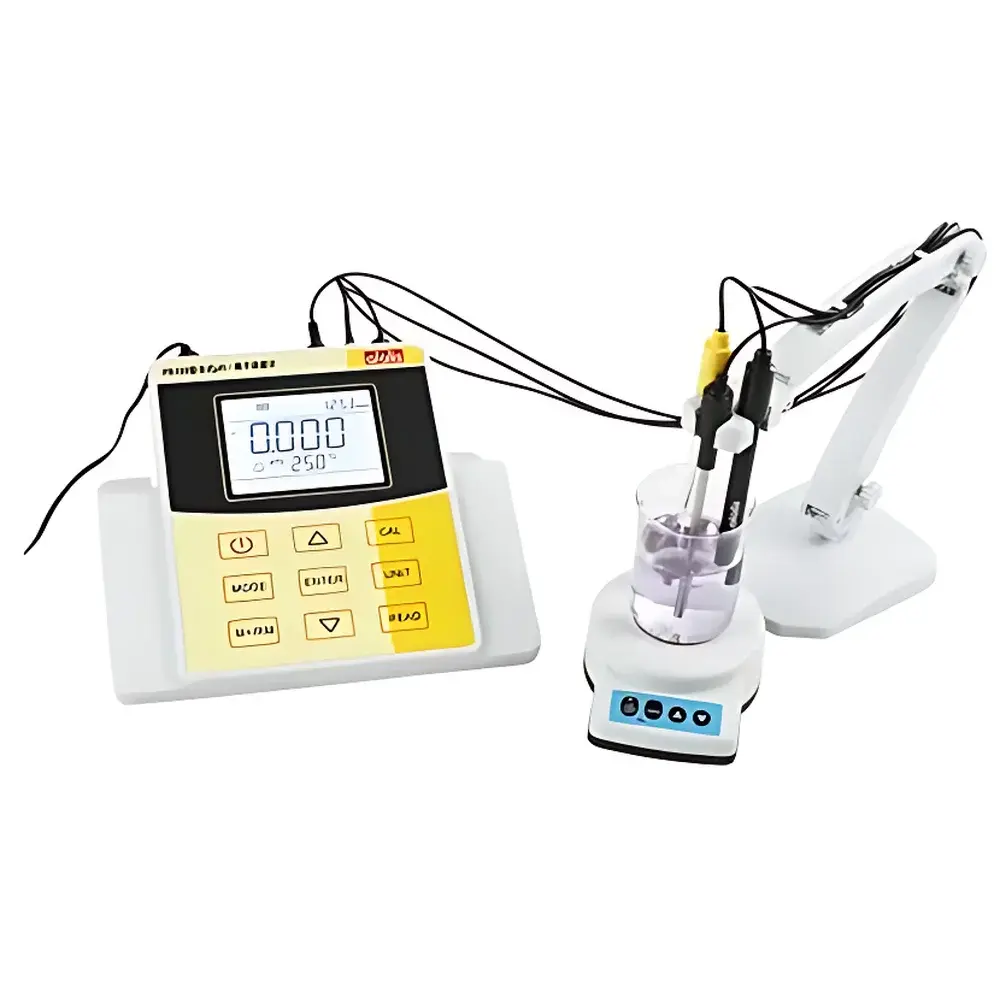
Alalis PI5100-Br Bromide Ion Concentration Meter
| Brand | Alalis |
|---|---|
| Origin | Shanghai, China |
| Model | PI5100-Br |
| Instrument Type | Benchtop Multi-Ion Analyzer |
| Measurement Range | 0.00–14.00 pX |
| Detection Limit | 0.01 ppm |
| Response Time | 1 s |
| Accuracy | ±0.01 pX (for monovalent ions) |
| Temperature Range | −10 to 110 °C |
| Resolution | 0.01 pX / 0.01 mol/L / 0.01 mg/L / 0.01 ppm |
| pH Range | −2.000 to 19.999 pH |
| mV Range | −1999.9 to +1999.9 mV |
| Temperature Compensation | Automatic/manual (0–60.0 °C for ion mode |
| Data Storage | 1000 sets (manual & auto) |
| Interface | USB |
| Display | 90 × 68 mm LCD with white backlight and real-time clock |
| IP Rating | IP54 |
| Compliance | GLP-compliant data management |
Overview
The Alalis PI5100-Br Bromide Ion Concentration Meter is a high-precision benchtop analyzer engineered for reliable, trace-level quantification of bromide (Br⁻) in aqueous environmental and industrial samples. Utilizing potentiometric detection with a solid-state or liquid-membrane bromide-selective electrode (ISE), the instrument measures activity-based concentration via Nernstian response—delivering logarithmic pX output (where X = Br⁻) calibrated against standard solutions. Its design adheres to fundamental electrochemical measurement principles defined in ISO 10523 and ASTM D1293, ensuring compatibility with regulatory water quality protocols. The PI5100-Br supports dual-mode operation: dedicated bromide analysis and multi-ion capability (up to 10 preconfigured ions, including Cl⁻, F⁻, NO₃⁻, CN⁻, and others), making it suitable for routine compliance testing in municipal wastewater treatment plants, drinking water distribution systems, coastal desalination influent monitoring, and industrial effluent characterization.
Key Features
- Potentiometric bromide detection with 1-second response time and 0.01 ppm detection limit, optimized for low-concentration environmental matrices.
- Multi-point automatic calibration (2–5 points) for bromide ISE, with real-time slope evaluation and acceptance criteria per ISO 17025 guidelines.
- Simultaneous pH, mV, and temperature measurement—enabling integrated sample condition assessment prior to ion analysis.
- Flexible unit selection: pX, mol/L, mg/L, and ppm—automatically interconverted using stoichiometric valence and atomic mass inputs (Br = 79.904 g/mol).
- GLP-compliant data handling: timestamped storage of 1000 measurement records with electrode ID, calibration history, operator ID, and ambient temperature metadata.
- Temperature compensation algorithms compliant with IUPAC-recommended thermodynamic correction models for ISEs across −10 to 110 °C.
- IP54-rated enclosure with sealed electrode ports and rubber protective caps—ensuring operational integrity in field laboratories and humid analytical environments.
- USB interface supporting direct data export to LIMS or spreadsheet applications; includes Windows-compatible communication software with audit-trail logging.
Sample Compatibility & Compliance
The PI5100-Br is validated for use with natural waters (surface, groundwater, seawater dilutions), treated effluents, cooling tower fluids, and pharmaceutical process rinse waters. Sample matrix requirements align with EPA Method 300.1 and ISO 10304-1 for ion chromatography cross-validation. Ionic strength adjustment (via supplied ionic strength adjuster) ensures activity coefficient correction for accurate pX-to-concentration conversion in variable-salinity samples. All firmware and calibration routines comply with FDA 21 CFR Part 11 requirements for electronic records and signatures when used in regulated GMP/GLP environments. Certificate of Conformance (CoC) and factory calibration report are provided with each unit.
Software & Data Management
The included PC software enables full remote control, calibration curve visualization, statistical summary (mean, SD, RSD), and PDF report generation—including instrument serial number, electrode lot codes, and calibration verification logs. Audit trails record all user actions (e.g., calibration edits, unit changes, data deletions) with immutable timestamps—supporting ISO/IEC 17025 Clause 7.7 and EU Annex 11 computerized system validation expectations. Data exports conform to ASTM E1461-22 structured CSV format for seamless integration into ELN platforms.
Applications
- Regulatory bromide monitoring in source water prior to ozonation (to prevent bromate formation per WHO Guidelines).
- Leachate analysis from landfills where brominated flame retardants may degrade to Br⁻.
- Quality control of bromine-based biocides in cooling water systems (ASTM D511).
- Verification of bromide removal efficiency in activated carbon or reverse osmosis pilot studies.
- Educational laboratory instruction on ion-selective electrode theory, Nernst equation derivation, and interference assessment (e.g., Cl⁻, I⁻, SCN⁻).
FAQ
What electrode configurations are supported for bromide measurement?
The PI5100-Br operates with a dedicated R2223 reference electrode paired with a selective bromide sensor (e.g., Ag₂S/AgBr membrane type); optional combination electrodes are available upon request.
Is temperature compensation mandatory for bromide pX readings?
Yes—temperature directly affects Nernst slope (59.16 mV/pX at 25 °C). The instrument applies real-time correction using either built-in or external T2132 thermistor input.
Can the device validate calibration according to ISO 8655?
While ISO 8655 applies to volumetric equipment, the PI5100-Br’s calibration verification protocol meets ISO/IEC 17025 Section 6.4.6 for measurement equipment performance checks using certified reference materials (CRM) traceable to NIST SRM 3194.
How is data integrity ensured during power interruption?
All measurements and calibrations are written to non-volatile memory immediately upon confirmation; no data loss occurs during unexpected shutdown.
Does the instrument support custom ion definitions beyond the 10 preset options?
Yes—users may configure new ion parameters (charge, molecular weight, selectivity coefficients) via the setup menu, enabling trace analysis of less common anions such as perchlorate (ClO₄⁻) or thiocyanate (SCN⁻).
Related Products







