
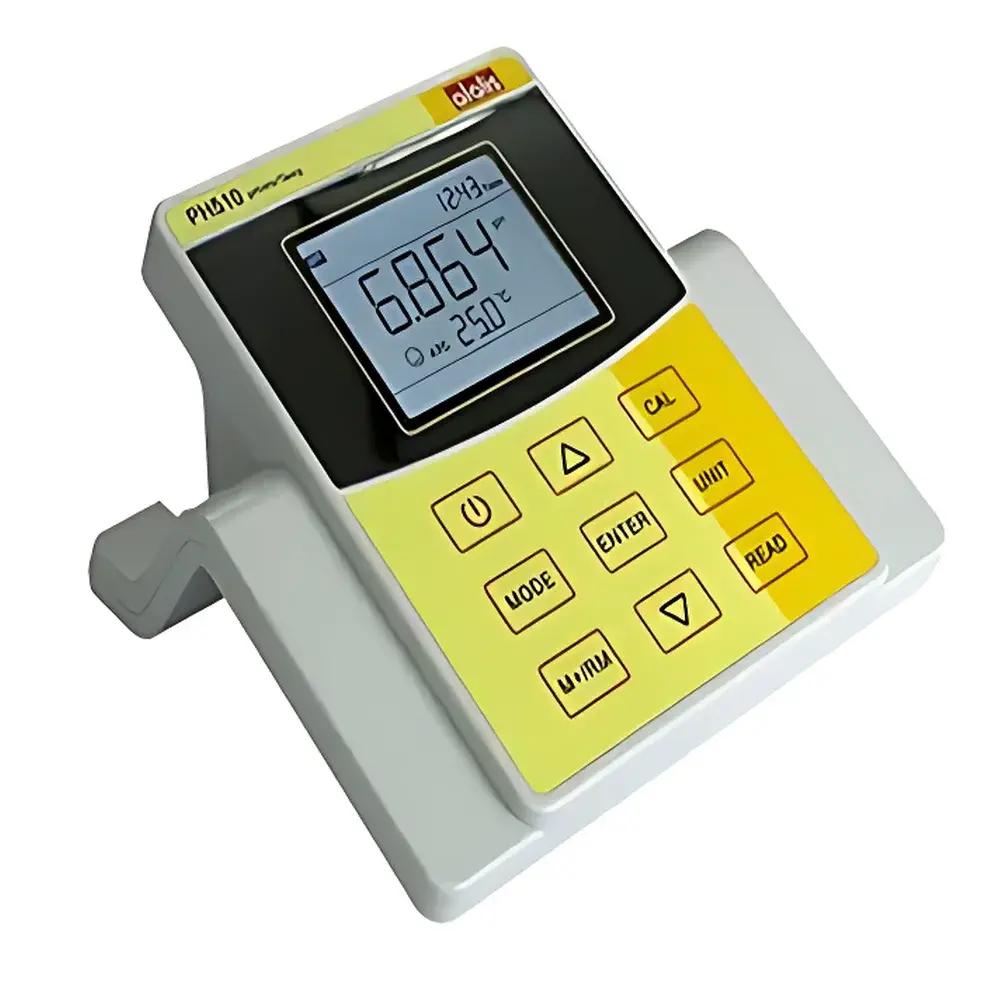
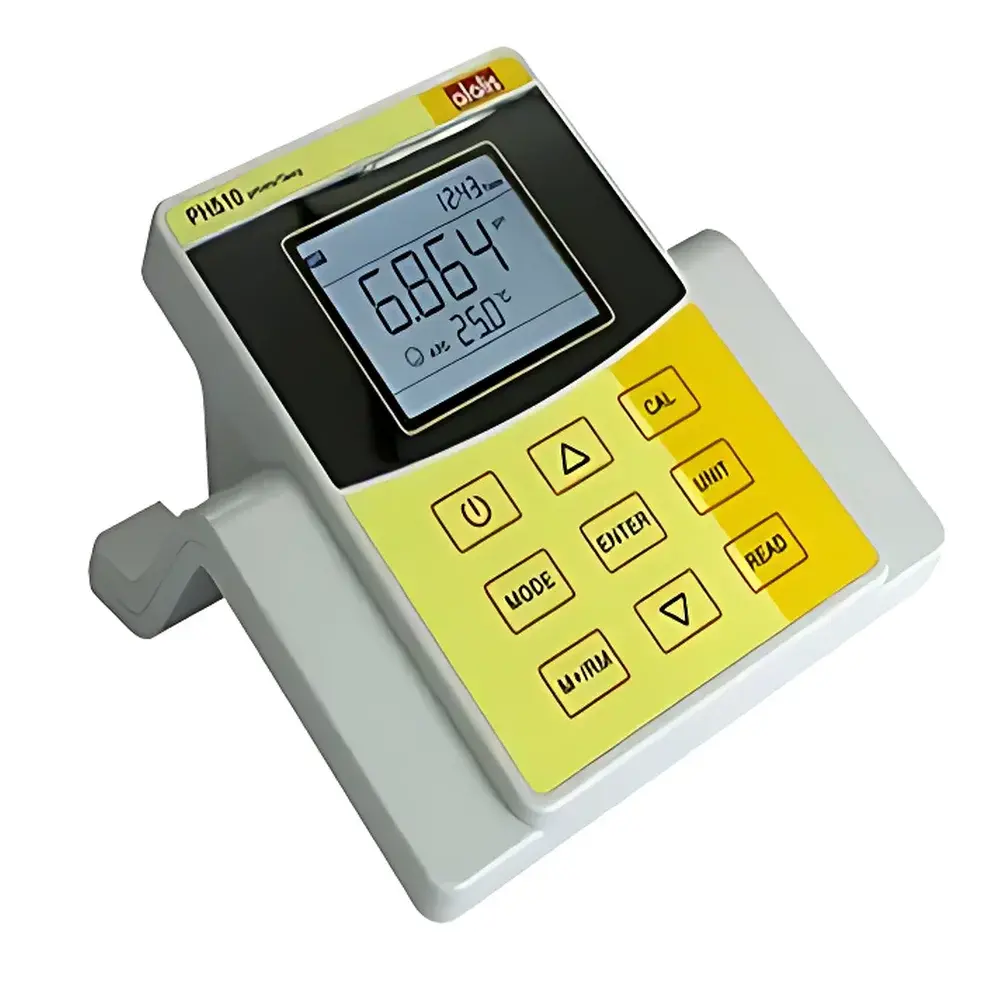
Alalis pH510 Professional Benchtop pH Meter
| Brand | Alalis |
|---|---|
| Origin | Shanghai, China |
| Model | pH510 Professional |
| Instrument Type | Benchtop |
| Parameter Types | Dual (pH & mV) |
| pH Measurement Range | −2.000 to 19.999 pH |
| pH Resolution | 0.001 / 0.01 / 0.1 pH |
| pH Accuracy | ±0.002 pH |
| mV Range | ±1999.9 mV |
| mV Resolution | 0.1 mV |
| mV Accuracy | ±0.03% FS |
| Temperature Range | −10 to 110 °C |
| Temperature Resolution | 0.1 °C |
| Temperature Accuracy | ±0.4 °C |
| Calibration Buffers | CH, USA, and NIST series (15 standard solutions + user-defined) |
| Temperature Compensation | Automatic or manual (0–100.0 °C) |
| Data Storage | 500 sets (manual & auto), with min/max tracking |
| Display | 90 × 68 mm LCD with white backlight, time stamp |
| Connectivity | USB interface |
| Enclosure Rating | IP54 |
| Compliance | GLP-compliant data management |
Overview
The Alalis pH510 Professional Benchtop pH Meter is a high-precision electrochemical instrument engineered for laboratory-grade pH and redox potential (mV) measurements in aqueous and low-ionic-strength media. Based on potentiometric measurement principles—where the electromotive force (EMF) generated across a glass pH electrode and reference electrode is converted into a pH value via the Nernst equation—the pH510 delivers traceable, reproducible results across an extended operational range of −2.000 to 19.999 pH. Its dual-parameter architecture supports simultaneous pH and mV readouts, enabling both acid-base characterization and oxidation-reduction potential analysis critical for process control, quality assurance, and regulatory compliance in regulated environments.
Key Features
- Multi-point calibration support: automated 1–5 point pH calibration with on-screen guidance, real-time buffer recognition, and automatic validation of slope and offset values.
- Comprehensive buffer compatibility: pre-programmed support for CH, USA, and NIST-certified buffer series (15 total standards), plus customizable user-defined buffer entries for non-standard applications.
- Dedicated measurement modes: high-purity water pH mode (with resistivity compensation), ammonia-added pure water mode (for power plant feedwater monitoring), and EH (redox) mode for ORP assessment.
- Intelligent endpoint detection: configurable stable-read and auto-hold functions minimize operator dependency and improve inter-operator repeatability.
- Large-format display: 90 × 68 mm monochrome LCD with white LED backlight, large-digit presentation, and integrated real-time clock for timestamped data logging.
- Full temperature compensation: selectable auto/manual compensation across −10 to 110 °C; supports both °C and °F units.
- Robust data governance: 500-entry internal memory with manual/auto logging, min/max tracking, and GLP-compliant metadata (date, time, calibration status, electrode ID if assigned).
- IP54-rated enclosure: dust-protected and splash-resistant front panel; rubber-sealed electrode ports prevent electrolyte ingress during routine use.
Sample Compatibility & Compliance
The pH510 is validated for use with standard aqueous samples, buffered solutions, purified water (including ASTM D1125 and ISO 3696 Grade 1–3), wastewater effluents, fermentation broths, pharmaceutical formulations, and food-grade liquids. Its extended pH range accommodates highly alkaline caustic solutions (e.g., NaOH scrubbers) and strongly acidic electrolytes (e.g., battery acid). The instrument conforms to IEC 61010-1 safety requirements and supports GLP/GMP workflows through audit-trail-ready data export. While not FDA 21 CFR Part 11–certified out-of-the-box, its USB-exported CSV logs are compatible with validated LIMS and ELN systems when paired with appropriate procedural controls.
Software & Data Management
Data transfer is facilitated via USB 2.0 interface using included PC communication software (Windows-compatible). Exported datasets include raw mV, compensated pH, temperature, calibration history, and timestamps—structured in comma-separated format for direct import into Excel, MATLAB, or statistical process control (SPC) platforms. All stored entries retain full context: electrode type (user-assigned identifier), calibration date/time, buffer IDs used, and measured stability flag. No cloud connectivity or proprietary firmware updates are required; device configuration remains fully local and auditable.
Applications
The pH510 serves as a primary analytical tool in environmental testing labs (EPA Method 9040C), pharmaceutical QC (USP ), bioprocess development (fermentation pH profiling), municipal water treatment (chlorination control), food safety programs (HACCP prerequisite monitoring), and academic research involving non-aqueous or mixed-solvent systems (when paired with appropriate electrodes). Its high-accuracy performance at extreme pH values makes it suitable for catalyst evaluation, electroplating bath control, and semiconductor rinse monitoring.
FAQ
What calibration standards does the pH510 support?
It natively recognizes 15 certified buffers across CH, USA, and NIST series—including pH 1.68, 4.01, 6.86, 7.00, 9.18, 10.01, 12.45—and allows entry of up to 5 custom buffer values.
Does the instrument meet ISO/IEC 17025 traceability requirements?
Yes—when used with NIST-traceable reference electrodes and certified buffer solutions, and when calibration records (including slope, offset, and date) are retained per laboratory SOPs.
Can the pH510 measure ORP in anaerobic digesters?
Yes—its EH mode supports ±1999.9 mV range with 0.1 mV resolution and ±0.03% FS accuracy, suitable for monitoring redox conditions in biogas reactors and denitrification basins.
Is temperature compensation mandatory for accurate pH readings?
While manual compensation is permitted, automatic temperature compensation (ATC) is strongly recommended for all non-ambient measurements to correct for the temperature-dependent Nernst slope deviation.
How is GLP compliance implemented in data storage?
Each logged reading includes immutable metadata: date/time stamp, operator ID (if entered), electrode serial (optional), calibration verification status, and measurement mode—enabling full traceability per ISO/IEC 17025 clause 7.7.





