
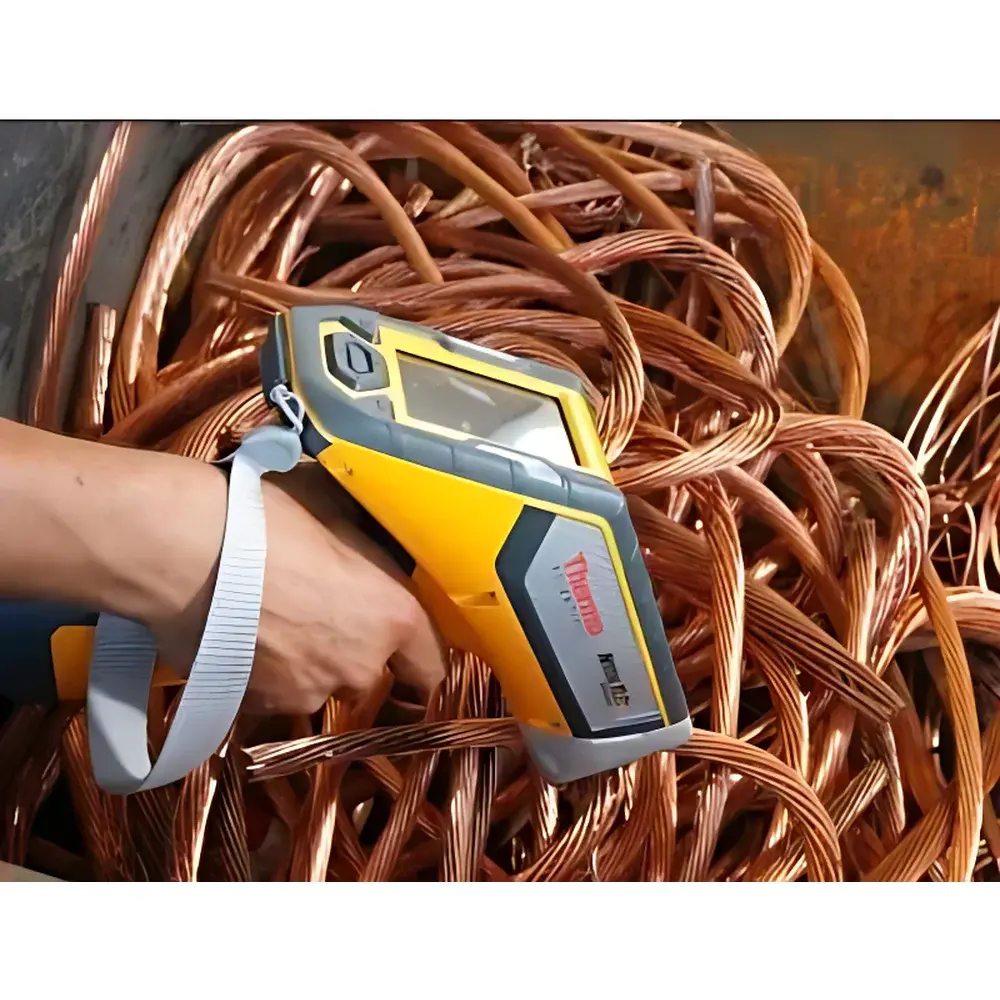
Thermo Scientific Niton XL2t Handheld Energy Dispersive X-Ray Fluorescence (ED-XRF) Spectrometer
| Brand | Thermo Fisher |
|---|---|
| Origin | USA |
| Manufacturer Type | Original Equipment Manufacturer (OEM) |
| Import Status | Imported |
| Model | XL2t |
| Application | Handheld / Portable |
| Industry-Specific Use | Non-Ferrous Metals |
| Elemental Range | Ti (22) to Bi (83), 25 elements |
| Concentration Range | 5 ppm – 99% |
| Energy Resolution | <185 eV |
| Repeatability | ±0.5% RSD |
Overview
The Thermo Scientific Niton XL2t is a handheld energy dispersive X-ray fluorescence (ED-XRF) spectrometer engineered for rapid, non-destructive elemental analysis in demanding field and industrial environments. Based on fundamental XRF physics—where a high-energy X-ray beam excites atoms in the sample, causing emission of characteristic secondary (fluorescent) X-rays—the XL2t quantifies elemental composition by measuring the energy and intensity of these emitted photons. Its optimized Ag-anode microfocus X-ray tube (45 kV, 80 µA max) and high-resolution silicon PIN detector enable precise detection across the S (16)–U (92) range, with standard configurations covering 23–34 elements depending on application-specific calibration. Designed for robustness and regulatory readiness, the XL2t meets international safety standards including IEC 62471 (LED/X-ray safety) and complies with radiation safety requirements for portable analytical devices (e.g., FDA 21 CFR 1020.40, EU Directive 2013/59/Euratom). Its architecture supports GLP/GMP-aligned workflows through audit-trail-capable software, password-protected user access, and automatic beam shutdown upon loss of sample contact.
Key Features
- Lightweight ergonomic design (1.53 kg) with tilt-adjustable high-brightness color touchscreen—optimized for daylight readability and glove-compatible operation.
- Dual-processor architecture: 400 MHz ARM11 CPU + dedicated 300 MHz DSP and 80 MHz ASIC for real-time spectral deconvolution and noise suppression.
- 4096-channel MCA (Multi-Channel Analyzer) with 64 MB system RAM / 128 MB user-accessible memory—enabling storage of >10,000 spectra with full metadata (GPS, time stamp, operator ID).
- Automatic filter switching driven by intelligent grade-matching algorithms—eliminates manual mode selection and reduces analysis time per sample by up to 40%.
- Integrated safety interlocks: beam auto-shutoff during air exposure, hardware-based dose monitoring, and configurable exposure limits per ISO 11322.
- Field-ready ingress protection: IP54-rated housing (dust- and splash-resistant), MIL-STD-810G compliant shock/vibration resistance, and operating temperature range of –10 °C to 50 °C.
Sample Compatibility & Compliance
The XL2t accommodates heterogeneous solid samples—including metal alloys, ores, soils, polymers, and consumer goods—without sample preparation. Its standardized analysis modes (Alloy, Mining, RoHS, Consumer Goods) are pre-calibrated against NIST traceable reference materials (e.g., SRM 679, 2519a, 2783) and validated per ASTM E1621 (XRF for alloy identification) and ISO 12885 (environmental soil screening). For regulated industries, the instrument supports 21 CFR Part 11-compliant electronic signatures and audit trails via NITON NDT software. Calibration stability is maintained through onboard reference checks and drift correction algorithms, ensuring ≤0.5% RSD repeatability across shifts and ambient conditions. All factory calibrations are documented per ISO/IEC 17025 requirements.
Software & Data Management
NITON NDT software provides full instrument control, report generation, and data governance. Users configure role-based permissions (administrator/operator/analyst), define custom report templates with embedded company logos, and export results in CSV, PDF, or XML formats compatible with LIMS integration. Bluetooth 4.0 and USB 2.0 interfaces support direct transfer to networked PCs or cloud repositories; optional Wi-Fi modules enable remote firmware updates and live telemetry. Data integrity is enforced via SHA-256 hashing of spectra files and timestamped revision history. The software also includes statistical process control (SPC) tools for trend analysis, outlier detection, and compliance reporting aligned with ISO 9001 quality management systems.
Applications
- Positive Material Identification (PMI): Instant alloy grade verification per ASTM A956 and ASME B16.5—critical for pipeline integrity, pressure vessel fabrication, and aerospace component certification.
- Mining & Geochemistry: In-situ ore grade estimation (Fe, Cu, Zn, Pb, Ni) and exploration mapping using calibrated mineral matrices (e.g., sulfides, silicates, carbonates).
- Environmental Monitoring: Screening for regulated metals (Pb, Cd, Hg, As, Cr) in soils, sediments, and leachates per EPA Method 6200 and EN 14385.
- Consumer Safety: RoHS/WEEE compliance testing of plastics, coatings, and electronics—detecting restricted substances at sub-10 ppm levels in polymer matrices.
- Recycling & Scrap Sorting: Real-time segregation of non-ferrous scrap (Al, Cu, Zn, Mg alloys) based on multi-element fingerprints and density-corrected quantification.
FAQ
Does the XL2t require annual recalibration?
No—its internal reference source and automated drift correction maintain calibration stability for ≥12 months under normal use. However, quarterly verification using certified check standards is recommended per ISO/IEC 17025.
Can the XL2t analyze light elements like magnesium or aluminum?
Yes, when equipped with the optional vacuum-pump or helium purge accessory (not standard on XL2t base models), detection of Mg (12), Al (13), and Si (14) becomes feasible in controlled atmospheres.
Is the instrument suitable for GMP-regulated pharmaceutical packaging analysis?
While not designed for USP / elemental impurity testing in drug products, it is widely deployed for packaging material verification (e.g., Al foil purity, stainless steel container grade) under ICH Q5E guidelines.
How does the XL2t ensure measurement reproducibility across operators?
Through standardized test protocols embedded in each application mode, mandatory sample positioning feedback (distance sensor), and operator ID logging—all enforced by NITON NDT software’s workflow engine.
What battery life can be expected during continuous operation?
Two hot-swappable Li-ion batteries provide ≥10 hours of typical usage (10-sec measurements at 1-s intervals); battery health and remaining capacity are displayed in real time on the GUI.




