
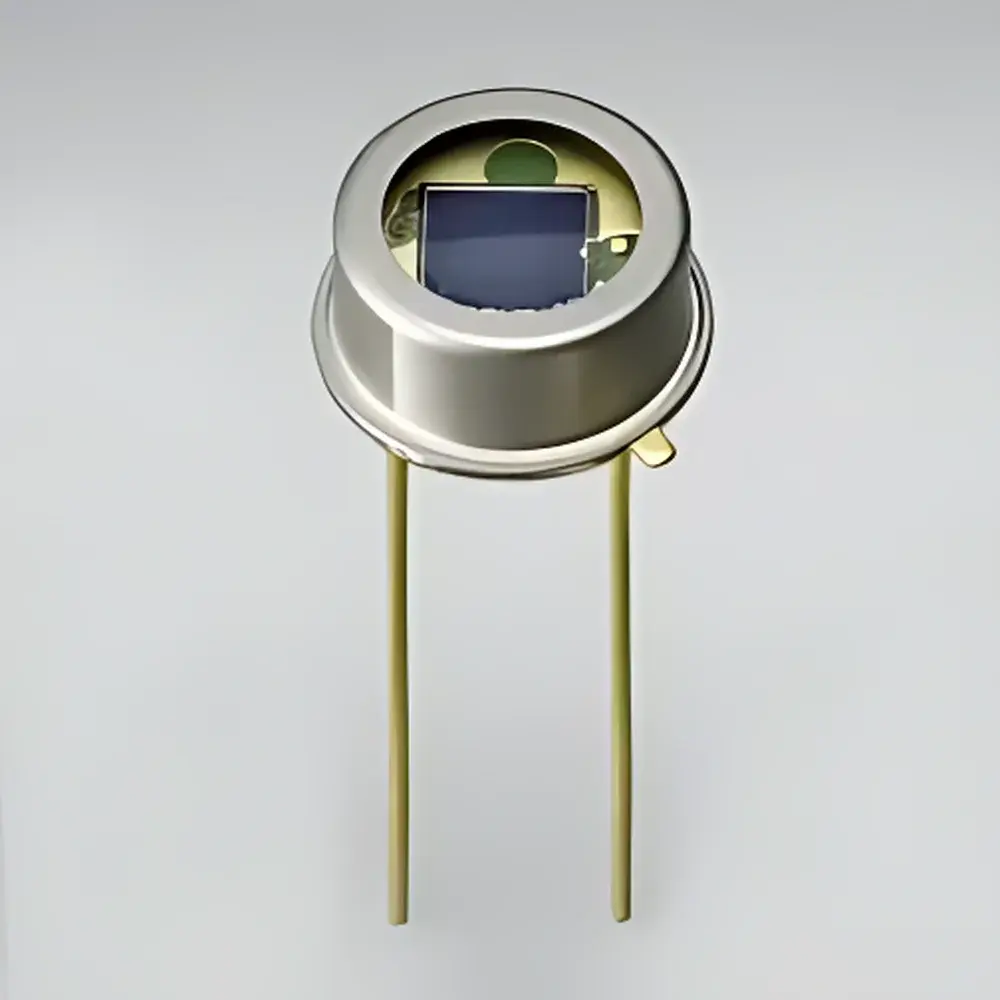
Hamamatsu Silicon Photodiode S1336-44BQ
| Brand | Hamamatsu |
|---|---|
| Origin | Japan |
| Manufacturer | Hamamatsu Photonics K.K. |
| Type | S1336-44BQ |
| Active Area | 3.6 × 3.6 mm² |
| Spectral Range | 190–1100 nm |
| Peak Responsivity Wavelength (Typ.) | 960 nm |
| Responsivity (Typ. at 960 nm) | 0.5 A/W |
| Dark Current (Max. at VR = 10 mV) | 50 pA |
| Junction Capacitance (Typ. at VR = 0 V, f = 10 kHz) | 150 pF |
| Rise Time (Typ. at VR = 0 V) | 0.5 µs |
| Reverse Voltage (Max.) | 5 V |
| Package | TO-5 Metal Can |
| Cooling | Non-cooled |
| Operating Temperature | –40 to +85 °C (Storage: –40 to +100 °C) |
Overview
The Hamamatsu Silicon Photodiode S1336-44BQ is a high-performance, metal-can packaged photodetector engineered for precision radiometric and photometric measurements across the ultraviolet (UV) to near-infrared (NIR) spectrum. Based on a single-element, planar-diffused silicon junction, this photodiode operates in photovoltaic or photoconductive mode and delivers stable, linear current output proportional to incident optical power. Its extended spectral response—from 190 nm (deep UV, enabled by quartz window transmission) to 1100 nm (beyond the silicon bandgap edge)—makes it suitable for applications requiring broadband sensitivity without the complexity of multiple detector types. The device features low junction capacitance (150 pF typical), fast temporal response (0.5 µs rise time), and exceptionally low dark current (≤50 pA), enabling high signal-to-noise ratio (SNR) operation in low-light and high-speed measurement environments. Designed and manufactured in Japan under strict ISO 9001-certified processes, the S1336-44BQ conforms to industrial reliability standards for long-term stability in laboratory instrumentation, analytical spectrophotometers, laser power monitoring systems, and UV-curing process control.
Key Features
- Extended UV–NIR spectral responsivity (190–1100 nm), with peak sensitivity at 960 nm (0.5 A/W typical)
- Low dark current (≤50 pA at 10 mV reverse bias), minimizing thermal noise in precision DC and low-frequency AC measurements
- Small junction capacitance (150 pF typical at 0 V bias, 10 kHz), supporting high-bandwidth signal acquisition and improved frequency response
- Fast rise time (0.5 µs typical at zero bias), suitable for pulsed light detection including Q-switched lasers and LED flash characterization
- Hermetically sealed TO-5 metal package with quartz window—provides mechanical robustness, moisture resistance, and consistent UV transmission
- Non-cooled operation with specified performance over –40 to +85 °C ambient range, eliminating thermoelectric cooling requirements and associated power/complexity
- High linearity (>99.9% up to 10 mW/cm² irradiance, typical) and repeatability across batch and lifetime, validated per Hamamatsu’s internal QA protocols
Sample Compatibility & Compliance
The S1336-44BQ is compatible with standard photodiode amplifier circuits (transimpedance or voltage-mode), optical bench mounts (e.g., SM1-threaded holders), and OEM integration into spectrometers, radiometers, and process sensors. Its 3.6 × 3.6 mm² active area enables efficient coupling with fiber-optic collimators (e.g., SMA-905 or FC/PC interfaces via adapter), integrating seamlessly into modular optical platforms. The device complies with RoHS Directive 2011/65/EU and REACH Regulation (EC) No. 1907/2006. While not certified as a medical device, its performance characteristics align with IEC 60794-2 (optical fiber cable components) and IEC 61000-4-2 (ESD immunity) test conditions during qualification. For regulated environments—including pharmaceutical QC labs and environmental monitoring—the photodiode supports traceable calibration against NIST-traceable reference detectors (e.g., Hamamatsu C12701 series) and satisfies prerequisite stability criteria outlined in ASTM E275 (Standard Practice for Describing and Measuring Performance of UV–Vis–NIR Spectrophotometers).
Software & Data Management
As a passive analog sensor, the S1336-44BQ does not include embedded firmware or digital interfaces. However, it is fully interoperable with industry-standard data acquisition hardware—including National Instruments USB-6211, Keysight 34972A, and Thorlabs PM100D power meter platforms—when paired with appropriate transimpedance amplifiers (e.g., Femto DLPCA-200 or Stanford Research SR570). Raw photocurrent outputs are compatible with MATLAB, Python (via PyVISA or nidaqmx), LabVIEW, and Igor Pro for real-time plotting, spectral reconstruction, and statistical analysis. When integrated into GLP/GMP-compliant systems, users may implement audit-trail-capable logging (per FDA 21 CFR Part 11) using timestamped binary data capture and metadata tagging (wavelength, integration time, temperature, bias voltage). Calibration coefficients (responsivity vs. wavelength) are provided in Hamamatsu’s official datasheet (Rev. D, 2023) and can be imported directly into spectral analysis software such as OceanView or Avantes AS5216.
Applications
- UV–Vis–NIR spectrophotometer detector arrays (as single-channel reference or scanning element)
- Laser power and energy monitoring for excimer (193 nm), Nd:YAG (1064 nm), and tunable OPO sources
- Fluorescence lifetime spectroscopy (FLIM) and time-resolved photoluminescence (TRPL) detection channels
- Environmental UV index sensors and solar irradiance monitoring (with cosine-corrected diffusers)
- Industrial UV curing dose control systems in semiconductor lithography and adhesive curing lines
- Calibration transfer standards in metrology labs performing inter-laboratory comparison of spectral responsivity
FAQ
Is the S1336-44BQ suitable for vacuum or high-humidity environments?
Yes—the hermetic TO-5 metal package provides IP67-equivalent sealing. It is rated for operation in 0–95% RH non-condensing environments and has been validated for bake-out compatibility up to 100 °C in vacuum chambers (≤10⁻⁵ Torr).
Can this photodiode be reverse-biased beyond 5 V?
No. Exceeding the maximum reverse voltage (5 V) risks permanent junction breakdown. For higher-speed operation requiring increased depletion depth, consider the S1336-8BQ variant (10 V max), which shares identical spectral and packaging specifications.
Does Hamamatsu provide NIST-traceable calibration certificates?
Yes—certified spectral responsivity calibration (200–1100 nm, ±2% uncertainty, k=2) is available as an optional service (Order Code: CAL-S1336-44BQ). Certificates include full uncertainty budgets and traceability statements compliant with ISO/IEC 17025.
What is the recommended load resistance for optimal SNR in DC photometry?
For DC or low-frequency (<10 Hz) applications, a 10 kΩ–1 MΩ feedback resistor in a transimpedance amplifier yields optimal trade-off between Johnson noise and bandwidth. For best SNR below 1 Hz, use ≥100 kΩ with low-noise op-amps (e.g., OPA141) and guarded PCB layout.





