
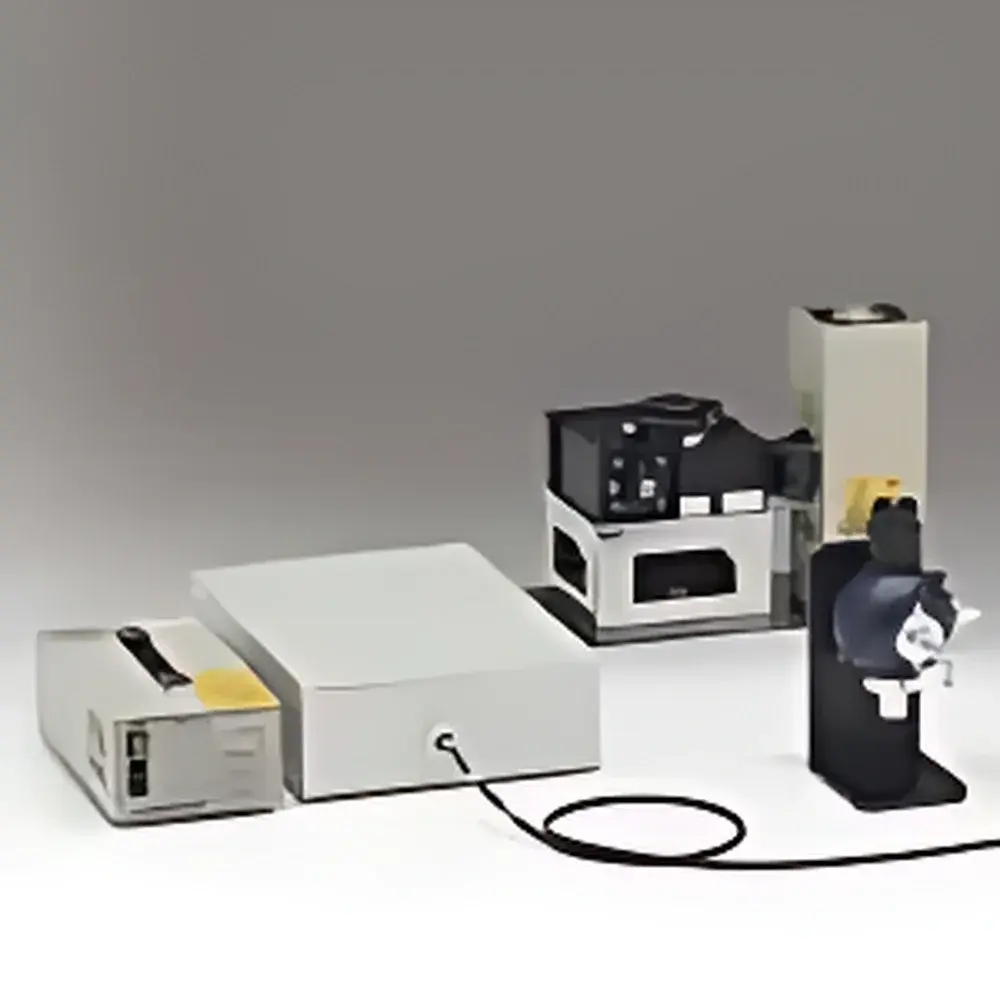
Hamamatsu C9920 Series Absolute Quantum Yield Measurement System
| Origin | Japan |
|---|---|
| Manufacturer Type | Authorized Distributor |
| Origin Category | Imported |
| Model | C9920 |
| Pricing | Upon Request |
Overview
The Hamamatsu C9920 Series is an absolute quantum yield measurement system engineered for rigorous photoluminescence (PL) and electroluminescence (EL) quantum efficiency characterization. It operates on the principle of integrating sphere-based spectral radiometry combined with calibrated excitation source control, enabling traceable, reference-free determination of absolute photoluminescent quantum yield (PLQY) and external quantum efficiency (EQE). Unlike relative methods requiring certified reference standards, the C9920 series employs a dual-detector architecture—featuring a high-sensitivity back-illuminated CCD spectrometer and a precision-calibrated photodiode—to simultaneously capture both excitation flux and emitted photon distribution within a thermally stabilized integrating sphere. This architecture satisfies ISO 11664-1:2019 (Colorimetry — Part 1: CIE standard colorimetric observers) and ASTM E2758-22 (Standard Practice for Determining Photoluminescent Quantum Yield of Materials) requirements for absolute quantum yield quantification. Designed for R&D laboratories in optoelectronics, materials science, and biophotonics, the system supports fundamental investigations into emissive mechanisms under controlled thermal and spectral conditions.
Key Features
- Reference-free absolute quantum yield measurement—no certified standard required for PLQY or EQE determination
- Motorized monochromator with xenon lamp excitation source, enabling automated wavelength selection from 250 nm to 800 nm (typical range)
- High-dynamic-range, thermoelectrically cooled back-illuminated CCD spectrometer for low-noise spectral acquisition
- Optimized 150 mm integrating sphere with Spectralon® coating (≥99% diffuse reflectance, 250–2500 nm), minimizing stray light and spectral distortion
- Integrated cryogenic sample stage compatible with liquid nitrogen dewars, supporting stable operation from −196 °C to +80 °C
- Software-controlled excitation wavelength scanning for continuous quantum yield mapping across excitation spectra
- Modular architecture supporting field-upgradable EL modules (C9920-11/12 configurations) and luminous intensity/distribution analysis add-ons
Sample Compatibility & Compliance
The C9920 accommodates solid, powder, and liquid samples without reconfiguration: thin-film samples are mounted on quartz substrates or integrated holders; powders are loaded into custom-designed quartz cuvettes with optical-grade windows; solutions are analyzed in standard 1 cm path-length quartz cells. All sample interfaces maintain alignment repeatability within ±0.1 mm to ensure measurement reproducibility. The system complies with GLP documentation requirements through audit-trail-enabled software (version 3.2+), supporting 21 CFR Part 11-compliant electronic signatures and data integrity protocols. Thermal stability during cryogenic operation adheres to IEC 61000-4-11 for immunity to voltage fluctuations during LN₂ cooldown cycles.
Software & Data Management
Hamamatsu’s Quantum Yield Analysis Software (QYAS v4.1) provides full instrument control, spectral deconvolution, and quantum yield calculation per ISO 11664-7:2022. It includes built-in correction algorithms for sphere wall absorption, detector responsivity drift, and excitation source spectral power distribution (SPD) calibration. Raw spectral datasets are exported in HDF5 format with embedded metadata (wavelength axis, integration time, temperature, excitation λ, sample ID), ensuring FAIR (Findable, Accessible, Interoperable, Reusable) data principles. Batch processing supports multi-sample comparative analysis with statistical reporting (mean, SD, CV%) across excitation wavelengths or temperature points.
Applications
- Quantitative evaluation of emissive layer materials for OLEDs, micro-LEDs, and QD-LED displays
- Structure–property correlation studies of metal–organic frameworks (MOFs), perovskites, and conjugated polymers
- Thermal quenching behavior analysis of phosphors and down-conversion materials from −196 °C to 80 °C
- Fluorescence quantum yield validation of bioconjugates, organic dyes, and semiconductor quantum dots under physiological and cryogenic conditions
- Development and QC of luminescent solar concentrators (LSCs) and anti-counterfeiting inks
FAQ
Does the C9920 require reference standards for absolute quantum yield measurement?
No. Its dual-detector integrating sphere design enables absolute PLQY determination without reference materials.
Can the system measure external quantum efficiency (EQE) for electroluminescent devices?
Yes—when configured with the C9920-11 or C9920-12 EL module, including current/voltage sourcing and synchronized electrical–optical triggering.
What is the lowest operational temperature achievable with the cryogenic option?
The system maintains stable measurement conditions at −196 °C using standard liquid nitrogen dewar integration.
Is the software compliant with FDA 21 CFR Part 11 requirements?
Yes—QYAS v4.1 supports role-based access control, electronic signatures, and full audit trail logging for regulated environments.
How is sample alignment verified during automated wavelength scans?
A real-time position feedback loop monitors sample stage coordinates; misalignment >±0.15 mm triggers automatic recalibration before data acquisition.



