
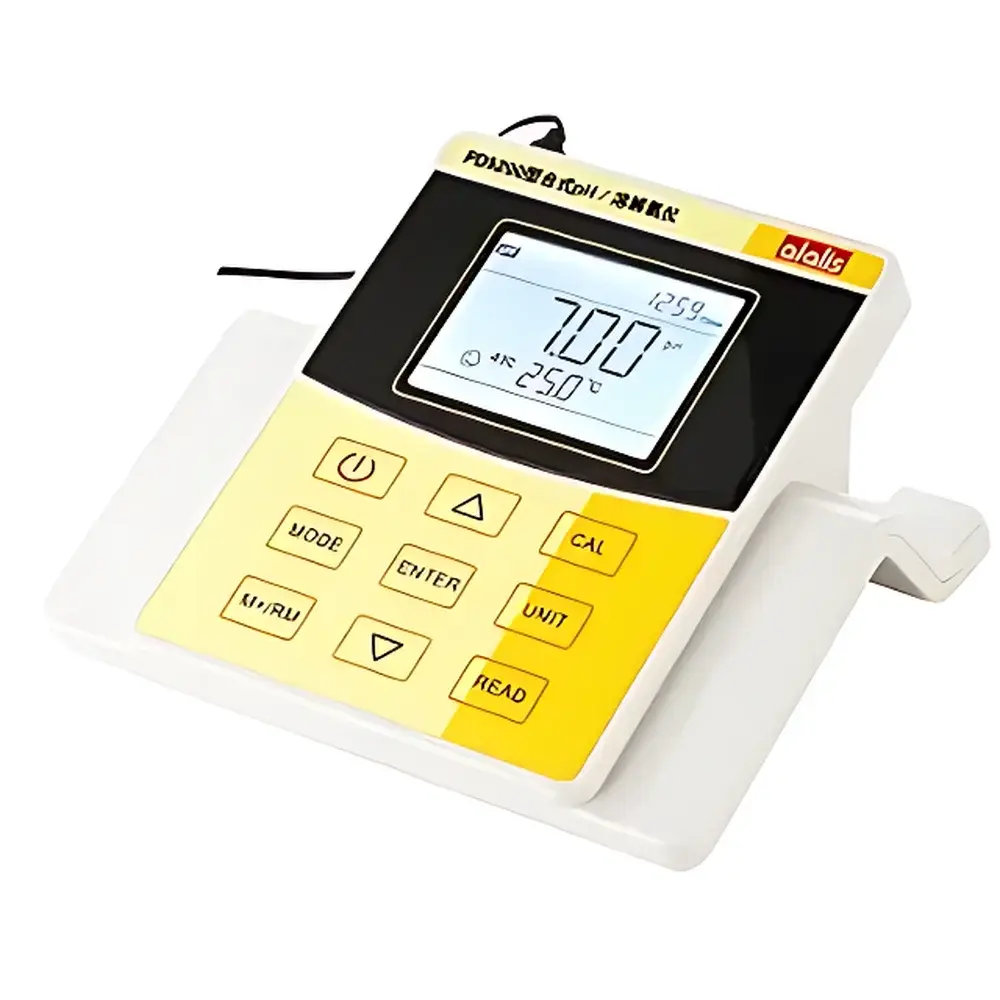
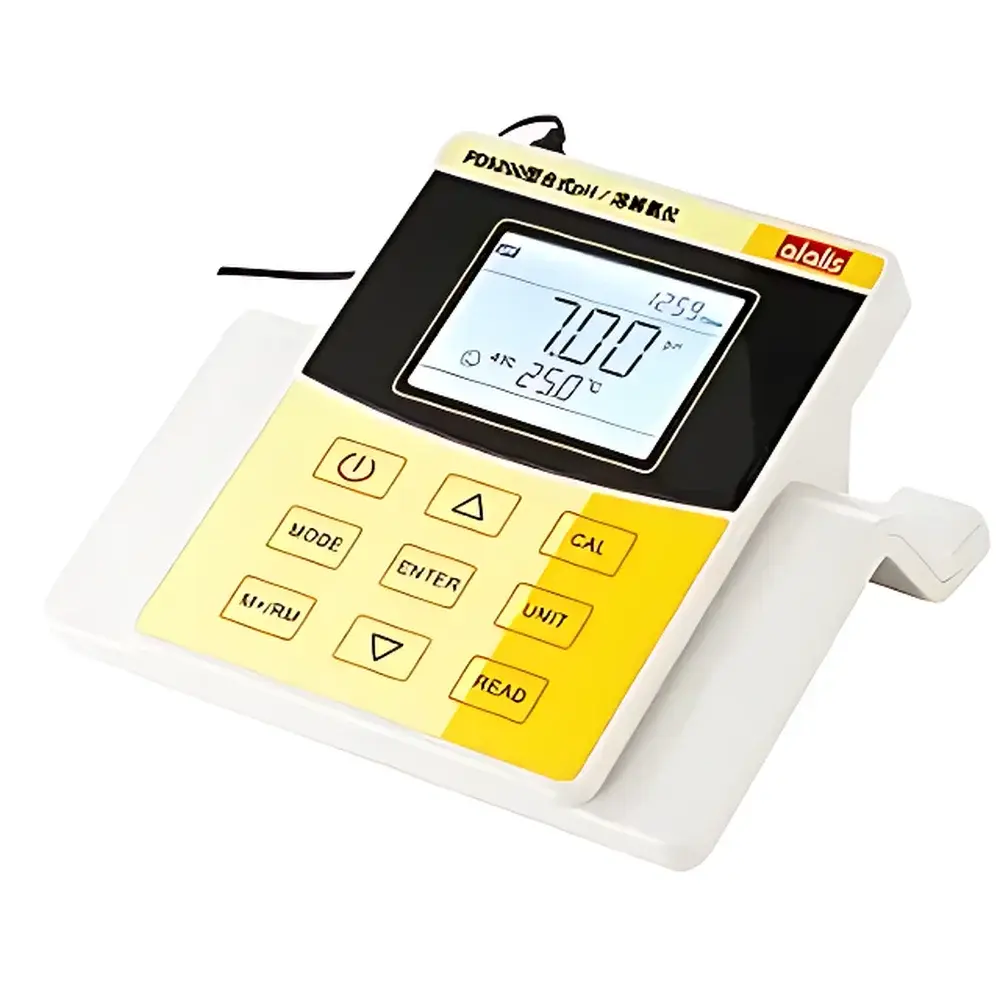
Alalis PD5200 Multi-Parameter Benchtop pH and Dissolved Oxygen Meter
| Brand | Alalis |
|---|---|
| Origin | Shanghai, China |
| Model | PD5200 |
| Instrument Type | Laboratory |
| Measurement Principle | Electrochemical Clark-type Polarographic Probe |
| Dissolved Oxygen Range | 0–20.00 mg/L |
| Accuracy (DO) | ±0.30 mg/L |
| Repeatability | 0.1% |
| Detection Limit (DO) | 0.10 mg/L |
| pH Range | −2.000–19.999 |
| pH Accuracy | ±0.002 pH |
| mV Range | ±1999.9 mV |
| mV Accuracy | ±0.03% FS |
| Temperature Range | −10–100 °C |
| Temp Accuracy | ±0.4 °C |
| Response Time (DO) | 30 s (90% at 25 °C) |
| Residual Current | 0.10 mg/L |
| DO Electrode | Membrane-covered polarographic sensor with integrated temperature compensation and salinity/pressure compensation |
| pH Calibration | Up to 5-point auto-calibration with NIST, USA, CH, and custom buffer sets (15 total) |
| Data Storage | 1000 entries (manual/auto), GLP-compliant |
| Connectivity | USB interface |
| IP Rating | IP54 |
| Display | 90 × 68 mm LCD with white backlight and time stamp |
Overview
The Alalis PD5200 Multi-Parameter Benchtop pH and Dissolved Oxygen Meter is an integrated laboratory instrument engineered for simultaneous, high-fidelity measurement of pH, redox potential (mV), dissolved oxygen (DO), DO saturation (%), and temperature in aqueous environmental and process samples. It employs a dual-sensor architecture: a glass-body pH/mV/temperature combination electrode and a Clark-type polarographic dissolved oxygen probe with a gas-permeable Teflon membrane and built-in thermistor. The DO measurement principle relies on electrochemical reduction of molecular oxygen at a polarized cathode (−0.6 V vs. Ag/AgCl), generating a diffusion-limited current linearly proportional to dissolved O₂ concentration—enabling trace-level quantification down to 0.10 mg/L. Designed for rigorous water quality analysis workflows, the PD5200 meets functional requirements for regulatory monitoring, method validation, and routine QC across municipal water treatment, aquaculture, bioreactor control, environmental field labs, and beverage production (e.g., wine fermentation).
Key Features
- Five-point automatic pH calibration with intelligent buffer recognition, guided step-by-step prompts, and real-time calibration diagnostics.
- Comprehensive buffer support: NIST, USA, and CH series standards (15 preloaded), plus user-defined buffer entry for non-standard solutions.
- Dedicated high-purity water modes—including ammonia-doped pure water pH measurement—to mitigate sodium error and junction potential drift.
- Redox (EH) measurement capability with mV resolution of 0.1 mV and full-scale accuracy of ±0.03% FS.
- Triple-parameter automatic compensation: temperature (−10–100 °C), salinity (0–45 ppt), and barometric pressure (80–105 kPa) for DO readings—critical for field-deployable accuracy.
- Polarographic DO probe features rapid polarization (3–5 min), replaceable membrane caps, and refillable electrolyte solution—ensuring long-term stability and reproducibility.
- Smart endpoint detection with auto-hold and stability-triggered locking, minimizing operator-dependent reading variability.
- Large 90 × 68 mm backlit LCD with time-stamped display, adjustable contrast, and dual temperature units (°C/°F).
- Robust mechanical design compliant with IP54 rating; all ports sealed with protective rubber caps to resist dust and incidental splashes.
- Factory-reset function and configurable auto-power-off enhance operational consistency and energy efficiency.
Sample Compatibility & Compliance
The PD5200 is validated for use with freshwater, seawater, wastewater effluents, culture media, and low-ionic-strength process streams. Its polarographic DO sensor exhibits minimal interference from common ions (Cl⁻, NO₃⁻, SO₄²⁻) and is insensitive to flow rate above 10 cm/s—making it suitable for stirred reactors and static grab samples alike. For pH, the triple-junction reference system and low-resistance glass membrane reduce clogging and junction potential errors in turbid or protein-rich matrices. The instrument adheres to fundamental metrological practices aligned with ISO 5667-3 (water sampling), ASTM D888 (dissolved oxygen in water), and USP (pH measurement). Data management conforms to GLP principles: each stored reading includes timestamp, electrode ID (if encoded), calibration history, and environmental compensation parameters—supporting audit readiness in regulated environments.
Software & Data Management
The PD5200 supports bidirectional USB communication via included PC software (Windows-compatible). Raw and processed data—including pH, mV, DO (mg/L and % saturation), temperature, salinity, and pressure—are exportable in CSV format for integration into LIMS or statistical analysis platforms. The internal memory stores up to 1000 measurement records with manual or time-triggered auto-storage intervals (configurable from 1 s to 60 min). All entries are tagged with date/time, operator ID (optional), and calibration verification flags. Audit-trail functionality logs critical events: calibration initiation/completion, parameter changes, and factory reset—fulfilling foundational expectations of FDA 21 CFR Part 11 for electronic records in non-GMP but quality-critical applications.
Applications
- Environmental monitoring of lakes, rivers, estuaries, and coastal zones per EPA Method 360.1 and ISO 5814.
- Wastewater treatment plant process control—nitrification/denitrification basin DO profiling and aeration optimization.
- Aquaculture operations: real-time DO surveillance in hatcheries and recirculating aquaculture systems (RAS) to prevent hypoxia stress.
- Pharmaceutical water systems: conductivity-coupled pH and DO trending in purified water (PW) and water-for-injection (WFI) loops.
- Fermentation process development: tracking aerobic respiration rates in yeast and bacterial cultures during scale-up studies.
- Educational laboratories: teaching core electrochemical concepts including Nernst equation derivation, oxygen diffusion kinetics, and buffer theory.
FAQ
What calibration buffers are supported for pH measurement?
The PD5200 supports 15 preprogrammed standard buffers across NIST, USA, and CH series—including pH 1.68, 4.01, 6.86, 7.00, 9.18, 10.01, and 12.45—as well as up to five user-defined buffers.
How does the instrument compensate for altitude-related pressure changes during DO measurement?
An integrated barometric pressure sensor (80–105 kPa range) automatically adjusts DO calculations using the Stern–Volmer relationship, eliminating manual correction tables.
Is the DO electrode suitable for continuous immersion in seawater?
Yes—the polarographic probe features a corrosion-resistant stainless-steel body and replaceable Teflon membrane; however, regular membrane cleaning and electrolyte replacement every 4–6 weeks are recommended for sustained accuracy in high-salinity environments.
Can the instrument store calibration data separately for pH and DO channels?
Yes—each sensor channel maintains independent calibration logs with timestamps, slope/mV values, and offset diagnostics, accessible via the menu or exported software report.
Does the PD5200 meet any international electrical safety or EMC standards?
The instrument complies with IEC 61010-1 (safety) and IEC 61326-1 (EMC) for laboratory equipment, with CE marking indicating conformity to EU directives.
Related Products







