
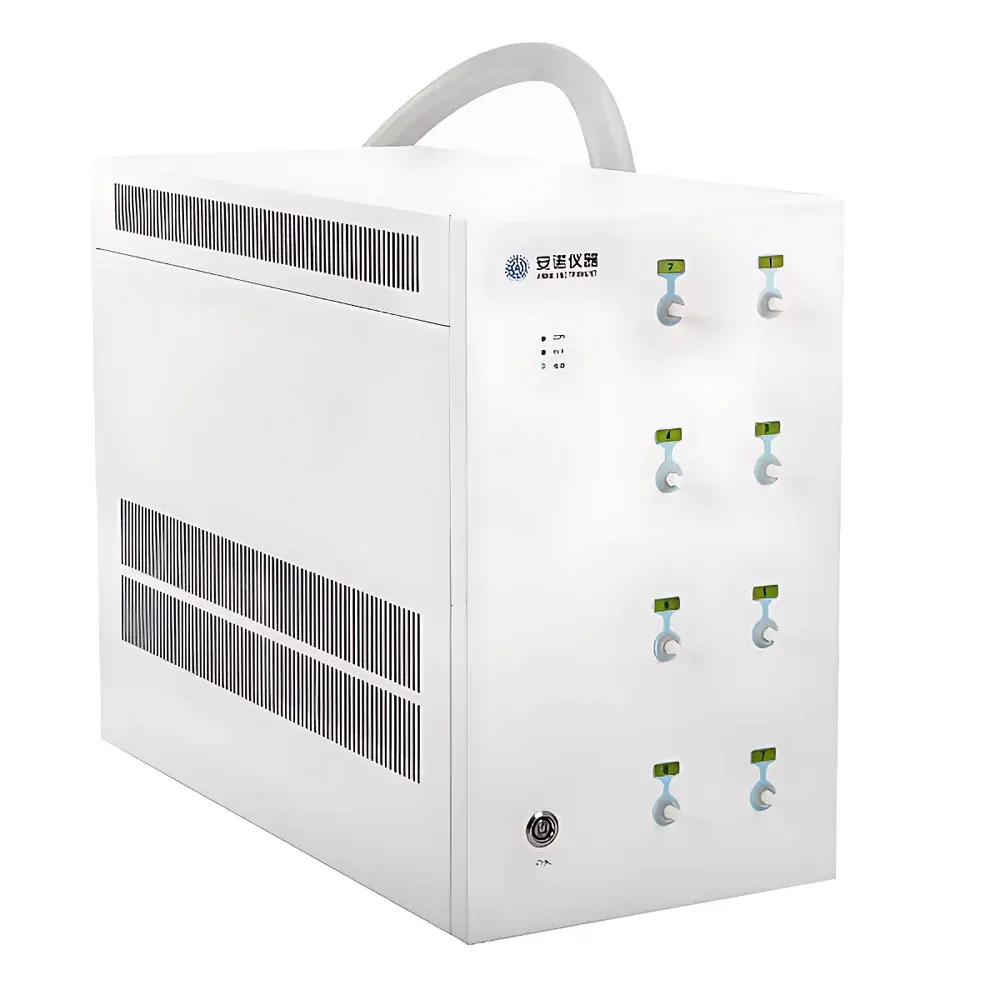
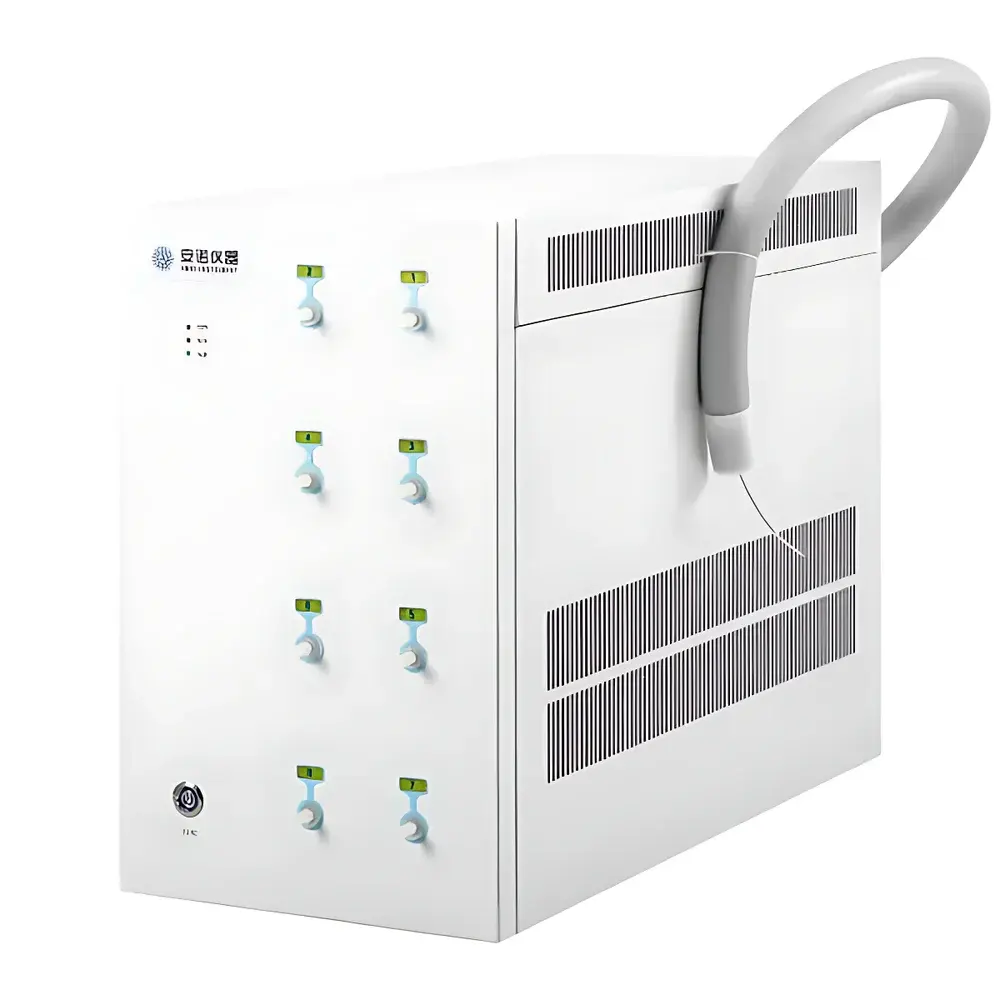
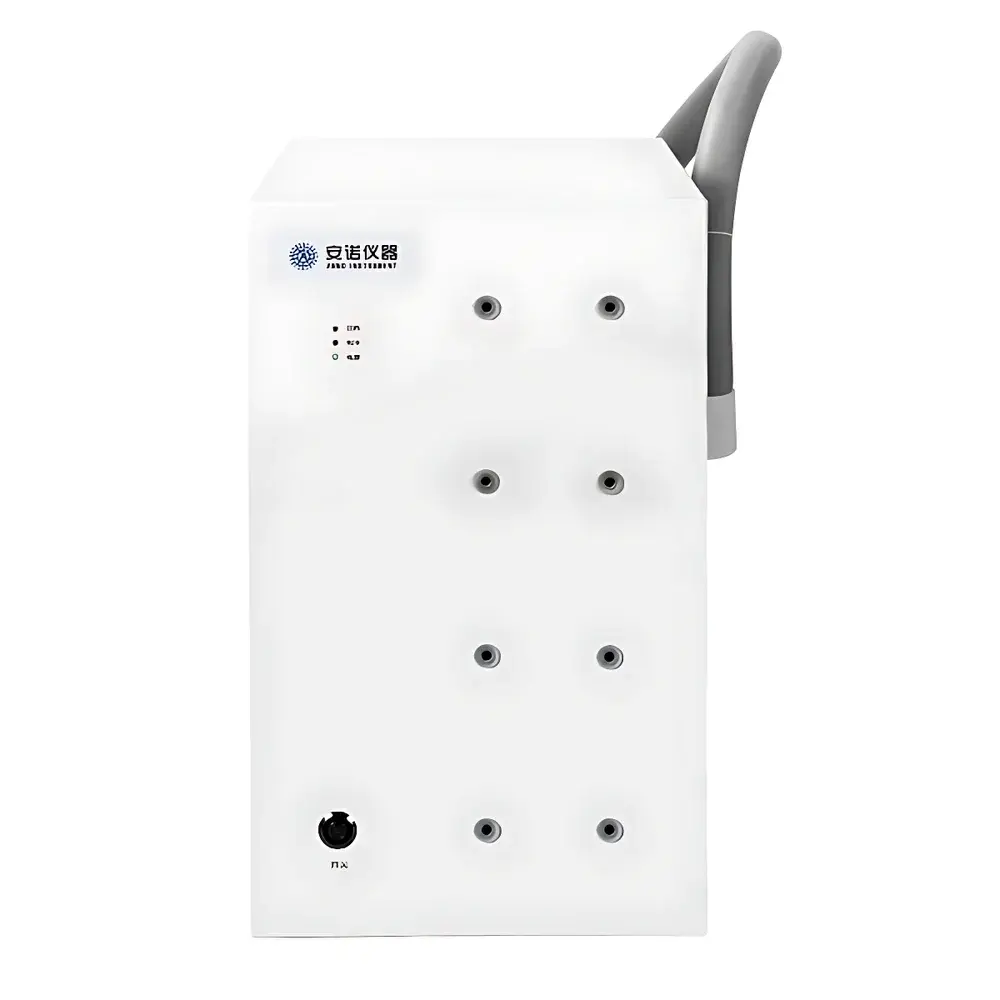
Annuo SC-4223 Automated Sulfur Compound Preconcentrator
| Brand | Annuo |
|---|---|
| Origin | Henan, China |
| Model | SC-4223 |
| Instrument Type | Automated Quantitative Gas Preconcentrator |
| Cold Trap Temperature Range | −30 °C to 300 °C (at 25 °C ambient) |
| Valve & Transfer Line Temperature Range | Ambient to 160 °C |
| Cooling Method | Peltier Thermoelectric |
| Sample Volume | 1–2000 mL |
| Maximum Concentration Ratio | 2000:1 |
| Precision | RSD ≤ 3% |
| Power Supply | AC 220 V, 50 Hz |
| Dimensions | 550 × 260 × 427 mm |
| Weight | ~20 kg |
| Interface Options | RS-232, Ethernet |
| GC Trigger Modes | Time-based or GC reverse control |
| Analysis Time Range | 0.1–999 min |
| Max Power Consumption | 1000 W |
Overview
The Annuo SC-4223 Automated Sulfur Compound Preconcentrator is a laboratory-grade gas preconcentration system engineered for trace-level analysis of volatile sulfur compounds (VSCs) in ambient air, industrial emissions, and environmental monitoring samples. It operates on the principle of cryogenic trapping followed by rapid thermal desorption—enabling quantitative recovery of low-boiling, reactive analytes such as hydrogen sulfide (H₂S), methanethiol (CH₃SH), dimethyl sulfide (DMS), and dimethyl disulfide (DMDS). Designed for seamless integration with gas chromatography (GC) and GC–mass spectrometry (GC–MS) platforms, the SC-4223 automates critical sample preparation steps including vacuum-assisted sampling, cold trap conditioning, transfer line purging, and timed thermal desorption. Its modular architecture supports method-defined workflows compliant with standardized analytical protocols, particularly those referenced in Chinese national standards (e.g., GB/T 14678–1993) for odorant and sulfur gas quantification.
Key Features
- Programmable cryogenic trapping across a broad thermal range (−30 °C to 300 °C), enabling selective retention and sharp elution of sulfur-containing volatiles.
- Independent heating zones for valves and transfer lines (ambient to 160 °C), minimizing condensation and carryover of high-polarity VSCs.
- Passivated gas pathways using inert-surface-treated stainless steel tubing and fittings, reducing adsorption losses and surface-catalyzed decomposition of labile species.
- Semi-closed-loop valve positioning control ensures repeatable switching accuracy for multi-step sequence execution (e.g., sample draw → trap fill → bake-out → desorb → GC injection).
- Dedicated purge channels for individual sample loop cleaning, eliminating cross-contamination between sequential analyses.
- Integrated quantitative loop heating function maintains consistent vapor-phase transfer efficiency during desorption.
- Flexible GC interfacing via time-triggered or hardware reverse-triggering (TTL/RS-232/Ethernet), supporting compatibility with major GC vendors including Agilent, Thermo Fisher, Shimadzu, and PerkinElmer.
- Compact footprint (550 × 260 × 427 mm) optimized for benchtop deployment in regulated QC laboratories and mobile field labs.
Sample Compatibility & Compliance
The SC-4223 is validated for use with gaseous matrices collected via Tedlar® bags, SUMMA® canisters, or direct-line sampling. It accommodates sample volumes from 1 mL to 2000 mL, delivering up to 2000-fold concentration enhancement while maintaining RSD ≤ 3% across replicate injections. The system adheres to fundamental requirements of ISO 16000-6 (indoor air—determination of volatile organic compounds), ASTM D5504 (sulfur compounds in natural gas), and US EPA Method TO-15 (determination of VOCs in air by GC–MS). While not certified under FDA 21 CFR Part 11, its software architecture supports audit-trail-capable operation when deployed within GLP/GMP-aligned environments where electronic record integrity is enforced through external validation protocols.
Software & Data Management
The SC-4223 is operated via dedicated Windows-based host software that provides full parameter control—including trap temperature ramp profiles, valve timing sequences, sample volume definition, and GC synchronization settings. The interface supports method storage, batch queueing, and real-time status monitoring (trap temperature, pressure, valve position, cycle progress). Raw instrument logs are exported in CSV format for LIMS integration. All user actions—including method edits, run initiations, and system diagnostics—are timestamped and logged locally. Optional remote access via Ethernet allows centralized supervision in multi-instrument labs without compromising local security policies.
Applications
- Environmental air quality monitoring: quantification of odor-causing sulfur gases near wastewater treatment plants, landfills, and pulp/paper facilities.
- Industrial hygiene: occupational exposure assessment of H₂S and organic sulfides in refinery, chemical manufacturing, and biogas upgrading operations.
- Food and beverage R&D: off-odor profiling in fermented products, dairy, and seafood processing streams.
- Method development and validation labs requiring reproducible preconcentration for regulatory reporting under CNAS or CMA accreditation frameworks.
- Research applications involving reactive sulfur speciation in atmospheric chemistry and microbial metabolism studies.
FAQ
What sulfur compounds is the SC-4223 specifically optimized for?
The system is calibrated and validated for hydrogen sulfide, methanethiol, dimethyl sulfide, and dimethyl disulfide—as specified in GB/T 14678–1993—but its thermal and flow parameters support adaptation to other volatile sulfur-containing analytes with boiling points below 150 °C.
Can the SC-4223 be used with GC–MS systems requiring splitless injection?
Yes—the desorption profile and transfer line temperature control allow precise matching to splitless inlet conditions; method optimization is required for dwell time and solvent delay alignment.
Is the cold trap replaceable, and what is its typical service life?
The Peltier-cooled trap assembly is field-replaceable; under routine maintenance (regular bake-outs and inert gas purging), operational longevity exceeds 2 years at 5–10 runs/day.
Does the system support unattended overnight operation?
Yes—batch sequencing, auto-shutdown after completion, and hardware interlocks for overtemperature and overpressure ensure safe extended operation.
What validation documentation is provided with the instrument?
Each unit ships with factory calibration reports for temperature sensors and flow verification data; IQ/OQ documentation templates are available upon request for customer-led qualification under internal SOPs.



