
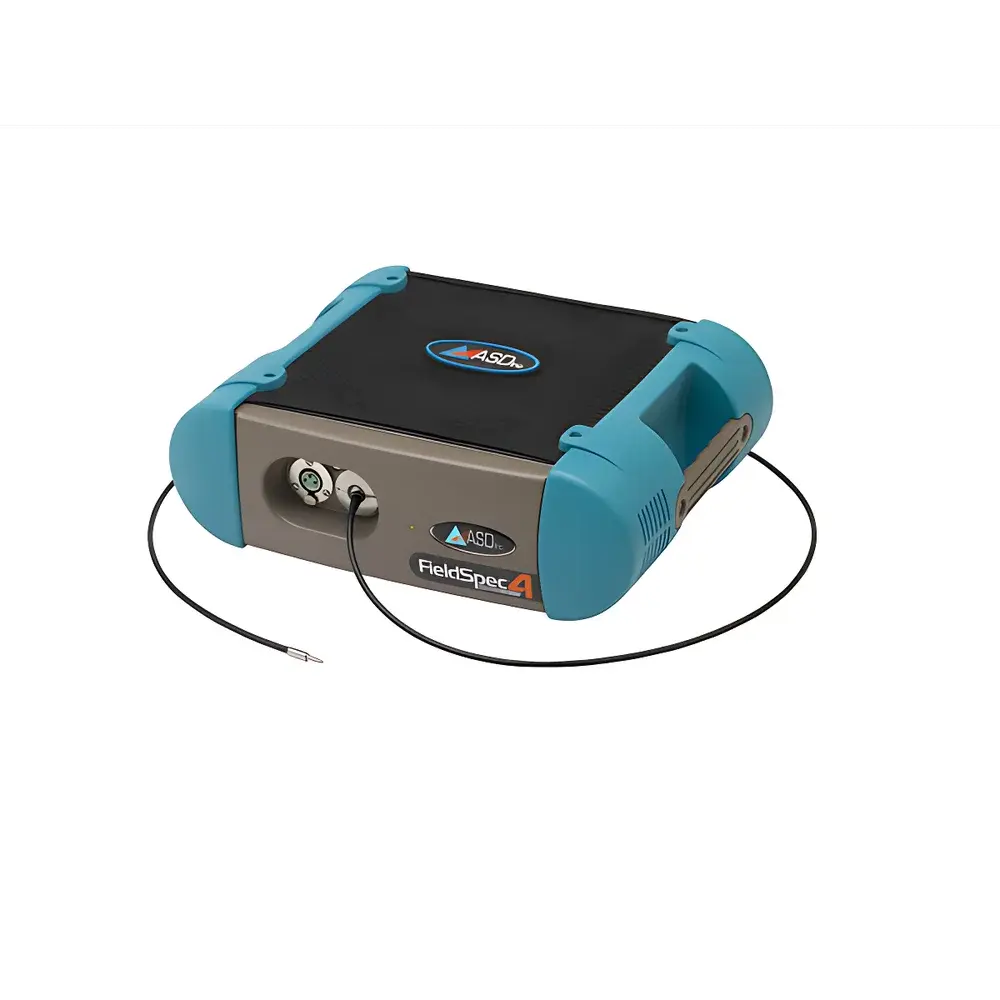
ASD FieldSpec 4 Hi-Res NG Portable Field Spectroradiometer
| Brand | ASD |
|---|---|
| Origin | USA |
| Model | FieldSpec 4 Hi-Res NG |
| Spectral Range | 350–2500 nm |
| Detector Configuration | Si (350–1000 nm), TE-cooled InGaAs (1001–1800 nm), TE-cooled InGaAs (1801–2500 nm) |
| Spectral Resolution | 3 nm @ 700 nm, 6 nm @ 1400 nm & 2100 nm |
| Sampling Interval | 1.4 nm (350–1000 nm), 1.1 nm (1001–2500 nm) |
| Stray Light | <0.02% (VNIR), <0.01% (SWIR 1 & 2) |
| Wavelength Accuracy | ±0.5 nm |
| Wavelength Repeatability | ±0.1 nm |
| Integration Time | 100 ms typical |
| NEΔL (VNIR) | 1.0 × 10⁻⁹ W/cm²/nm/sr @ 700 nm |
| NEΔL (SWIR 1) | 8.0 × 10⁻⁹ W/cm²/nm/sr @ 1400 nm |
| NEΔL (SWIR 2) | 8.0 × 10⁻⁹ W/cm²/nm/sr @ 2100 nm |
| Radiance Dynamic Range | Up to 2× solar (VNIR), 10× solar (SWIR) |
| Calibration Traceability | NIST-traceable radiometric, reflectance, irradiance, and colorimetric calibrations available |
| Fiber Input | 1.5 m, 25° FOV (lens options available) |
| Channels | 2151 spectral bands |
| Weight | 5.44 kg |
| Warranty | 12 months comprehensive coverage with technical support |
Overview
The ASD FieldSpec 4 Hi-Res NG is a high-performance, portable field spectroradiometer engineered for rigorous ground-based spectral validation of next-generation airborne and spaceborne hyperspectral imaging systems—including AVIRIS-NG, HySpex ODIN-1024, and PRISMA. Operating across the full solar-reflective spectrum (350–2500 nm), it integrates three optically aligned detector modules: a 512-pixel silicon array for the VNIR region (350–1000 nm), and two thermoelectrically (TE) cooled InGaAs detectors covering SWIR-1 (1001–1800 nm) and SWIR-2 (1801–2500 nm). Its design prioritizes spectral fidelity over speed—achieving 3 nm resolution at 700 nm and 6 nm at key atmospheric water absorption features (1400 nm, 2100 nm)—to prevent interpolation-induced information loss during sensor cross-calibration and atmospheric correction workflows. Unlike conventional field spectrometers optimized for rapid surveying, the FieldSpec 4 Hi-Res NG is purpose-built to match or exceed the resolving power of modern pushbroom hyperspectral imagers, ensuring that in situ measurements serve as authoritative reference standards for radiometric, geometric, and spectral validation under GLP-compliant field protocols.
Key Features
- Triple-detector architecture with TE-cooled InGaAs for stable, low-noise SWIR performance across two non-overlapping sub-bands (1001–1800 nm and 1801–2500 nm)
- NIST-traceable absolute calibration for radiance, irradiance, reflectance, and CIE colorimetry—each delivered with documented uncertainty budgets and certificate of conformance
- High spectral sampling density: 1.4 nm interval (350–1000 nm), 1.1 nm interval (1001–2500 nm), enabling robust derivative analysis and narrowband feature detection (e.g., chlorophyll red edge, cellulose absorption at 2090 nm)
- Ultra-low stray light (<0.02% VNIR; <0.01% SWIR) achieved via dual-stage order-sorting filters and optimized optical baffling—critical for accurate retrieval of weak absorption features in vegetative and mineral spectra
- Wavelength accuracy ±0.5 nm and repeatability ±0.1 nm—validated using mercury-argon lamp references and maintained through internal wavelength stabilization routines
- Ruggedized aluminum chassis rated for field deployment (IP54 equivalent), integrated GPS and inclinometer for georeferenced metadata capture
- Real-time spectral preview and quality assurance metrics (SNR, saturation status, dark current drift) via embedded ARM processor and touchscreen interface
Sample Compatibility & Compliance
The FieldSpec 4 Hi-Res NG supports direct measurement of bidirectional reflectance distribution function (BRDF)-sensitive targets—including vegetation canopies, soil surfaces, painted panels, mineral samples, and calibration standards—using its standard 1.5 m fiber optic cable with 25° foreoptic. Optional lens assemblies (e.g., 1°, 5°, 8°, 25° FOV) enable spatially resolved measurements from handheld, tripod-mounted, or UAV-integrated configurations. All factory calibrations comply with ISO/IEC 17025:2017 requirements for testing laboratories, and spectral data acquisition workflows align with ASTM E275, ASTM E308, and ISO 11664-4 for colorimetry and reflectance metrology. For regulated environments (e.g., USDA ARS field trials, NASA calibration/validation campaigns), optional 21 CFR Part 11–compliant software modules provide electronic signatures, audit trails, and role-based access control.
Software & Data Management
Operated via ViewSpec Pro v6.x, the instrument’s native software suite delivers real-time spectral visualization, batch processing, and export to ENVI, HDF5, and ASCII formats. The platform includes built-in algorithms for atmospheric correction (using MODTRAN-derived look-up tables), spectral angle mapper (SAM) classification, and derivative spectroscopy (first and second order). Raw data files embed EXIF-style metadata—including GPS coordinates, timestamp, ambient temperature, integration time, and calibration ID—ensuring FAIR (Findable, Accessible, Interoperable, Reusable) data principles. Exported spectra are fully compatible with NASA’s SPECCHIO database schema and ESA’s Sentinel Toolbox, facilitating integration into continental-scale spectral libraries such as the USGS Spectral Library v7 and ECOSTRESS L2 products.
Applications
- Pre-launch and on-orbit vicarious calibration of hyperspectral sensors (e.g., EnMAP, PRISMA, EMIT)
- Phenotyping and stress detection in precision agriculture via red-edge inflection point (REIP) and photochemical reflectance index (PRI) derivation
- Mineral identification and lithological mapping using diagnostic SWIR absorptions (e.g., Al-OH at 2200 nm, Mg-OH at 2320 nm)
- Coastal and inland water quality monitoring through CDOM and chlorophyll-a retrieval algorithms
- Material identification in cultural heritage studies (pigment analysis, varnish degradation assessment)
- Light source characterization and LED spectral power distribution (SPD) validation per IES LM-79 and CIE S 025/E:2015
FAQ
Is the FieldSpec 4 Hi-Res NG suitable for laboratory use, or is it strictly a field instrument?
It is engineered for both controlled lab environments and harsh outdoor conditions—its TE-cooled detectors maintain thermal stability across −10°C to +40°C ambient ranges, and its sealed optical path prevents humidity-induced drift.
Can the instrument perform absolute irradiance measurements without external accessories?
Yes—when coupled with the optional calibrated cosine receptor (ASD Model CR-1), it delivers traceable irradiance data compliant with ISO 9060:2018 Class A specifications.
What spectral libraries are natively supported in ViewSpec Pro?
The software includes built-in access to the USGS Digital Spectral Library, ECOSTRESS endmember sets, and the JPL Spectral Library—expandable via user-defined CSV or ENVI-compatible .sli files.
Does the system support automated time-series measurements?
Yes—via programmable scripting (Python API) and external trigger input, enabling synchronized acquisitions with weather stations, flux towers, or drone payloads.
How frequently must the instrument be recalibrated to maintain NIST traceability?
Annual recalibration is recommended; ASD provides certified recalibration services with full uncertainty reporting and cross-validation against primary standards at their Boulder, CO facility.



