
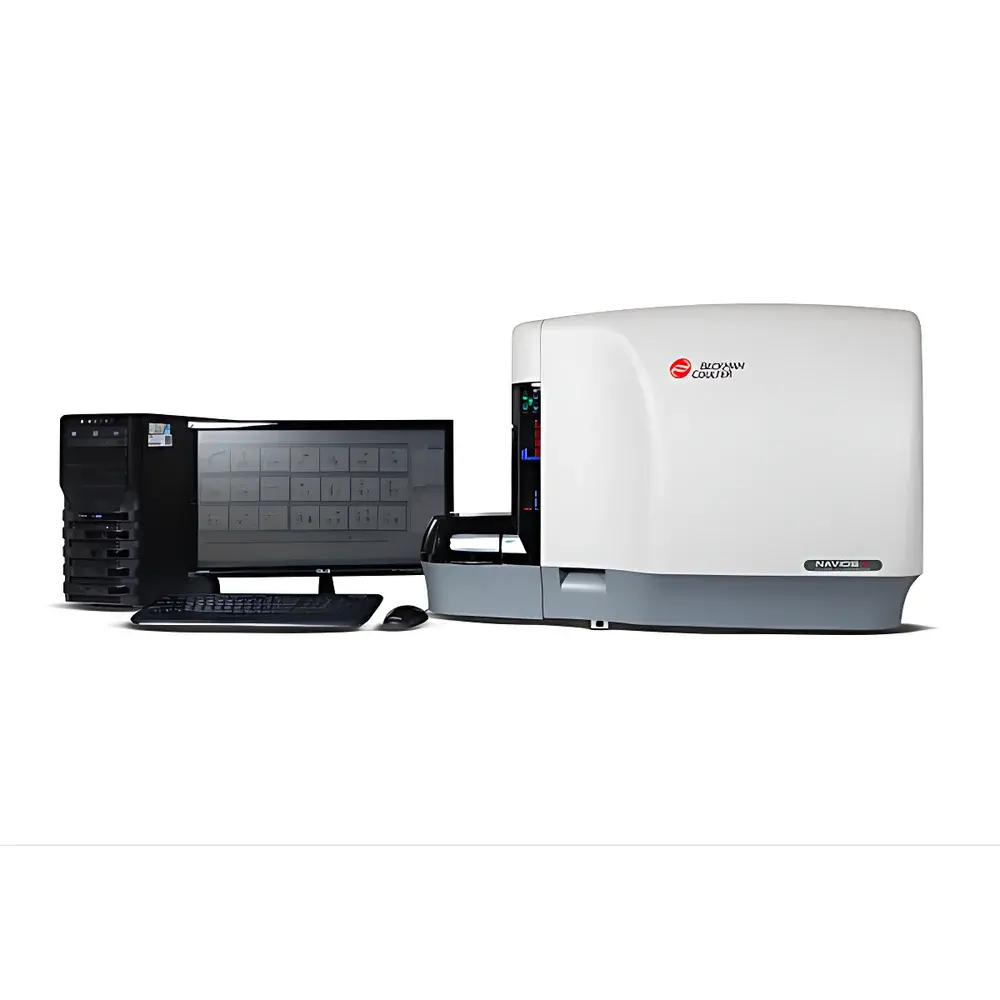
Beckman Coulter Navios EX Spectral Flow Cytometer
| Brand | Beckman Coulter |
|---|---|
| Origin | USA |
| Manufacturer Type | Original Equipment Manufacturer (OEM) |
| Product Category | Imported Instrument |
| Model | Navios EX |
| Technology Platform | Spectral Flow Cytometry |
| Instrument Type | Clinical-Grade Flow Cytometer |
| Laser Configuration | Up to 3 Lasers |
| Detection Channels | 12 |
| Forward Scatter (FSC) Collection Modes | Wide (1–18°), Narrow (1–8°), Wide Enhanced (optimized for submicron particles) |
Overview
The Beckman Coulter Navios EX is a clinical-grade spectral flow cytometer engineered for high-parameter, high-fidelity cell analysis in demanding diagnostic and translational research environments. Unlike conventional filter-based flow cytometers, the Navios EX employs full-spectrum detection—capturing the complete emission profile of each fluorochrome across all photodetectors—and applies real-time spectral unmixing algorithms to resolve overlapping signals with exceptional accuracy. This architecture eliminates compensation errors, enables flexible panel design, and supports robust multi-color immunophenotyping with up to 12 simultaneous parameters. Its optimized optical path, combined with a 20-bit analog-to-digital converter (ADC), delivers a dynamic range of 1,048,576 channels—critical for resolving heterogeneous populations spanning orders of magnitude in fluorescence intensity or granularity, including rare subsets, small extracellular vesicles, and weakly stained progenitor cells.
Key Features
- Spectral Acquisition Architecture: Captures full emission spectra from each event at 40 MHz sampling rate, preserving signal integrity even at high event rates (>30,000 events/sec) without loss of resolution or sensitivity.
- Enhanced Forward Scatter (FSC) Flexibility: Software-selectable FSC collection geometries—Wide (1–18°), Narrow (1–8°), and Wide Enhanced—allow precise optimization for particle size ranges from 0.4 µm (e.g., exosomes, bacterial cells) to >20 µm (e.g., activated lymphocytes, apoptotic bodies).
- High-Fidelity Digital Pulse Processing: Digitizes raw photomultiplier tube (PMT) waveforms prior to peak integration, enabling post-acquisition reanalysis of pulse shape, width, area, and height—essential for doublet discrimination and morphological assessment.
- Clinical-Ready Design: Compliant with IEC 61010-1 safety standards and designed to support 21 CFR Part 11-compliant workflows when integrated with Beckman Coulter’s Kaluza Clinical software and validated instrument qualification protocols.
- Modular Laser Integration: Supports up to three solid-state lasers (e.g., 405 nm, 488 nm, 638 nm) with individually adjustable power output and beam alignment—facilitating long-term stability and reproducible excitation conditions across longitudinal studies.
Sample Compatibility & Compliance
The Navios EX is validated for use with whole blood, bone marrow aspirates, peripheral blood mononuclear cells (PBMCs), cultured cell lines, and purified extracellular vesicle preparations. Its low-noise electronics and optimized fluidics enable reliable detection of submicron particles down to 0.4 µm using calibrated Rainbow calibration beads (SPHERO™). The system meets ISO 13485 requirements for in vitro diagnostic (IVD) device manufacturing and supports GLP/GMP-aligned validation documentation packages—including Installation Qualification (IQ), Operational Qualification (OQ), and Performance Qualification (PQ)—for regulated laboratories. All optical components are factory-aligned and sealed, minimizing maintenance intervals and ensuring inter-laboratory comparability per CLSI EP17-A2 guidelines.
Software & Data Management
Kaluza Analysis 2.x and Kaluza Clinical software provide native support for spectral unmixing, automated compensation-free gating, and batch processing of large-scale clinical trial datasets. Raw FCS 3.1 files retain full spectral data for retrospective reanalysis, while audit trails log all user actions—including gate modifications, parameter transformations, and export events—in accordance with FDA 21 CFR Part 11 requirements. Data export options include CSV, PDF, and image formats compatible with LIMS integration and centralized biobank repositories. Optional cloud-enabled remote monitoring allows IT administrators to track instrument uptime, QC performance, and consumables usage via secure HTTPS endpoints.
Applications
- Clinical immunophenotyping for hematologic malignancy classification (e.g., WHO/ELN guidelines)
- Minimal residual disease (MRD) monitoring in AML, ALL, and multiple myeloma
- Immunomonitoring in vaccine trials and checkpoint inhibitor therapy
- Extracellular vesicle characterization in liquid biopsy development
- Stem/progenitor cell enumeration and functional profiling in regenerative medicine
- Multi-parametric quality control of CAR-T and other advanced therapy medicinal products (ATMPs)
FAQ
Does the Navios EX require daily optical alignment?
No—optical components are factory-aligned and hermetically sealed; routine alignment is not required. Daily QC is performed using standardized Rainbow beads and verified via built-in CV% tracking for PMT voltage stability.
Can I upgrade from a filter-based Navios to the Navios EX?
No—the Navios EX features a fundamentally different detector architecture (spectral vs. filter-based) and is not a field-upgradable variant. It is a distinct platform requiring dedicated installation and training.
Is the Navios EX compatible with third-party reagents and antibodies?
Yes—provided conjugates are spectrally resolvable and validated for use on spectral platforms. Beckman Coulter provides spectral library support for over 200 commercially available fluorochromes, including tandem dyes and polymer dyes.
What regulatory documentation is provided for clinical deployment?
A comprehensive regulatory dossier—including CE-IVD marking (Class B), FDA 510(k) clearance (K201290), and ISO 13485 certification—is supplied with each system, along with IQ/OQ/PQ templates and risk management files compliant with ISO 14971.
How does the Wide Enhanced FSC mode improve detection of submicron particles?
By extending the angular collection range and optimizing PMT gain and threshold settings, Wide Enhanced mode increases signal-to-noise ratio for particles <1 µm—enabling consistent discrimination of 0.4 µm calibration beads from background noise without compromising linearity for larger cells.
Related Products




