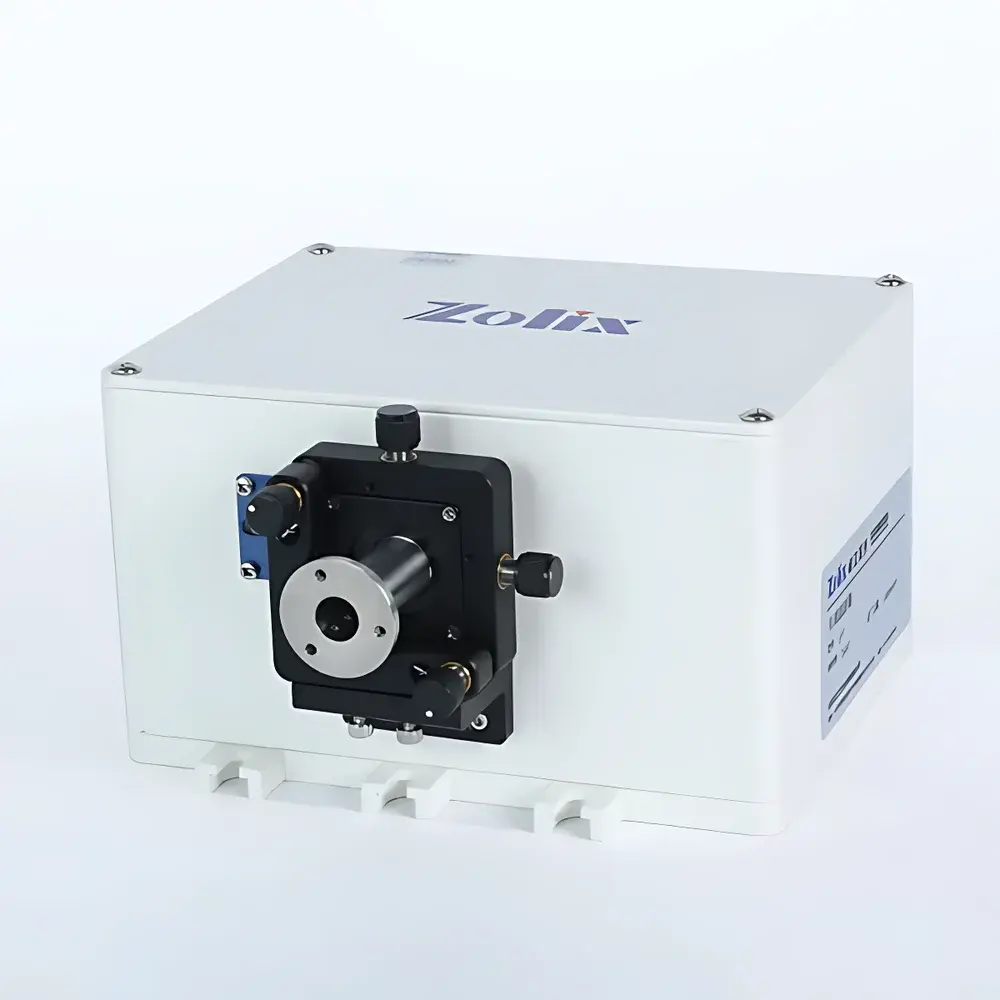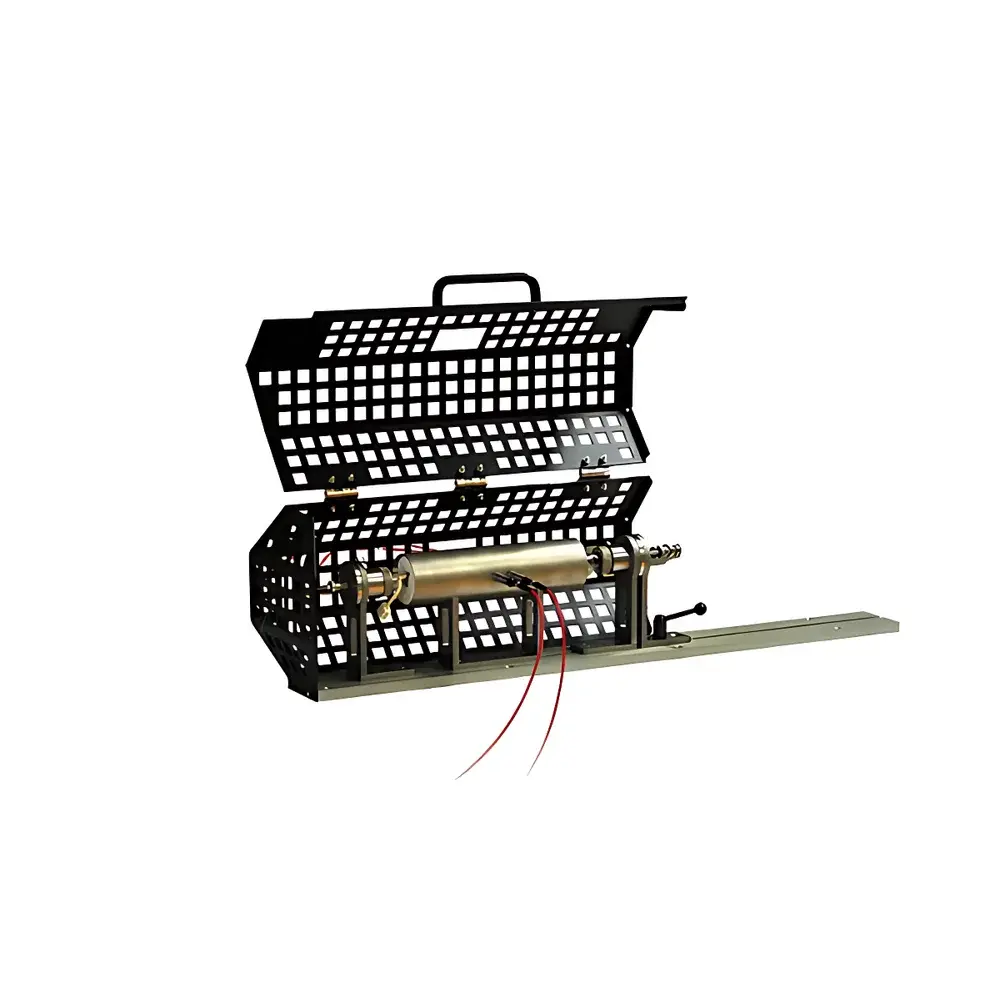
Insplorion X1 Nanoplasmonic Sensor Analyzer
| Brand | Insplorion AB |
|---|---|
| Origin | Sweden |
| Model | X1 |
| Temperature Range | RT to 600 °C |
| Sensor Substrate | Fused Silica (9.5 mm × 9.5 mm × 1 mm) |
| Standard Coating Options | Au, SiO₂, Si₃N₄, TiO₂, Al₂O₃ |
| Optical Readout | Halogen Tungsten Lamp (≥2000 h lifetime) |
| Wavelength Range | 450–1000 nm |
| Measurement Spot Size | ~3 mm diameter circular area |
| Time Resolution | Up to 10 Hz (10 samples/s) |
| Noise Level | < 0.01 nm (in liquid-phase mode: 1 Hz) |
| Gas Inlet/Outlet | 1/8″ and 1/4″ stainless steel or quartz fittings |
| Software | Insplorion NPS Suite (Windows-compatible) |
| Data Output Format | ASCII |
Overview
The Insplorion X1 Nanoplasmonic Sensor Analyzer is an advanced in situ and real-time optical instrumentation platform engineered for high-precision monitoring of nanoscale structural and dielectric changes in thin films, nanostructured materials, and catalytic surfaces under controlled thermal and gaseous environments. Based on nanoplasmonic sensing (NPS) — a label-free, non-invasive optical technique leveraging localized surface plasmon resonance (LSPR) shifts in nanostructured gold transducers — the X1 detects minute refractive index variations at material interfaces with sub-nanometer resolution. Unlike conventional ellipsometry or QCM systems, NPS enables quantitative tracking of adsorption, phase transitions (e.g., glass transition Tg), hydrogenation/dehydrogenation kinetics, and interfacial reaction dynamics without requiring electrical contact or vacuum compatibility. The instrument operates from ambient temperature up to 600 °C at atmospheric pressure, making it uniquely suited for catalysis, energy storage, polymer science, and solid-state reaction studies where environmental control and temporal fidelity are critical.
Key Features
- Dual-channel high-temperature reactor: Two independent sample positions enable parallel comparative measurements — essential for reference-subtracted analysis, reproducibility validation, or multi-condition screening under identical thermal/gas protocols.
- Remote optical architecture: Only the sensor chip enters the reaction chamber; all optics (light source, spectrometer, fiber coupling) remain external. This design eliminates thermal drift in optical alignment and ensures long-term signal stability across extreme temperature ramps.
- Modular sensor platform: Standard 9.5 mm × 9.5 mm fused silica chips feature electron-beam-patterned nanodisk arrays of gold. Optional functional coatings (SiO₂, TiO₂, Al₂O₃, etc.) support tailored surface chemistry for gas-specific interactions or polymer adhesion control.
- High-temp gas handling integration: Equipped with standardized 1/8″ inlet and 1/4″ outlet ports (stainless steel or quartz), the system supports seamless connection to mass flow controllers (MFCs), gas manifolds, and vacuum lines. Full compatibility with Bronkhorst® MFCs enables precise, multi-gas composition control (up to 16 channels).
- Real-time spectroscopic acquisition: Continuous spectral monitoring from 450–1000 nm at up to 10 Hz sampling rate delivers time-resolved LSPR peak position, full width at half maximum (FWHM), and extinction intensity — enabling simultaneous kinetic and thermodynamic parameter extraction.
Sample Compatibility & Compliance
The X1 accommodates a broad range of solid-state and thin-film specimens: metallic nanoparticles (Pd, Mg, Ni), dielectric nanolayers (polymer brushes, metal oxides), supported catalysts, and ultrathin polymer films (<10 nm). Its non-contact, optical readout imposes no electrical or mechanical constraints on sample conductivity, morphology, or substrate rigidity. All hardware components meet CE marking requirements for electromagnetic compatibility (EMC Directive 2014/30/EU) and low-voltage safety (LVD Directive 2014/35/EU). While the X1 itself is not FDA- or ISO-certified as a medical device, its data output format (ASCII) and timestamped metadata structure align with GLP-compliant documentation practices. When integrated into validated laboratory workflows, the system supports audit-ready data provenance for R&D reporting under ISO/IEC 17025 and ASTM E2500-21 guidelines for analytical instrument qualification.
Software & Data Management
The Insplorion NPS Suite is a Windows-native application providing full instrument control, real-time spectral visualization, and post-acquisition multivariate analysis. It supports automated temperature ramping, gas switching sequences, and synchronized MFC triggering. Raw spectra are saved in human-readable ASCII format — directly importable into Python (NumPy/Pandas), MATLAB, Origin, or Igor Pro for custom modeling. Key derived parameters include resonance wavelength shift (Δλ), peak broadening (ΔΓ), and normalized extinction (A/A0). The software includes built-in fitting algorithms for Voigt-profile deconvolution and baseline correction. Audit trail functionality logs user actions, method parameters, and calibration events — supporting traceability requirements under 21 CFR Part 11 when deployed with appropriate IT governance controls (e.g., electronic signatures, role-based access).
Applications
- Hydrogen interaction kinetics: Quantification of size-dependent hydride formation enthalpy and hysteresis in sub-5 nm Pd nanoparticles; single-particle thermodynamics of Mg–H and Pd–H systems under dynamic H2/Ar atmospheres.
- Thin-film glass transition analysis: Thickness-dependent Tg mapping in PMMA films down to 5 nm; size-resolved Tg depression in PS nanoparticles (20–200 nm), correlating mobility gradients with interfacial confinement effects.
- Catalytic surface restructuring: In situ observation of oxide-support interactions during CO oxidation or NOx reduction; detection of transient surface reconstruction preceding steady-state activity.
- Gas-sensing validation: Benchmarking response/recovery times and limit-of-detection (LOD) for H2, NH3, or VOCs on functionalized plasmonic transducers under industrially relevant conditions (T > 300 °C, p = 1 bar).
FAQ
What is the fundamental measurement principle of the X1?
The X1 employs nanoplasmonic sensing (NPS), detecting shifts in the localized surface plasmon resonance (LSPR) wavelength of nanostructured gold transducers induced by local refractive index changes at the sensor surface.
Can the X1 operate under vacuum or reducing atmospheres?
Yes — the reactor is compatible with inert, oxidizing, and reducing gas environments (e.g., H2, CO, NH3) at atmospheric pressure; optional vacuum-rated versions with differential pumping are available upon request.
Is custom sensor chip fabrication supported?
Yes — Insplorion offers bespoke chip designs including alternative nanostructure geometries (nanorings, nanostars), substrate materials (silicon, sapphire), and functional coatings beyond standard options.
How is temperature calibrated and controlled?
An integrated K-type thermocouple mounted adjacent to the sensor position provides closed-loop feedback to a PID-controlled heating element; calibration is traceable to NIST standards via external reference thermometry.
What level of training and technical support is included?
Delivery includes on-site or remote installation, hands-on operation training (4–8 hours), and 12 months of software updates and priority email/phone support — extendable under annual maintenance agreements.