
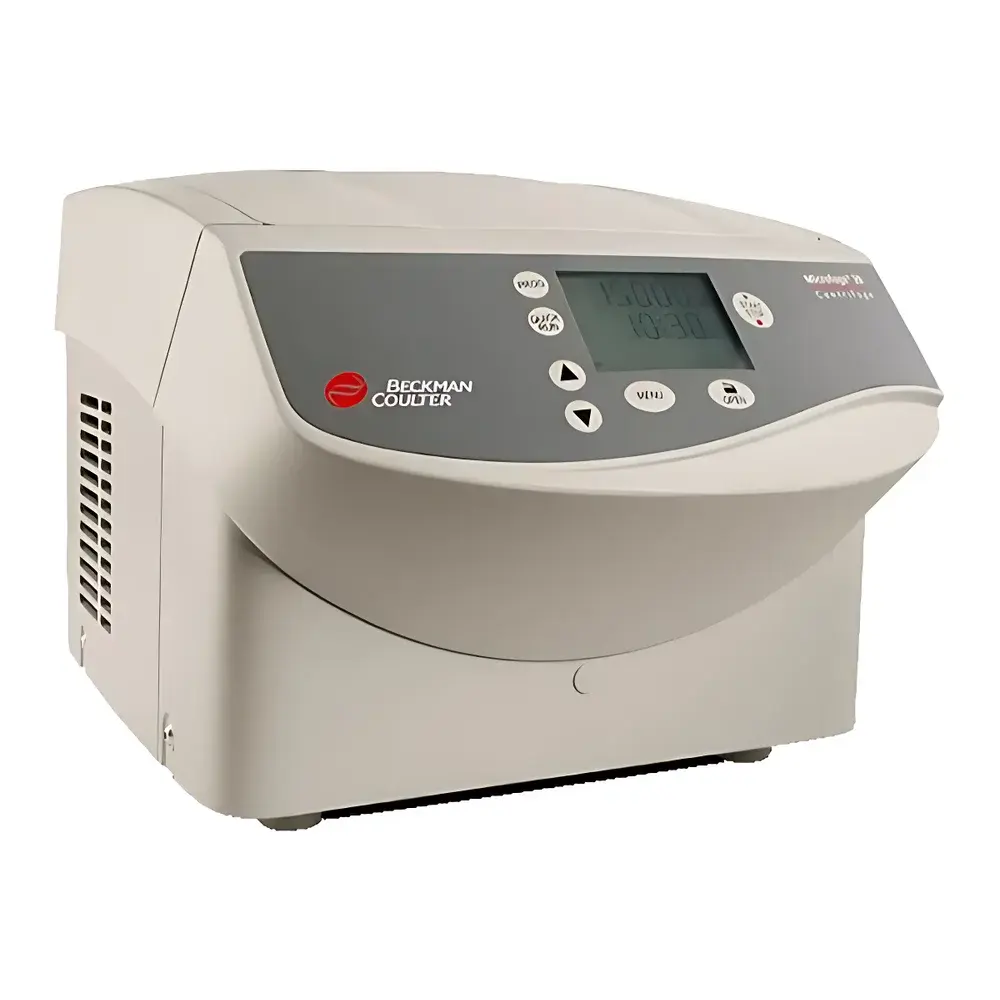
Beckman Coulter Microfuge 20 High-Speed Centrifuge
| Brand | Beckman Coulter |
|---|---|
| Origin | USA |
| Manufacturer | Beckman Coulter, Inc. |
| Type | Benchtop Centrifuge |
| Category | High-Speed Centrifuge (10,000–30,000 rpm) |
| Maximum Speed | 15,000 rpm |
| Maximum RCF | 20,627 × g |
| Maximum Capacity | 36 × 2.0 mL |
| Dimensions (W × D × H) | 31.0 × 42.0 × 27.0 cm |
| Temperature Range | 5–40 °C |
| Speed Accuracy | ±50 rpm |
| Timer Range | 1 s to 99 min 59 s (or continuous) |
| Display | Simultaneous rpm and RCF readout |
| Rotor Compatibility | FA361.5 fixed-angle rotor (standard), plus three additional optional rotors |
Overview
The Beckman Coulter Microfuge 20 High-Speed Centrifuge is an engineered benchtop solution designed for precision separation of biological macromolecules, subcellular components, and particulate matter in research and clinical laboratory environments. Utilizing fixed-angle rotor centrifugation based on sedimentation principles under controlled gravitational force, the Microfuge 20 delivers reproducible pelleting and clarification performance across a wide range of sample types—including nucleic acids, proteins, organelles, bacteria, and cellular debris. Its compact footprint (31.0 × 42.0 × 27.0 cm), combined with a maximum speed of 15,000 rpm and a peak relative centrifugal force (RCF) of 20,627 × g, enables rapid processing of up to 36 × 2.0 mL tubes per run—making it especially suited for high-throughput workflows in molecular biology, biochemistry, and cell culture laboratories. The unit operates within a temperature-controlled environment (5–40 °C), supporting protocols requiring thermal stability without integrated refrigeration; ambient-cooled operation ensures low power consumption and reduced maintenance overhead.
Key Features
- High-speed performance with precise speed control (±50 rpm accuracy) and real-time display of both rotational speed (rpm) and calculated RCF (× g)
- Benchtop form factor optimized for space-constrained labs while maintaining robust mechanical architecture and vibration-dampened operation
- Programmable timer with 1-second resolution (up to 99 min 59 s) and continuous mode for extended runs
- Standard FA361.5 fixed-angle rotor rated for 36 × 2.0 mL microcentrifuge tubes—validated for biosafety Level 2 (BSL-2) handling of potentially hazardous samples
- Three additional rotor options available (including swing-bucket and specialized angle rotors), enabling method flexibility across diverse sample volumes and densities
- User-defined protocol storage simplifies repeat applications such as DNA precipitation, protein pellet recovery, or bacterial harvest—reducing setup time and operator variability
- Intuitive front-panel interface with dual-parameter readout and tactile feedback controls minimizes training requirements and supports GLP-compliant documentation practices
Sample Compatibility & Compliance
The Microfuge 20 accommodates standard polypropylene and polyethylene microcentrifuge tubes (0.2–2.0 mL), PCR strips, and skirted plates compatible with FA-series rotors. It supports common biochemical buffers (e.g., Tris-HCl, PBS, guanidinium thiocyanate), organic solvents used in nucleic acid extraction (e.g., phenol-chloroform), and viscous lysates containing detergents or glycerol. While not a Class II biosafety cabinet-integrated system, its sealed rotor design and certified FA361.5 rotor meet IEC 61010-1 safety standards for laboratory equipment. The instrument complies with electromagnetic compatibility (EMC) directives (EN 61326-1) and is CE-marked for use in EU-regulated laboratories. For regulated environments, audit trails may be generated via external logging when paired with validated LIMS interfaces.
Software & Data Management
The Microfuge 20 operates as a standalone instrument with no embedded operating system or network connectivity. All operational parameters—including speed, time, and RCF—are set locally and retained in non-volatile memory for up to five user programs. While it does not support FDA 21 CFR Part 11 electronic signatures or built-in data export, its deterministic behavior, calibrated speed accuracy, and traceable rotor identification enable integration into quality systems requiring documented parameter verification. Laboratories implementing ISO/IEC 17025 or CLIA protocols routinely validate rotor-specific run logs using external timestamped notebooks or connected lab management software.
Applications
- Nucleic acid purification: rapid pelleting of ethanol-precipitated DNA/RNA from aqueous phases
- Protein fractionation: isolation of insoluble inclusion bodies or membrane-associated fractions
- Cellular subfractionation: differential centrifugation steps for mitochondria, nuclei, or lysosomal enrichment
- Microbial processing: harvesting of bacterial or yeast cultures prior to lysis or plasmid extraction
- Clinical specimen preparation: serum separation from whole blood in diagnostic workflows (when used with appropriate tube types)
- Small-volume phase separation: recovery of organic-aqueous interface layers in lipid or metabolite extractions
FAQ
Is the Microfuge 20 suitable for GMP-regulated production environments?
It is intended for R&D and QC testing—not for direct use in cGMP manufacturing processes—due to lack of electronic recordkeeping and automated calibration reporting.
Can the Microfuge 20 accommodate 0.5 mL tubes?
Yes, when used with compatible adapters in the FA361.5 rotor or alternative rotors specified in the Beckman Coulter rotor compatibility matrix.
What maintenance intervals are recommended?
Routine cleaning of the chamber and rotor seating surfaces is advised after each use; full preventive maintenance—including bearing inspection and speed calibration—is recommended annually or after 1,000 runs, whichever occurs first.
Does the unit include rotor imbalance detection?
No. The Microfuge 20 relies on proper manual loading and rotor balancing per manufacturer guidelines; it does not feature active imbalance sensing or automatic shutdown.
Is rotor lifetime tracked by the instrument?
No. Rotor usage must be manually logged per Beckman Coulter’s rotor life policy (typically defined by cumulative run hours and maximum speed history), which is required for compliance with ISO 13485 and similar quality frameworks.



