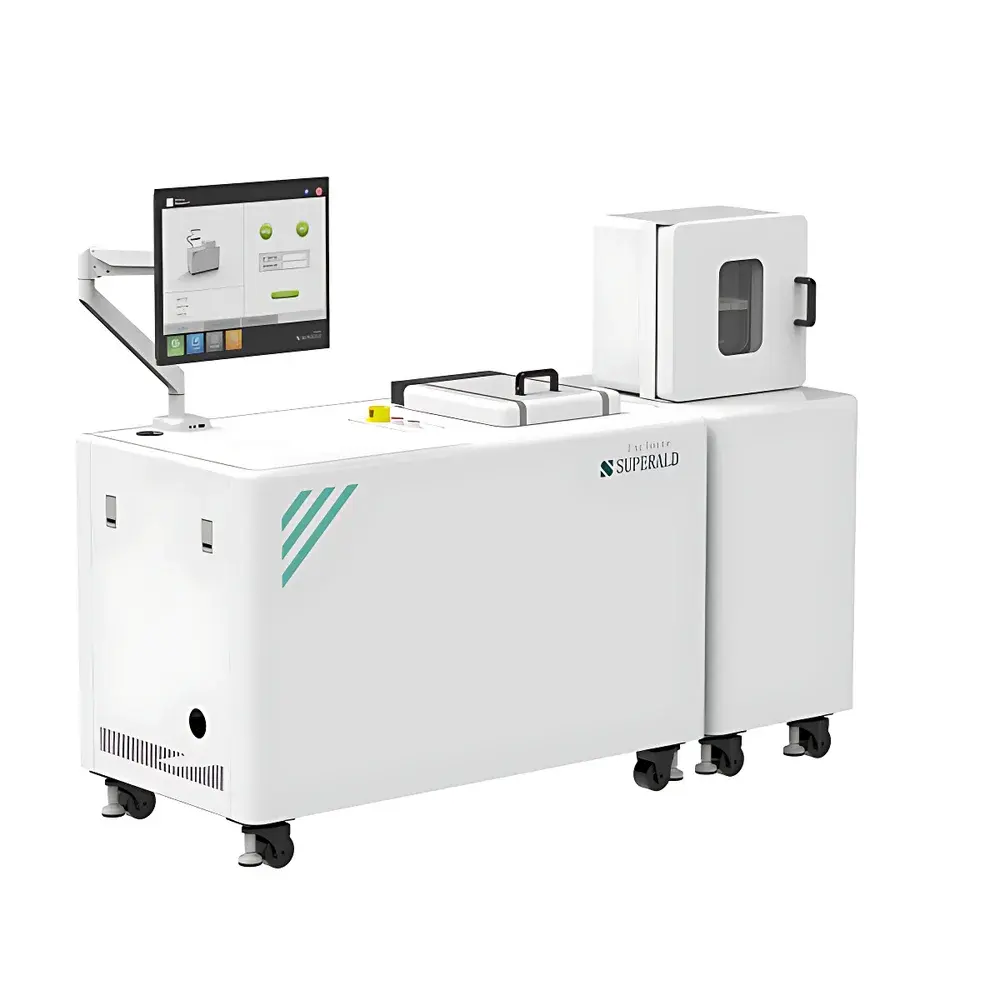
SUPERALD PA Series Powder-Encapsulating Atomic Layer Deposition System
| Brand | SUPERALD |
|---|---|
| Origin | Guangdong, China |
| Manufacturer Type | Authorized Distributor |
| Product Origin | Domestic (China) |
| Model | PA Series |
| Process Temperature Range | RT to 450°C |
| Precursor Channels | Up to 4 (customizable), supporting solid & liquid precursors |
| Reactant Channels | 2 (customizable) |
| Carrier Gas | N₂ with MFC flow control (customizable) |
| Pressure Monitoring | Triple corrosion-resistant capacitance manometers, 0.005–1000 Torr |
| Base Vacuum | <5×10⁻³ Torr |
| Heating Zone Temperature Range | RT to 150°C |
Overview
The SUPERALD PA Series Powder-Encapsulating Atomic Layer Deposition (ALD) System is an engineered solution for conformal, atomic-scale thin-film synthesis on high-surface-area particulate substrates—including nanoparticles, microspheres, porous powders, and granular catalyst supports. Unlike planar-substrate ALD tools, the PA Series integrates a fluidized or vibrated powder chamber with precisely synchronized pulsing of gaseous and vaporized precursors, enabling uniform surface saturation and self-limiting chemisorption across complex three-dimensional particle morphologies. The system operates on the fundamental principle of sequential, non-overlapping surface reactions—each ALD cycle deposits one monolayer via saturative adsorption followed by purge and reaction steps—ensuring sub-nanometer thickness control, exceptional film uniformity (<±1.5% across gram-scale batches), and near-perfect step coverage even on particles with aspect ratios exceeding 100:1. Designed for semiconductor-grade process reproducibility, it meets the stringent requirements of advanced packaging, battery electrode engineering, and heterogeneous catalysis development.
Key Features
- Gram-scale powder processing chamber with programmable fluidization/vibration control to ensure continuous particle exposure and minimize agglomeration.
- Dual-zone thermal management: independent heating of precursor sources (RT–150°C) and reactor chamber (RT–450°C), with ±0.5°C stability over 24 h.
- Modular precursor delivery: up to four chemically isolated, temperature-controlled lines accommodating solid (sublimation-heated), liquid (bubbler + carrier gas), and gaseous precursors—with integrated leak-tight valves and real-time vapor pressure monitoring.
- Corrosion-resistant vacuum architecture: triple capacitance manometer array (0.005–1000 Torr range) enables accurate pressure profiling during purge and reaction phases; base vacuum <5×10⁻³ Torr achieved with standard oil-sealed rotary vane pump.
- Industrial-grade control platform: 19-inch touchscreen HMI, Windows 7 embedded OS, PLC-based real-time logic controller with EtherCAT fieldbus integration, supporting deterministic multi-task scheduling and audit-trail logging.
- One-touch deposition workflow: automated sequence execution covering pump-down, bake-out, temperature ramp, ALD cycling, cooldown, and vent—fully configurable per recipe with interlocked safety validation at each stage.
Sample Compatibility & Compliance
The PA Series accommodates a broad spectrum of powder substrates: metal oxides (e.g., SiO₂, TiO₂, Al₂O₃ nanoparticles), carbon blacks, MOFs, zeolites, LiCoO₂/LiFePO₄ cathode powders, silicon anode particles, and polymer microspheres. All wetted components are electropolished stainless steel or PFA-lined to resist halide- and oxygen-sensitive chemistries (e.g., TMA, TEMAHf, O₃, NH₃). The system complies with CE machinery directive (2006/42/EC) and electromagnetic compatibility (2014/30/EU); vacuum and gas handling subsystems conform to ISO 2852 (hygienic clamp connections) and SEMI S2-0215 (safety guidelines for semiconductor equipment). For regulated environments, optional 21 CFR Part 11-compliant electronic signatures, audit trail archiving, and role-based access control (RBAC) are available.
Software & Data Management
The SUPERALD Control Suite provides full lifecycle process management: recipe creation with cycle-by-cycle parameter definition (pulse time, dwell time, purge duration, temperature setpoints), historical data export in CSV/SQLite format, and trend analysis for film growth rate, chamber pressure transients, and precursor consumption. All operational events—including valve actuation, temperature deviations >±2°C, vacuum faults, and user login/logout—are timestamped and stored with SHA-256 hash integrity verification. The software supports GLP/GMP-aligned documentation: electronic batch records (EBR), deviation reporting, and change control logs. Remote diagnostics via secure VPN and OPC UA server integration enable seamless connection to MES/SCADA systems.
Applications
- Nanomaterial Functionalization: Conformal Al₂O₃, TiO₂, or ZrO₂ encapsulation of quantum dots and plasmonic nanoparticles for enhanced environmental stability and controlled release kinetics.
- Battery Electrode Engineering: Atomic-layer coating of LiNiMnCoO₂ (NMC) cathodes with Li₃PO₄ or AlF₃ to suppress transition-metal dissolution; Si anode passivation with TiN to mitigate SEI instability and dendrite nucleation.
- Heterogeneous Catalysis: Site-isolated single-atom catalysts (e.g., Pt₁/Al₂O₃) and bimetallic core-shell nanoparticles (e.g., Pd@Ru) synthesized via sequential ALD with sub-monolayer precision.
- Biomedical Powders: Low-temperature (<120°C) deposition of biocompatible TiN, ZrN, or TaN on drug carrier microparticles for moisture barrier protection and controlled dissolution profiles.
- Optoelectronic Pigments: Surface passivation of phosphor powders (e.g., YAG:Ce) with Al₂O₃ to reduce surface quenching and improve quantum yield under UV excitation.
FAQ
What powder morphologies are compatible with the PA Series?
Spherical, irregular, porous, and aggregated particles ranging from 10 nm to 500 µm are supported—provided bulk density allows effective fluidization or mechanical agitation without sintering.
Can the system handle air-sensitive precursors such as alkyl metals?
Yes—optional glovebox integration (O₂/H₂O <0.1 ppm) and inert-gas purged precursor transfer lines enable safe handling of pyrophoric and hydrolytically unstable compounds.
Is remote monitoring and recipe synchronization across multiple units possible?
Yes—the control suite supports centralized recipe database management via SQL Server and real-time status polling through RESTful API endpoints.
How is film thickness uniformity verified on powder samples?
Cross-sectional TEM of embedded particles, XPS depth profiling, and BET surface area reduction analysis are recommended validation methods; in situ quartz crystal microbalance (QCM) is available as an add-on module.
Does the system support in situ plasma enhancement?
Plasma-assisted ALD (PE-ALD) is supported via optional RF (13.56 MHz) or microwave (2.45 GHz) source integration with impedance-matched chamber coupling and pulsed bias control.
Related Products