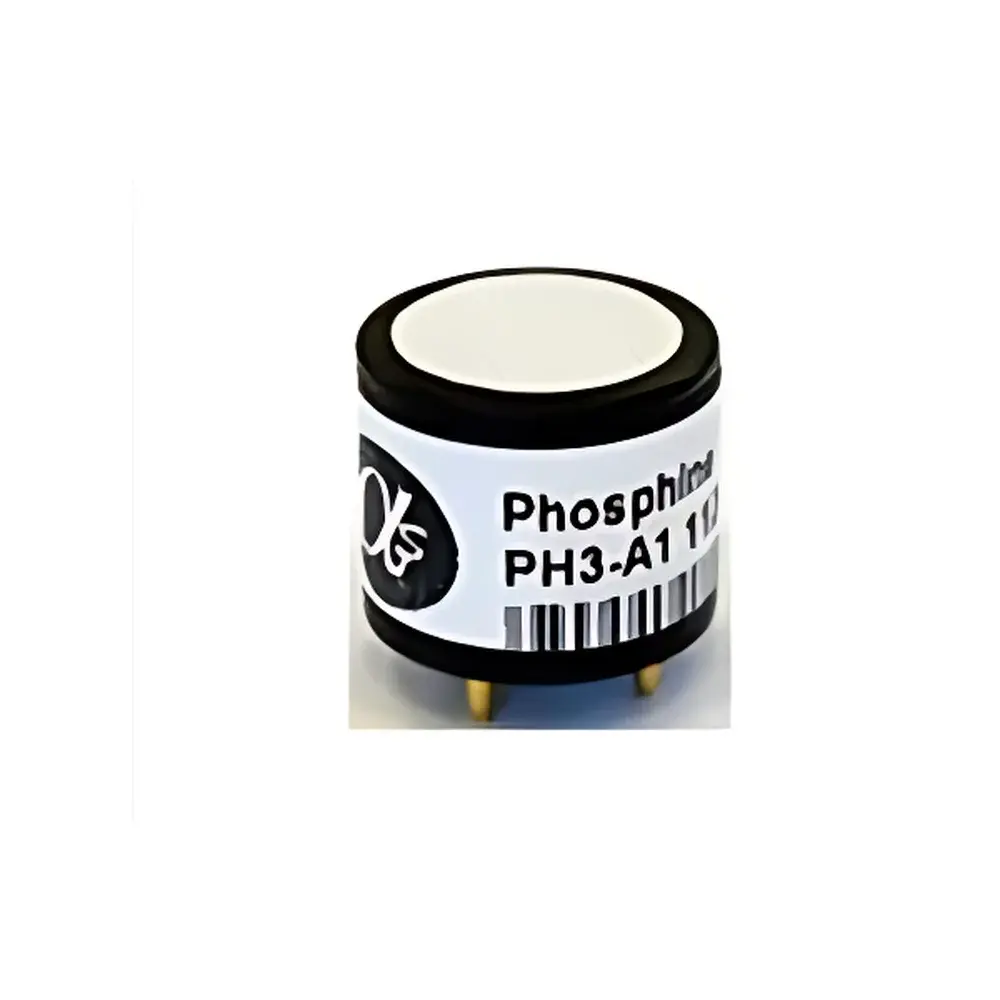
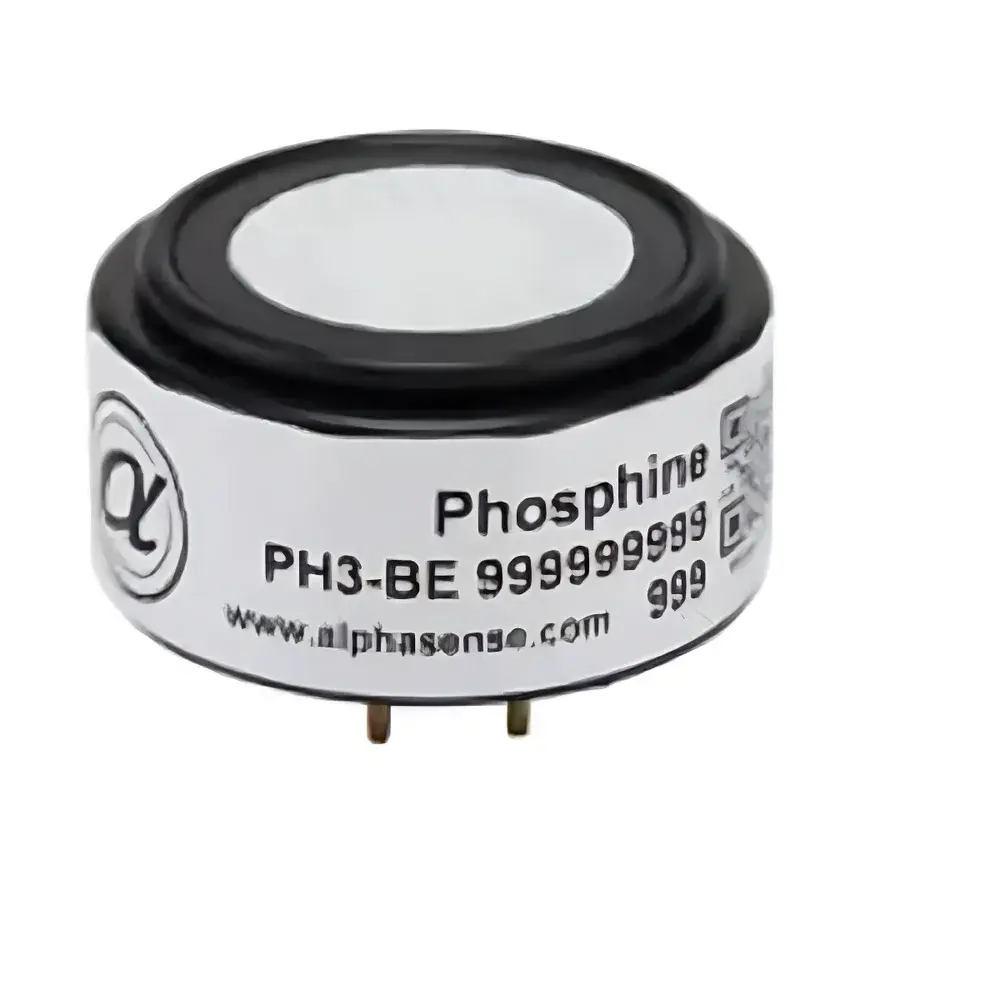
Alphasense PH3-BE Phosphine (PH₃) Electrochemical Gas Sensor
| Brand | Alphasense |
|---|---|
| Origin | UK |
| Model | PH3-BE |
| Measurement Principle | Electrochemical |
| Detection Range | 0–2000 ppm |
| Sensitivity | 15–25 nA/ppm |
| Response Time (t₉₀) | <25 s |
| Linear Range | –50 to –350 ppm (zero-based calibration context) |
| Overload Capacity | 5000 ppm |
| Resolution | 2 ppm |
| Dimensions | Ø32.3 × 16.5 mm |
| Operating Temperature | –20 to +50 °C |
| Operating Humidity | 20–90 % RH (non-condensing) |
| Load Resistance | 10–33 Ω |
| Expected Service Life | 24 months |
| Storage Shelf Life | 6 months |
Overview
The Alphasense PH3-BE is a high-stability, diffusion-type electrochemical gas sensor engineered for the selective detection of phosphine (PH₃) in ambient air and industrial process environments. Based on a three-electrode electrochemical cell architecture, it operates via controlled oxidation of phosphine at the working electrode, generating a current proportional to gas concentration. This principle ensures high specificity to PH₃ while minimizing cross-sensitivity to common interferents such as CO, H₂S, SO₂, and NO₂—critical for applications in fumigation monitoring, grain storage safety, semiconductor fabrication facilities, and confined-space entry programs. The sensor features a hydrophobic PTFE membrane that regulates gas diffusion, enhances long-term baseline stability, and provides inherent protection against particulate contamination and condensation. Its compact cylindrical form factor (Ø32.3 × 16.5 mm) enables seamless integration into portable detectors, fixed-gas monitoring systems, and OEM instrumentation platforms compliant with IEC 61000-6-2/6-3 and EN 50104 standards.
Key Features
- Electrochemical transduction with integrated temperature compensation circuitry for stable output across –20 °C to +50 °C
- Typical sensitivity of 20 ± 5 nA/ppm under standard conditions (20 °C, 50 % RH), traceable to NIST-traceable calibration gases
- Fast t₉₀ response time ≤25 seconds—enabling real-time exposure assessment in occupational health scenarios
- Robust mechanical design with gold-plated contacts and epoxy-sealed housing rated IP54 for field durability
- Linear output over the –50 to –350 ppm range relative to zero reference; full-scale span calibrated to 2000 ppm
- Maximum overload tolerance of 5000 ppm for transient exposure without permanent performance degradation
- Resolution of 2 ppm supports compliance with OSHA PEL (0.3 ppm TWA) and ACGIH TLV (0.4 ppm TWA) when used in validated instrument configurations
Sample Compatibility & Compliance
The PH3-BE is optimized for use in clean, non-corrosive air matrices. It is not recommended for continuous operation in environments containing >10 ppm chlorine, ozone, or strong oxidizing acids, which may accelerate electrolyte depletion. For regulatory alignment, the sensor meets the functional requirements of EN 45544-1 (electrochemical sensors for workplace monitoring) and supports system-level compliance with ISO 16000-23 (indoor air—determination of phosphine). When integrated into certified instruments, it contributes to adherence with OSHA 29 CFR 1910.120 (HAZWOPER), EU Directive 2017/164 (indicative occupational exposure limit values), and IECEx/ATEX Zone 1/21 system certifications (dependent on host enclosure rating). Calibration must be performed using certified PH₃ standard gas (e.g., nitrogen-balanced, ±2 % uncertainty) per ISO 12032.
Software & Data Management
As a raw analog output device (current loop, typically 0–200 nA), the PH3-BE requires external signal conditioning—including low-noise transimpedance amplification, cold-junction compensation, and digital conversion—to generate calibrated concentration data. When interfaced with Alphasense’s AS-MD series interface modules or third-party DAQ systems supporting 24-bit ADC resolution, it enables timestamped logging with audit-trail capability. Firmware-integrated diagnostics (e.g., end-of-life flagging, zero-drift trending, and impedance monitoring) support predictive maintenance scheduling in accordance with ISO/IEC 17025 quality management requirements. Data export formats (CSV, Modbus RTU/TCP) facilitate integration into SCADA, LIMS, and EHS platforms compliant with FDA 21 CFR Part 11 for electronic records and signatures.
Applications
- Real-time phosphine monitoring during structural fumigation of grain silos, shipping containers, and warehouse facilities
- Personal exposure assessment for pest control operators using handheld multi-gas detectors
- Leak detection and area monitoring in semiconductor manufacturing cleanrooms where PH₃ is used as a dopant source
- Environmental monitoring near landfill sites and wastewater treatment plants where anaerobic decomposition may generate PH₃
- OEM integration into automated ventilation control systems triggered by threshold exceedance (e.g., >0.3 ppm)
- Research-grade quantification in atmospheric chemistry studies requiring sub-ppm resolution and long-term drift stability
FAQ
What is the recommended calibration frequency for the PH3-BE sensor?
Calibration is advised before each day’s use in critical applications (e.g., fumigation), or at minimum every 30 days for fixed installations, using certified 10 ppm PH₃ standard gas. Zero calibration should be performed in certified zero air.
Can the PH3-BE operate in high-humidity environments?
Yes—within 20–90 % RH non-condensing. Prolonged exposure above 90 % RH may cause temporary signal suppression due to membrane saturation; recovery is typically complete within 1 hour after return to nominal humidity.
Does the sensor require a bias voltage or external power supply?
No. The PH3-BE is a passive electrochemical cell requiring only a load resistor (10–33 Ω) and a virtual-ground amplifier. No external bias or heating elements are needed.
How does temperature affect measurement accuracy?
The built-in thermistor enables software-based compensation. Uncorrected drift is approximately ±0.15 %/°C; with compensation, total error remains within ±3 % FS across the full operating range.
Is the PH3-BE compatible with PID or MOS-based detector platforms?
No—it is designed exclusively for electrochemical signal chains. Integration with PID or metal-oxide platforms would require hardware redesign and invalidate performance specifications.