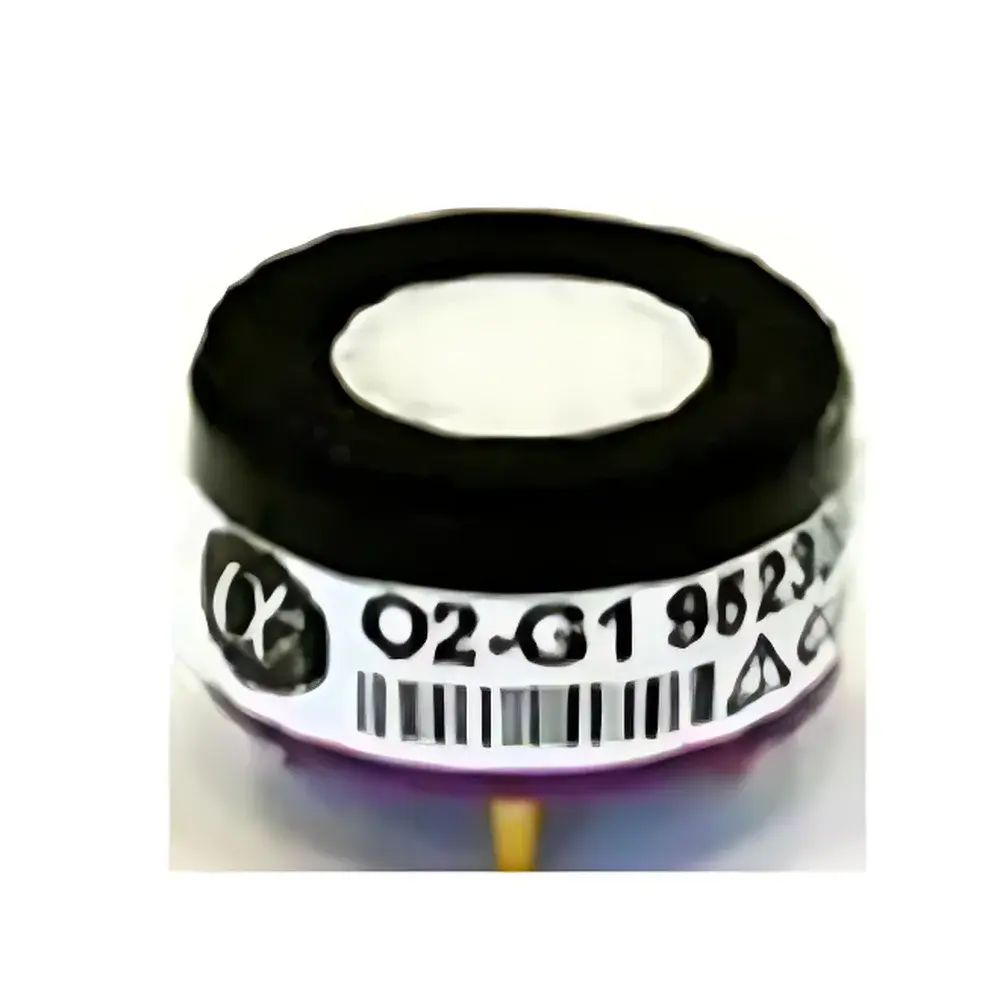
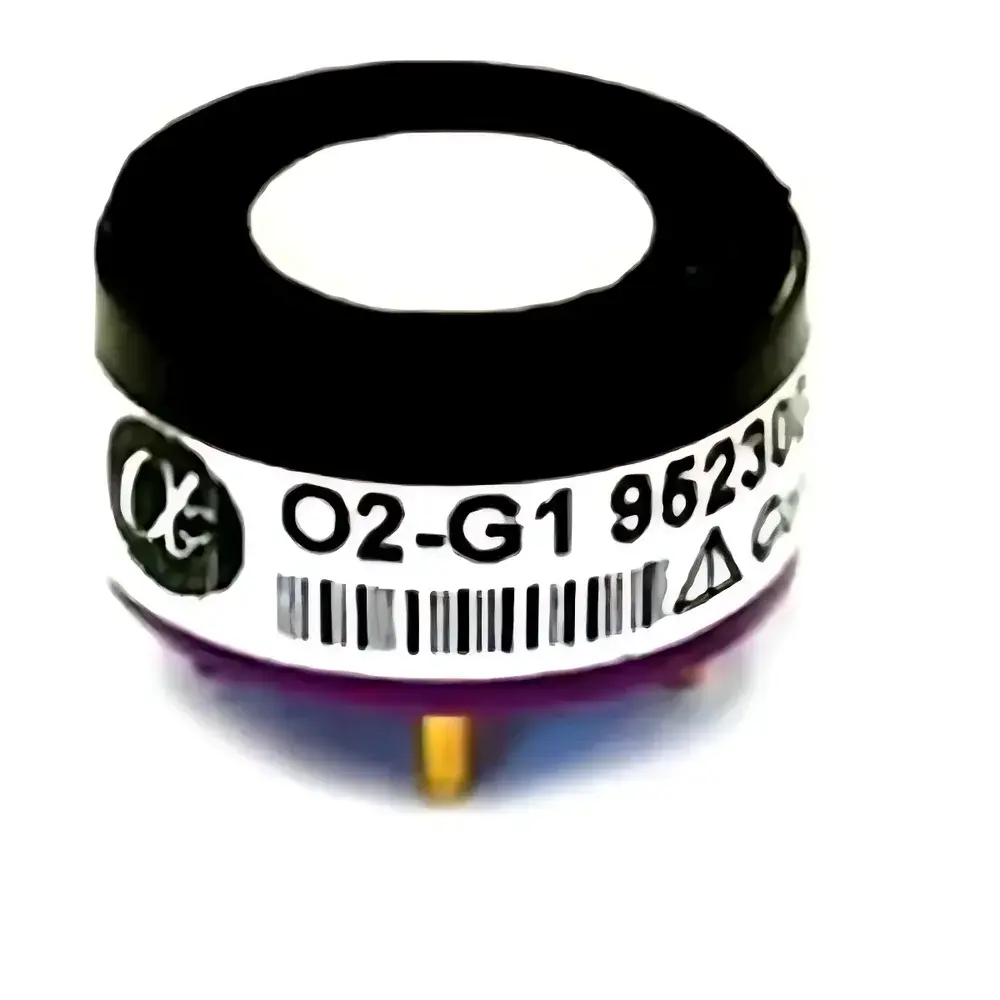
Alphasense O2-G1 Miniature Electrochemical Oxygen Sensor
| Brand | Alphasense (UK) |
|---|---|
| Origin | United Kingdom |
| Model | O2-G1 (Miniature) |
| Measurement Range | 0–30% O₂ |
| Operating Lifetime | >12 months |
| Dimensions | Φ20.3 × 10.2 mm |
| Output Current | 65–85 µA @ 22°C, 20.9% O₂ |
| Response Time (t₉₀) | <18 s |
| Weight | <7 g |
| Operating Temperature | −30 to +55°C |
| Pressure Range | 80–120 kPa |
| Humidity Range | 5–95% RH (non-condensing) |
| Storage Life | 6 months |
| Load Resistance | 47–100 Ω |
Overview
The Alphasense O2-G1 is a miniature, high-stability electrochemical oxygen sensor engineered for reliable, low-power detection of molecular oxygen (O₂) in ambient and process gas streams. Based on the principle of galvanic cell electrochemistry, the sensor generates a current proportional to the partial pressure of O₂ diffusing through a selective hydrophobic membrane into an aqueous electrolyte. This diffusion-limited current is linearly related to O₂ concentration across its full 0–30% vol range, enabling precise quantification without external power supply—ideal for battery-operated or intrinsically safe instrumentation. Its compact cylindrical form factor (Φ20.3 × 10.2 mm) and sub-7 g mass support integration into space-constrained devices including portable gas detectors, fixed-point safety monitors, and embedded environmental analyzers.
Key Features
- Galvanic operation: Self-powered design eliminates need for external bias voltage, reducing system complexity and power consumption.
- Stable baseline & low drift: Optimized electrode composition and sealed electrolyte formulation ensure long-term zero stability and minimal sensitivity decay over >12 months of continuous operation.
- Rapid response: t₉₀ <18 seconds under standard conditions (22°C, 101.3 kPa), facilitating real-time monitoring in dynamic environments such as confined-space entry or combustion control loops.
- Wide environmental tolerance: Certified performance across −30 to +55°C and 80–120 kPa absolute pressure; suitable for outdoor deployment, industrial enclosures, and mobile platforms.
- Robust humidity resilience: Functional across 5–95% RH (non-condensing), with integrated hydrophobic barrier minimizing electrolyte evaporation and cross-sensitivity to water vapor.
- Controlled load interface: Designed for direct connection to 47–100 Ω load resistors, enabling straightforward analog signal conditioning and ADC interfacing in OEM instrumentation.
Sample Compatibility & Compliance
The O2-G1 is intended for measurement of O₂ in clean, non-corrosive gas matrices—including air, nitrogen, argon, and inert carrier gases. It is not recommended for use in strongly acidic, alkaline, or solvent-saturated atmospheres, nor in environments containing high concentrations of CO₂, H₂S, or Cl₂, which may accelerate electrolyte depletion or membrane fouling. The sensor complies with RoHS 2011/65/EU and REACH (EC) No. 1907/2006 requirements. While not intrinsically certified as a complete assembly, its construction supports integration into ATEX Zone 1/21 or IECEx-certified instruments when housed in appropriate explosion-proof enclosures per EN 60079-0 and EN 60079-26.
Software & Data Management
As a passive analog transducer, the O2-G1 outputs a linear current signal requiring external signal conditioning. When integrated into host systems compliant with ISO/IEC 17025 or FDA 21 CFR Part 11, calibration data—including date-stamped span/zero verification, temperature-compensated slope coefficients, and sensor serial traceability—must be recorded in secure, audit-ready formats. Alphasense provides NIST-traceable calibration certificates upon request, supporting GLP/GMP documentation workflows. OEMs commonly implement digital compensation algorithms using onboard temperature sensors (e.g., PT1000 or thermistor) to correct for thermal drift per ISO 12032:2020 guidelines for electrochemical gas sensors.
Applications
- Fixed and portable oxygen deficiency/enrichment alarms in mining, tunneling, and confined-space entry systems
- Process oxygen monitoring in inert gas blanketing (e.g., food packaging, pharmaceutical drying)
- Medical device integration: anesthesia gas analyzers, ventilator O₂ feedback control, and hyperbaric chamber monitoring
- Environmental chambers and controlled-atmosphere storage facilities
- Combustion efficiency analysis in boiler and furnace management systems
- Research-grade atmospheric profiling in unmanned aerial vehicles (UAVs) and ground-based micro-stations
FAQ
What is the recommended calibration frequency for the O2-G1 in continuous operation?
Calibration should be performed at installation and repeated at intervals not exceeding 6 months—or more frequently if exposed to extreme temperature cycling, condensation events, or known contaminant exposure.
Can the O2-G1 be used in high-CO₂ environments such as fermentation or biogas applications?
No. Elevated CO₂ (>5%) accelerates electrolyte carbonate formation, leading to irreversible sensitivity loss and shortened service life. Alternative paramagnetic or zirconia-based sensors are advised for such applications.
Is temperature compensation mandatory for accurate readings?
Yes. Sensitivity varies by approximately −0.2%/°C near room temperature; omission of compensation introduces systematic error exceeding ±2% FS across the operational range.
How should unused O2-G1 sensors be stored?
Store upright in original sealed packaging at 20–25°C and 30–60% RH. Do not refrigerate or freeze. Shelf life is guaranteed for 6 months from date of manufacture when stored per Alphasense Technical Note TN-004.
Does the O2-G1 require a warm-up period before stable output?
No. Galvanic sensors exhibit immediate output upon exposure to O₂; however, mechanical stabilization (e.g., mounting stress relaxation) may require up to 30 minutes after physical installation before final zero stabilization.