
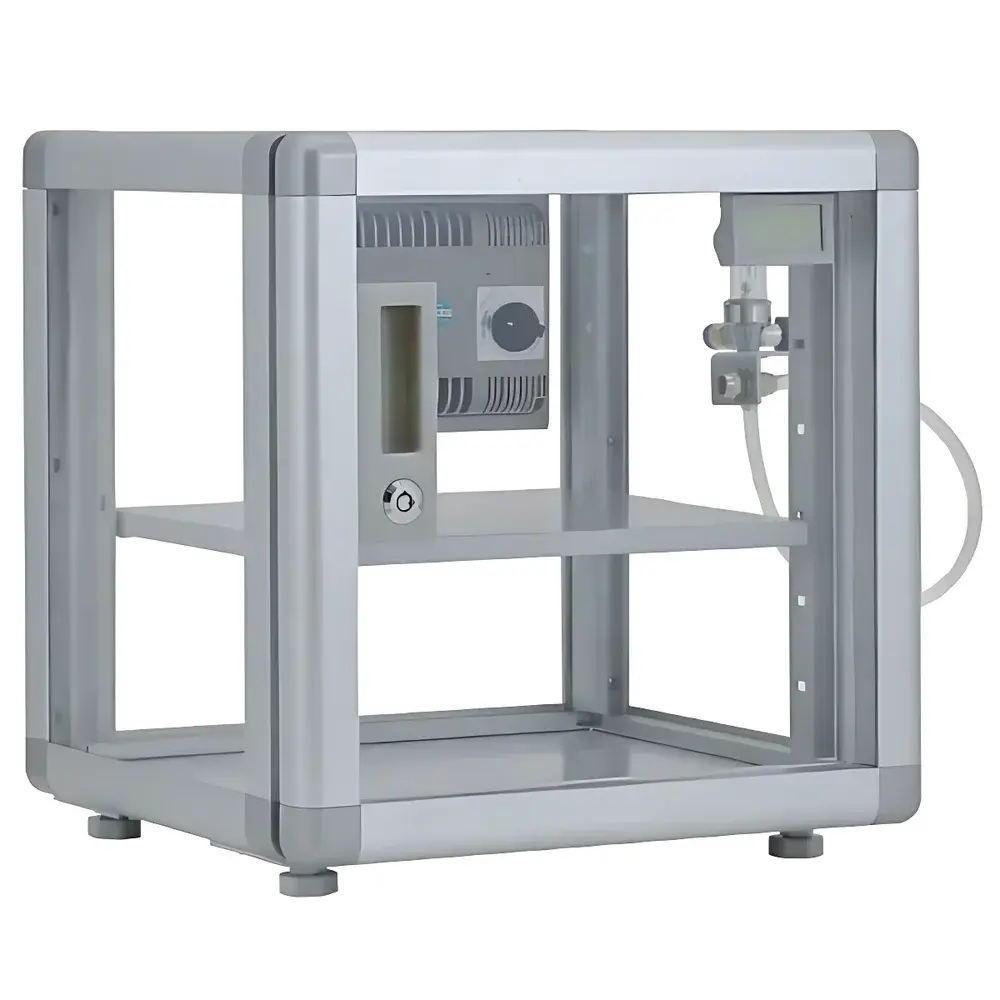
Totech SDA Series Acrylic Desiccator Cabinet
| Brand | Totech |
|---|---|
| Origin | Japan |
| Model | SDA-800S / SDA-400S / SDA-200S / SDA-050S / SDA-070S |
| Humidity Control | 3% RH or 20% RH |
| Construction | Aluminum Frame + Acrylic Body |
| Shelf Material | Stainless Steel (ESD-Safe) |
| Optional | Digital Humidity Display Panel |
| Application | Laboratory & Academic Research Environments |
| Compliance | Designed for ISO/IEC 17025-aligned storage conditions |
Overview
The Totech SDA Series Acrylic Desiccator Cabinet is an engineered solution for precision moisture-sensitive material storage in controlled laboratory and academic environments. Built upon over five decades of humidity control expertise since Totech’s founding in 1974, this series leverages nitrogen-purged desiccation technology to maintain stable low-humidity atmospheres—either at 3% RH or 20% RH—without requiring continuous external nitrogen supply in standard operation. The cabinet operates on a closed-loop purge-and-recirculation principle, integrating a high-efficiency desiccant module with pressure-regulated inert gas management. Unlike conventional silica-gel cabinets, the SDA series achieves long-term RH stability through active humidity sensing and adaptive purge cycling, minimizing nitrogen consumption while ensuring repeatability across daily operational cycles. Its transparent acrylic construction enables real-time visual monitoring of stored samples without compromising environmental integrity—a critical requirement for wafer handling, calibration standards, hygroscopic reference materials, and pre-weighing protocols in analytical chemistry labs.
Key Features
- Precision humidity control at two user-selectable setpoints: 3% RH (ultra-dry) or 20% RH (moderate dry), each maintained with ±1.5% RH stability under steady-state conditions.
- Structural integration of lightweight yet rigid aluminum extrusion framing with optically clear, impact-resistant acrylic panels—enabling full sample visibility without UV degradation or static accumulation.
- ESD-safe stainless steel shelving with grounded conductive coating (surface resistivity <1×10⁶ Ω/sq), certified per ANSI/ESD S20.20 for electrostatic discharge protection during semiconductor component or PCB storage.
- Modular design supports rapid disassembly and reconfiguration: all panels detach via tool-free cam-lock fasteners; no adhesives or permanent seals are used, facilitating cleaning, maintenance, and ISO-compliant decontamination.
- Optional digital panel interface provides real-time RH readout, purge cycle status, desiccant saturation alert, and configurable alarm thresholds—logging data via RS-232 output for integration into lab-wide environmental monitoring systems.
- No internal fans or moving parts within the storage chamber—eliminating turbulence-induced particle generation and ensuring laminar, contamination-minimized airflow for Class 1000 cleanroom-compatible use.
Sample Compatibility & Compliance
The SDA series accommodates a broad range of moisture-sensitive specimens including but not limited to: silicon wafers, thin-film sensors, lithium-ion battery electrode materials, pharmaceutical reference standards (per USP ), NIST-traceable hygrometric artifacts, and optical calibration filters. All models comply with mechanical safety requirements per IEC 61010-1 and electromagnetic compatibility standards per EN 61326-1. While not classified as medical devices, the cabinets support GLP and GMP-aligned storage workflows when deployed with documented environmental monitoring procedures. Their passive nitrogen conservation architecture reduces dependency on high-purity gas infrastructure, making them suitable for facilities operating under ISO/IEC 17025 Clause 5.9 (environmental conditions for testing and calibration).
Software & Data Management
The optional digital control panel does not run proprietary software but delivers standardized serial output (ASCII protocol over RS-232) compatible with third-party data acquisition platforms such as LabVIEW, MATLAB, or custom SCADA implementations. Logged parameters include timestamped RH values, cumulative purge duration, desiccant service interval countdown, and fault codes. Audit trail functionality meets basic FDA 21 CFR Part 11 readiness when paired with validated host systems—though full electronic signature compliance requires external validation of the entire data chain. No cloud connectivity or remote firmware updates are implemented, preserving system determinism and cybersecurity boundaries required in regulated research settings.
Applications
- Pre-conditioning of moisture-critical reference materials prior to gravimetric analysis (e.g., ASTM E1257, ISO 5725).
- Storage of humidity-sensitive MEMS devices and photonic components during fabrication transfer stages.
- Long-term archival of hygroscopic chemical standards used in titration, Karl Fischer water determination, and IR spectroscopy calibration.
- Controlled environment staging for printed circuit board (PCB) assembly lines operating under J-STD-033 moisture sensitivity level (MSL) protocols.
- Supporting ISO 14644-1 Class 5–7 cleanroom buffer zones where passive desiccation complements HEPA filtration without introducing vibration or heat load.
FAQ
Does the SDA series require continuous nitrogen supply?
No—it operates primarily in recirculation mode using integrated desiccant regeneration; nitrogen is consumed only during initial purge and periodic refresh cycles.
Can the cabinet be integrated into a central building monitoring system?
Yes, via RS-232 output with configurable polling intervals; Modbus RTU adaptation is achievable using standard protocol converters.
Is static dissipation performance independently certified?
Yes—shelving assemblies carry ANSI/ESD S20.20 verification documentation issued by Totech’s accredited test laboratory.
What is the recommended desiccant replacement interval?
Under typical lab usage (8 hrs/day, 25°C ambient), the factory-installed desiccant module lasts 12–18 months before saturation indicators trigger.
Are custom dimensions or RH setpoints available?
Standard models are fixed at five predefined volumes; non-standard RH setpoints below 3% RH or above 20% RH are not supported due to thermodynamic constraints of the core desiccation architecture.



