
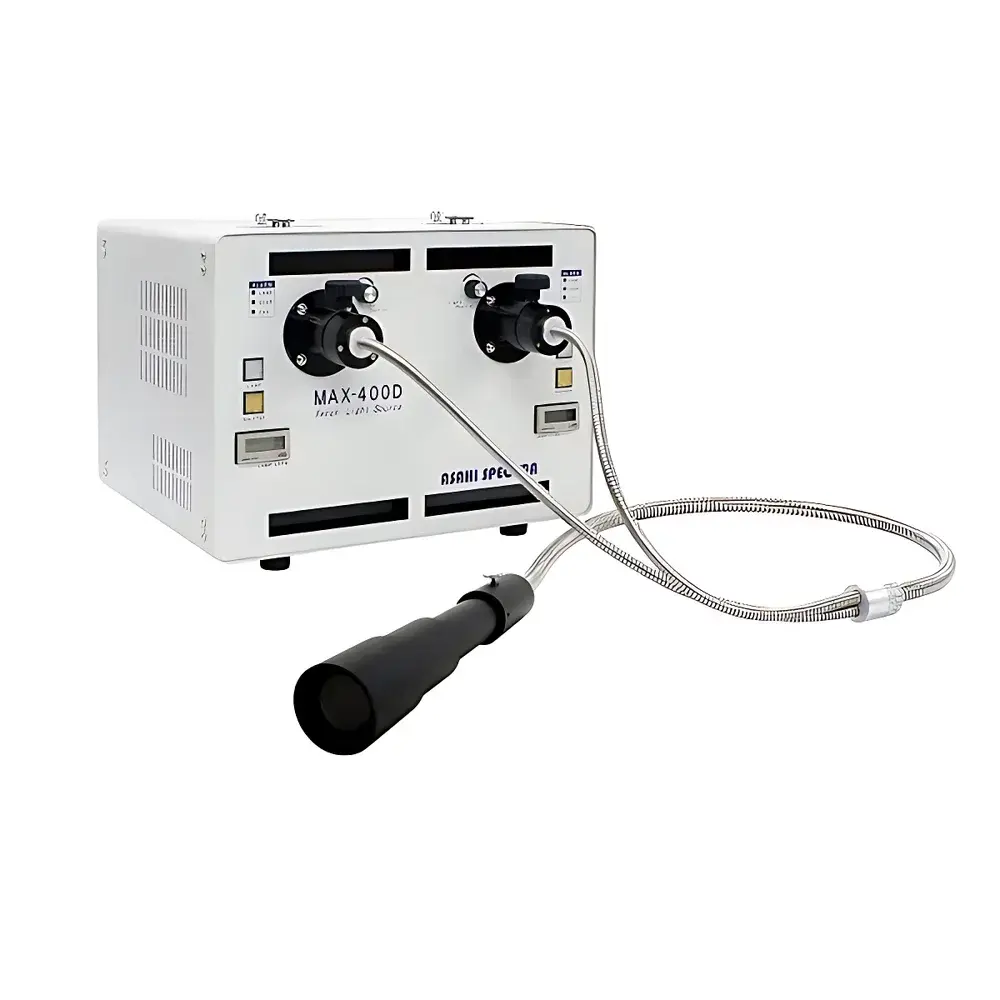
Asahi Spectra MAX-400D High-Power Dual Xenon Light Source
| Brand | Asahi Spectra |
|---|---|
| Origin | Japan |
| Model | MAX-400D |
| Light Source Type | Dual 400W Xenon Arc Lamps (VIS) |
| Spectral Range | 400–700 nm (with YSC0750 ultra-cold filter) |
| Input Voltage | AC 100–240 V ±10%, 50/60 Hz |
| Power Consumption | ≤1360 VA |
| Lamp Operating Conditions | DC 14.3 V, 28 A (per lamp) |
| Rated Lamp Life | 500 h (under specified operating conditions) |
| Illumination Method | External (non-contact, off-axis) |
| Cooling | Forced-air cooling |
| Control Interface | RS-485 remote control |
| Optical Output Coupling | Integrated bifurcated fiber-optic light guide (standard) |
| Filter Mount | 50 mm diameter or 50×50 mm square, thickness <6 mm |
| Dimensions | 390 × 341 × 292 mm (W×D×H) |
| Weight | 19.8 kg |
Overview
The Asahi Spectra MAX-400D is a high-intensity, dual-lamp xenon arc light source engineered for demanding optical laboratory applications requiring stable, broadband visible illumination with exceptional spatial uniformity and temporal repeatability. Unlike conventional single-lamp systems, the MAX-400D integrates two independently regulated 400W xenon short-arc lamps—delivering up to 400% higher radiant flux in the visible spectrum (400–700 nm) compared to its predecessor, the MAX-350. Its spectral output is optimized using the YSC0750 ultra-cold filter, which suppresses near-infrared radiation while preserving photometric integrity across the visible band. The system operates on a constant-current DC power supply (14.3 V, 28 A per lamp), ensuring stable arc positioning and minimized flicker—critical for high-speed imaging and quantitative sensor characterization. Designed for external illumination geometry, the MAX-400D eliminates the need for precise optical axis alignment; instead, light is efficiently extracted via a proprietary bifurcated fiber-optic light guide, enabling flexible beam delivery without mechanical repositioning.
Key Features
- Dual 400W xenon arc lamps providing high radiance and extended dynamic range in the visible spectrum (400–700 nm)
- Integrated forced-air cooling system with real-time thermal monitoring and automatic shutdown on fan failure or temperature anomaly
- Manual intensity control allowing continuous dimming from 100% down to approximately 30% of maximum output
- RS-485 digital interface for remote operation, lamp-hour logging, and status reporting in automated test environments
- Modular filter mount accommodating standard 50 mm round or 50×50 mm square optical filters (thickness <6 mm) for spectral shaping
- Shutter mechanism with mechanical actuation for precise exposure timing control
- Lamp life counter with hour-based tracking and end-of-life warning indicators
- Comprehensive safety architecture including redundant fusing, overcurrent protection, lid-open interlock, and arc-failure detection
Sample Compatibility & Compliance
The MAX-400D is compatible with a wide range of optical setups requiring broadband visible excitation or illumination—including high-speed CMOS/CCD camera calibration rigs, microscope back-illumination modules, machine vision test benches, and photodetector responsivity characterization systems. Its external illumination design avoids sample heating artifacts common in collimated direct-illumination configurations. All electrical and thermal subsystems comply with IEC 61000-6-3 (EMI emission) and IEC 61000-6-2 (immunity) standards. The unit is CE-marked and conforms to RoHS Directive 2011/65/EU. While not certified for Class I laser product compliance (as it emits incoherent broadband light), its optical output adheres to IEC 62471 Photobiological Safety classification for Exempt Group under normal operating conditions when used with supplied filters and fiber coupling.
Software & Data Management
The MAX-400D does not include embedded software but provides full RS-485 command protocol documentation (ASCII-based, Modbus RTU compatible) for integration into third-party automation platforms such as LabVIEW, MATLAB, Python (PySerial), or custom SCADA systems. Supported commands include lamp on/off, shutter open/close, intensity setpoint adjustment, lamp-hour readout, and fault-code polling. All operational parameters—including cumulative lamp runtime, thermal status, and error flags—are logged internally and retrievable via serial query. For GLP/GMP-aligned environments, users may implement external audit-trail logging through host-system timestamped command records, satisfying basic traceability requirements under FDA 21 CFR Part 11 when paired with appropriate electronic signature controls.
Applications
- High-speed imaging system validation and synchronization testing (e.g., >10,000 fps camera characterization)
- Quantitative evaluation of CMOS/CCD sensor quantum efficiency, linearity, and dynamic range
- Illumination source for transmitted-light microscopy with adjustable brightness and spectral filtering
- Backlighting in industrial machine vision inspection systems requiring uniform, flicker-free illumination
- Photostability testing of optical materials and coatings under controlled visible irradiance
- Calibration of spectroradiometers and luminance meters within CIE 1931 color space constraints
- Optical component transmittance/reflectance measurement where broadband VIS excitation is required
FAQ
What is the spectral output stability over lamp lifetime?
Output stability remains within ±3% RMS fluctuation (measured at 550 nm over 1 h) during the first 300 h of operation; degradation beyond 400 h is gradual and predictable, with intensity dropping ~12% at rated end-of-life (500 h).
Can the MAX-400D be integrated into a cleanroom environment?
Yes—the unit generates no oil vapor or particulate emissions, and its forced-air cooling uses sealed, low-noise fans compliant with ISO Class 5 ambient airflow requirements when installed outside the cleanroom with fiber-optic feedthrough.
Is UV or NIR output suppressed by default?
The standard configuration includes the YSC0750 ultra-cold filter, which attenuates >95% of radiation above 750 nm and reduces UV below 400 nm to negligible levels; additional bandpass or longpass filters can be mounted externally.
Does the system support analog intensity modulation?
No—the intensity control is digital-step or manual potentiometer-based; for analog modulation (e.g., 0–10 V), an external current driver interface must be implemented per Asahi Spectra’s technical note TN-MAX400D-02.
What maintenance is required between lamp replacements?
No scheduled maintenance is required beyond periodic cleaning of air intake grilles and verification of fiber-optic connector integrity; lamp replacement is the sole consumable service task, performed using factory-recommended alignment jigs.




