Thermal Atomic Layer Deposition System SUPERALD Thermal-ALD E200S
| Brand | SUPERALD |
|---|---|
| Origin | Guangdong, China |
| Manufacturer Type | Authorized Distributor |
| Country of Origin | China |
| Model | Thermal-ALD E200S |
| Substrate Size | 200 mm (8 inch) diameter (customizable) |
| Process Temperature Range | Room Temperature to 500 °C (customizable) |
| Precursor Channels | Up to 6 independent precursor lines (customizable), supporting both solid and liquid precursors with individual source heating (RT–200 °C) |
| Reactant Gas Lines | 2 (customizable) |
| Carrier Gas | N₂ with Mass Flow Controllers (MFCs) |
| Pressure Monitoring | Dual corrosion-resistant capacitance manometers (0.005–1000 Torr) |
| Base Vacuum | <5×10⁻³ Torr |
| Vacuum System | Standard oil-sealed rotary vane pump |
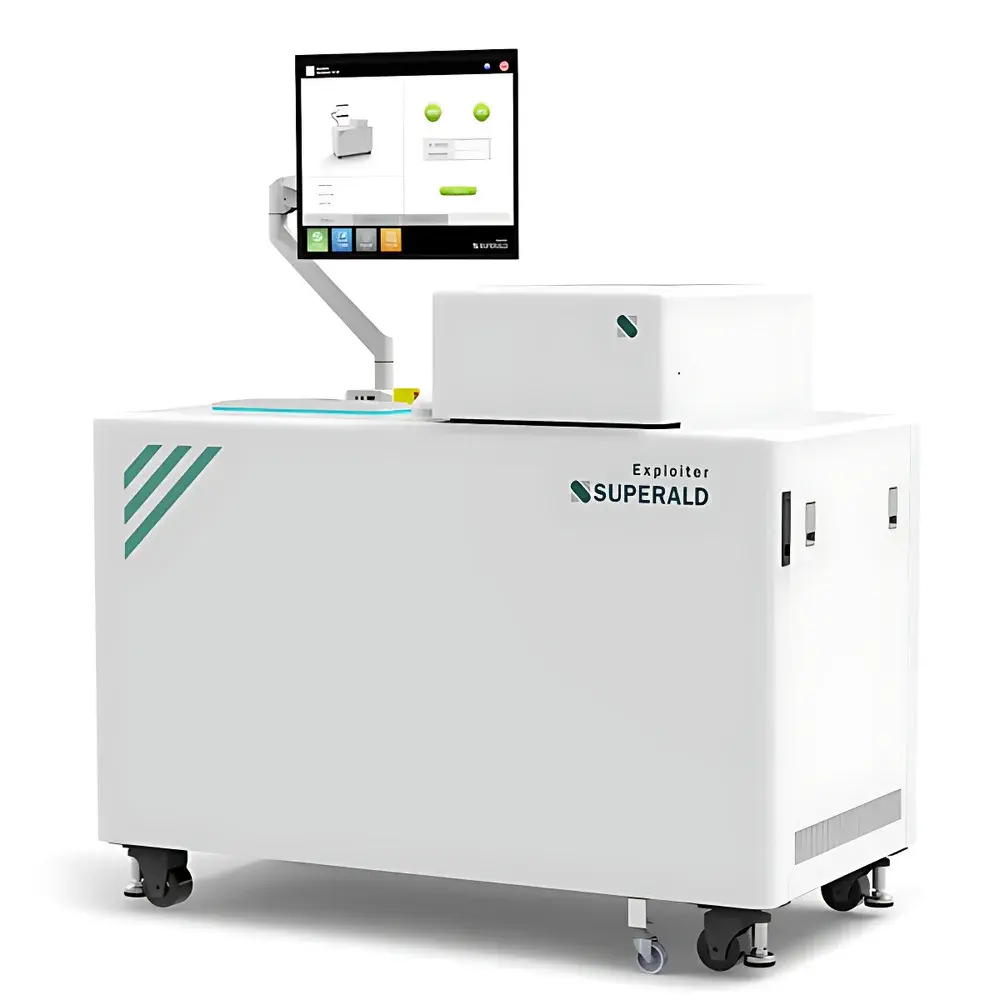
| Control System | 19-inch industrial touch-enabled display, embedded industrial PC (Windows 7), PLC-based real-time control with fieldbus support |
| Plasma Upgrade Port | Integrated PEALD interface for seamless thermal-to-plasma ALD mode transition without chamber replacement |
Overview
The SUPERALD Thermal-ALD E200S is a high-precision, modular thermal atomic layer deposition system engineered for reproducible, self-limiting thin-film growth at the atomic scale. It operates on the fundamental principle of sequential, surface-saturated chemical reactions—each ALD cycle comprising alternating pulses of gaseous precursors and purging steps—ensuring sub-nanometer thickness control, exceptional conformality (>95% step coverage on features >50:1 aspect ratio), and uniformity across 200 mm wafers. Designed for semiconductor process development, R&D labs, and pilot-line manufacturing, the E200S supports both low-temperature (<150 °C) and high-temperature (up to 500 °C) processes, enabling deposition of oxides, nitrides, metals, sulfides, and complex multilayers with minimal interfacial diffusion or nucleation delay. Its architecture integrates vacuum integrity, thermal stability, and gas-phase purity management to meet stringent requirements for advanced node device fabrication—including gate-stack engineering, interconnect barrier/seed layers, and MEMS passivation.
Key Features
- Modular 6-precursor delivery system with independent temperature-controlled source bottles (RT–200 °C), compatible with volatile solids (e.g., cyclopentadienyl-based metal complexes) and liquids (e.g., TMA, DEZ, TEMAHf)
- Dual corrosion-resistant capacitance manometers for high-fidelity pressure monitoring across ultra-low (5×10⁻³ Torr) to atmospheric regimes—critical for optimizing purge efficiency and reaction kinetics
- Integrated plasma upgrade port enables direct retrofit to plasma-enhanced ALD (PEALD) without chamber disassembly, supporting dual-mode operation (thermal + plasma) under identical vacuum and substrate handling conditions
- Industrial PLC + Windows 7-based HMI with full audit trail capability: all recipes, parameter logs, alarm events, and user actions are timestamped and exportable in CSV format—aligned with GLP/GMP documentation practices
- “One-Touch Deposition” automation sequence: vacuum pump-down → temperature ramp → ALD cycling → cooldown—programmable per layer, with real-time feedback on chamber pressure, temperature, and valve status
- Ergonomic 360° rotatable 19-inch touchscreen display with adjustable tilt and suspension mount; aluminum frame construction ensures mechanical rigidity, thermal dissipation, and ESD-safe grounding
Sample Compatibility & Compliance
The E200S accommodates standard 200 mm (8 inch) silicon, sapphire, quartz, and flexible polymer substrates, with optional custom chucks for non-planar or microstructured samples (e.g., nanowire arrays, porous anodic alumina). All wetted surfaces are electropolished stainless steel or anodized aluminum, minimizing particle generation and metal contamination. The system complies with SEMI S2-0201 safety guidelines and incorporates hardware-enforced interlocks (e.g., door-open inhibition, overpressure venting, thermal runaway cutoff) certified to IEC 61000-6-2/4 EMC standards. For regulated environments, software supports configurable user roles (Operator, Engineer, Administrator), electronic signatures, and 21 CFR Part 11–compliant data archiving when paired with networked storage.
Software & Data Management
The embedded control software provides deterministic real-time scheduling of pulse durations, purge times, and temperature ramps with ≤100 ms timing resolution. Each recipe stores not only process parameters but also hardware state snapshots (MFC setpoints, valve positions, sensor readings), enabling full traceability for failure analysis. Historical run data—including chamber pressure transients, precursor partial pressures (via optional QCM or residual gas analyzer integration), and thermal profiles—is indexed by wafer ID and timestamp. Export formats include CSV, XML, and SQLite for integration into LIMS or MES platforms. Optional Python API allows remote scripting of multi-step sequences (e.g., graded composition ramps, bilayer stacks with interfacial annealing).
Applications
- Semiconductor Manufacturing: High-κ dielectrics (Al₂O₃, HfO₂, ZrO₂), metal gates (TiN, TaN), diffusion barriers (WNₓ), and selective metal nucleation layers for Cu interconnects
- Energy Devices: Al₂O₃ passivation on c-Si solar cells; LiCoO₂ and NMC cathode coatings for enhanced cycle life; artificial SEI on Si anodes; Al₂O₃/AlN encapsulation on solid-state electrolytes
- Optoelectronics: Hermetic, pinhole-free encapsulation of OLED emitters (H₂O/O₂ permeation rate <10⁻⁶ g·m⁻²·day⁻¹); ZnO and TiO₂ antireflection and electron transport layers
- Catalysis: Single-atom catalysts (Pt, Ru, Ir on CeO₂ or carbon supports); core–shell nanoparticles (e.g., Pt@SiO₂); and oxide-overcoated metal catalysts with tunable metal–support interaction
- Biomedical Engineering: Bioinert TiN and ZrN coatings on orthopedic implants; antimicrobial Ag-doped ZnO films; and drug-eluting polymer surface functionalization via ALD-mediated linker monolayers
- MEMS/NEMS: Wear-resistant MoS₂ and WS₂ solid lubricants; hermetic Al₂O₃ sealing of resonators; and piezoelectric ZnO/AlN actuator stacks with minimized interfacial stress
FAQ
What vacuum level is required for stable ALD operation?
Base pressure <5×10⁻³ Torr is recommended prior to precursor introduction to minimize background H₂O/O₂ contamination—particularly critical for moisture-sensitive precursors such as alkylamides or metal halides.
Can the system deposit multilayer heterostructures with abrupt interfaces?
Yes. The E200S achieves interface sharpness <0.3 nm (measured by XRR and STEM-EELS) through precise purge optimization, inert gas isolation between precursor pulses, and synchronized temperature stabilization during layer transitions.
Is remote diagnostics and preventive maintenance supported?
The embedded industrial PC includes SSH access and VNC-enabled remote desktop. Predictive maintenance alerts (e.g., pump oil degradation, MFC calibration drift) are triggered based on runtime statistics and logged sensor trends.
How is precursor cross-contamination prevented during multi-source operation?
Each precursor line has dedicated stainless-steel tubing, heated transfer lines (to prevent condensation), and isolated pneumatic valves with double-seal design. A nitrogen curtain separates precursor manifolds from the reaction zone.
Does the system support in situ metrology integration?
Yes. Standard RS-232 and Ethernet ports allow synchronization with ellipsometers (e.g., Woollam), QCM sensors, or optical emission spectrometers for real-time growth rate and stoichiometry monitoring.