
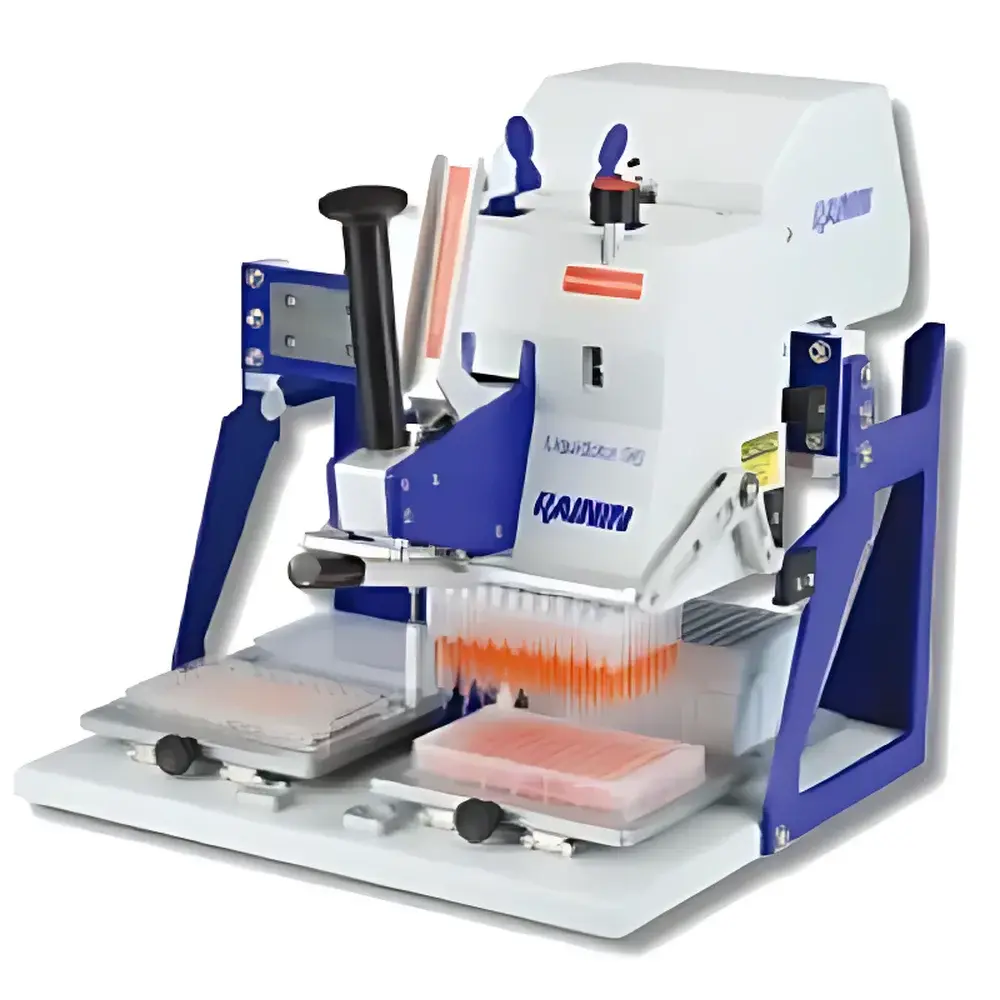
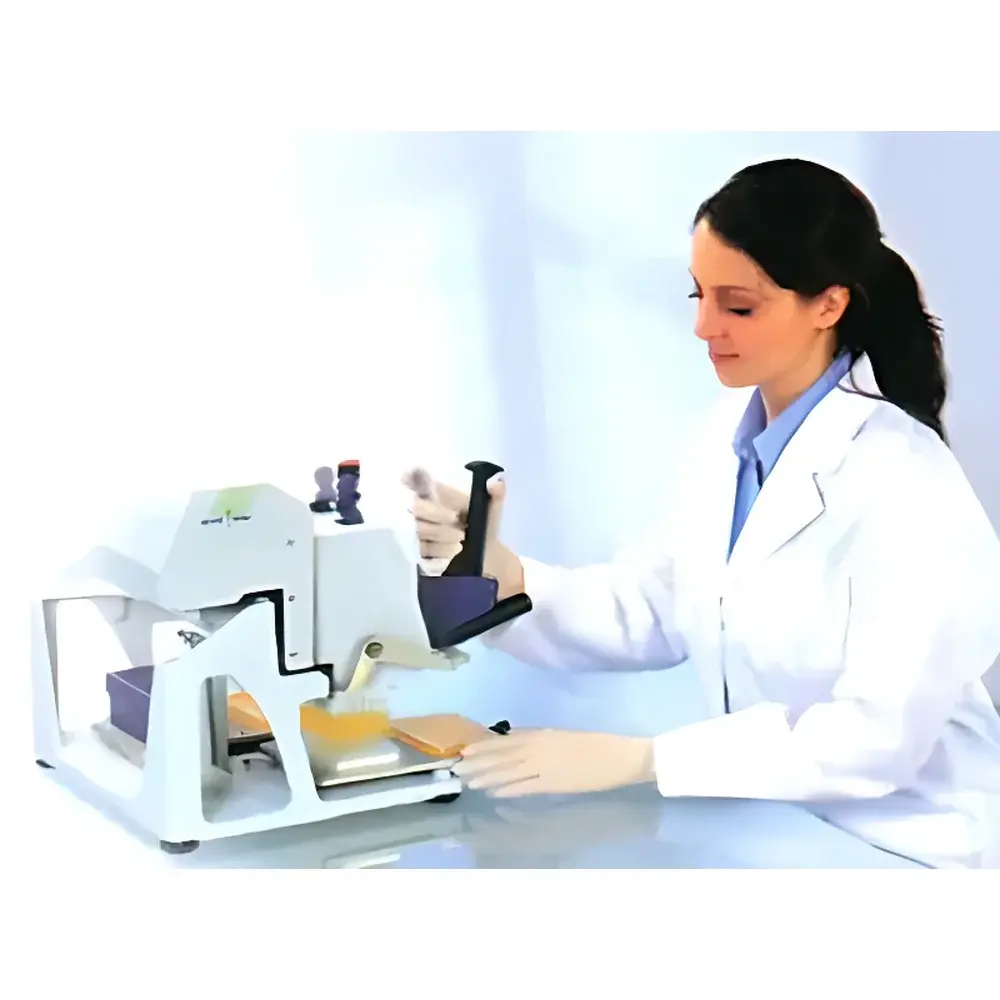
Rainin Liquidator™ 96 Manual High-Throughput Pipetting Workstation
| Brand | Rainin |
|---|---|
| Origin | Switzerland |
| Model | Liquidator™ 96 |
| Channel Configuration | 96-channel |
| Volume Range | 5–200 µL |
| Compatible Plate Formats | 96-well and 384-well microplates (with optional adapter) |
| Ergonomic Design | Yes |
| Software Requirement | None |
| Compliance | ISO 8655-compliant calibration methodology, LTS® tip system certified for traceable accuracy |
Overview
The Rainin Liquidator™ 96 Manual High-Throughput Pipetting Workstation is an engineered solution for precise, reproducible parallel liquid handling across standard 96-well and 384-well microplate formats. Unlike motorized or robotic systems, the Liquidator™ 96 operates on a fully manual, spring-assisted mechanical principle—leveraging Rainin’s proprietary LTS® (Low Retention Tip System) architecture to ensure consistent plunger displacement, uniform tip sealing force, and minimal carryover. Its design follows fundamental pipetting physics: synchronized piston movement across all 96 channels ensures identical aspiration and dispensing kinetics per well, eliminating inter-channel variability common in sequential multi-channel devices. This mechanical fidelity supports applications demanding high within-plate precision (e.g., ELISA wash steps, qPCR master mix distribution) without dependency on external power, software, or calibration routines beyond routine ISO 8655 verification.
Key Features
- True parallel 96-channel operation with simultaneous actuation—no staggered dispensing or sequential channel lag.
- Integrated ergonomic lever mechanism reduces hand fatigue by up to 40% compared to conventional multi-channel pipettes during extended use (validated per ISO 11228-3 biomechanical guidelines).
- Compact footprint (20.3 × 12.7 × 15.2 cm) enables deployment on crowded biosafety cabinets, laminar flow hoods, or benchtop PCR workstations.
- LTS® tip interface guarantees secure, leak-free engagement with Rainin’s certified low-retention tips—including filter and sterile options—ensuring compatibility with sensitive assays involving proteins, nucleic acids, or low-volume reagents.
- No firmware, no drivers, no USB connection required—operation is immediate upon installation of compatible tips and adjustment of volume dial.
- Volume adjustment is tactile and linear (5–200 µL range), calibrated to ±1.5% at 200 µL and ±3.0% at 5 µL per ISO 8655-2 specifications.
Sample Compatibility & Compliance
The Liquidator™ 96 handles aqueous buffers, serum-containing media, glycerol solutions (up to 20% v/v), and viscous PCR master mixes without requiring recalibration. It is routinely deployed in GLP-compliant laboratories for assay development workflows where audit trails are maintained manually via lab notebook entries and tip lot traceability. While the device itself does not generate electronic records, its LTS tip system conforms to ISO 8655-6 for tip performance certification, and all consumables (e.g., LQR-200F, LQR-200S) carry full CoA documentation supporting ICH Q5E and USP analytical instrument qualification requirements. Optional accessories—including the LIQ-384PA 384-well adapter and LIQ-AP height-adjustable stand—extend usability across diverse plate geometries while preserving mechanical alignment integrity.
Software & Data Management
The Liquidator™ 96 operates independently of software control, eliminating dependencies on operating systems, driver updates, or cybersecurity patching. All operational parameters (volume setting, tip type, plate layout) are recorded manually in laboratory notebooks or integrated into LIMS via user-defined SOP templates. For labs requiring digital workflow integration, Rainin provides downloadable PDF-based calibration logs and tip traceability sheets aligned with FDA 21 CFR Part 11 Annex 11 expectations for paper-based systems. No embedded memory, no network interface, and no data export functionality are present—ensuring intrinsic compliance with air-gapped environments and reducing validation burden in regulated QC/QA settings.
Applications
- ELISA & Immunoassays: Synchronized washing of 96-well plates with precise dwell time control and uniform aspiration depth.
- Cell Culture & Monoclonal Antibody Production: Rapid medium exchange in hybridoma screening plates and feeder-layer removal prior to cloning.
- Molecular Biology: Accurate distribution of Taq polymerase, dNTPs, and primers into 96-well qPCR plates; compatible with low-volume (5 µL) reaction setups.
- Functional Genomics: Arrayed siRNA transfection, CRISPR guide RNA delivery, and yeast two-hybrid mating plate replication.
- Protein Crystallization: Nanoliter-scale reagent mixing in sitting-drop and hanging-drop trays using the LIQ-TRAY reagent reservoir system.
- High-Content Screening (HCS): Uniform cell seeding and compound dilution across multi-well assay plates prior to imaging.
FAQ
Does the Liquidator™ 96 require electrical power or computer connectivity?
No. It is a fully manual, mechanically actuated device with no batteries, motors, or digital components.
Can it be used with non-Rainin tips?
Only LTS®-certified tips are guaranteed to deliver specified accuracy and reproducibility; third-party tips may compromise seal integrity and volume consistency.
What is the recommended calibration frequency?
Per ISO 8655-5, users should perform gravimetric verification at least quarterly—or after any impact event—and document results against traceable standards.
Is the 384-well capability native or accessory-dependent?
384-well operation requires the LIQ-384PA adapter kit; the base unit is optimized for 96-well format.
How is tip ejection managed across all 96 channels?
A single, centrally located ejection lever actuates simultaneous tip release across all positions—minimizing risk of partial ejection or tip residue carryover.



