
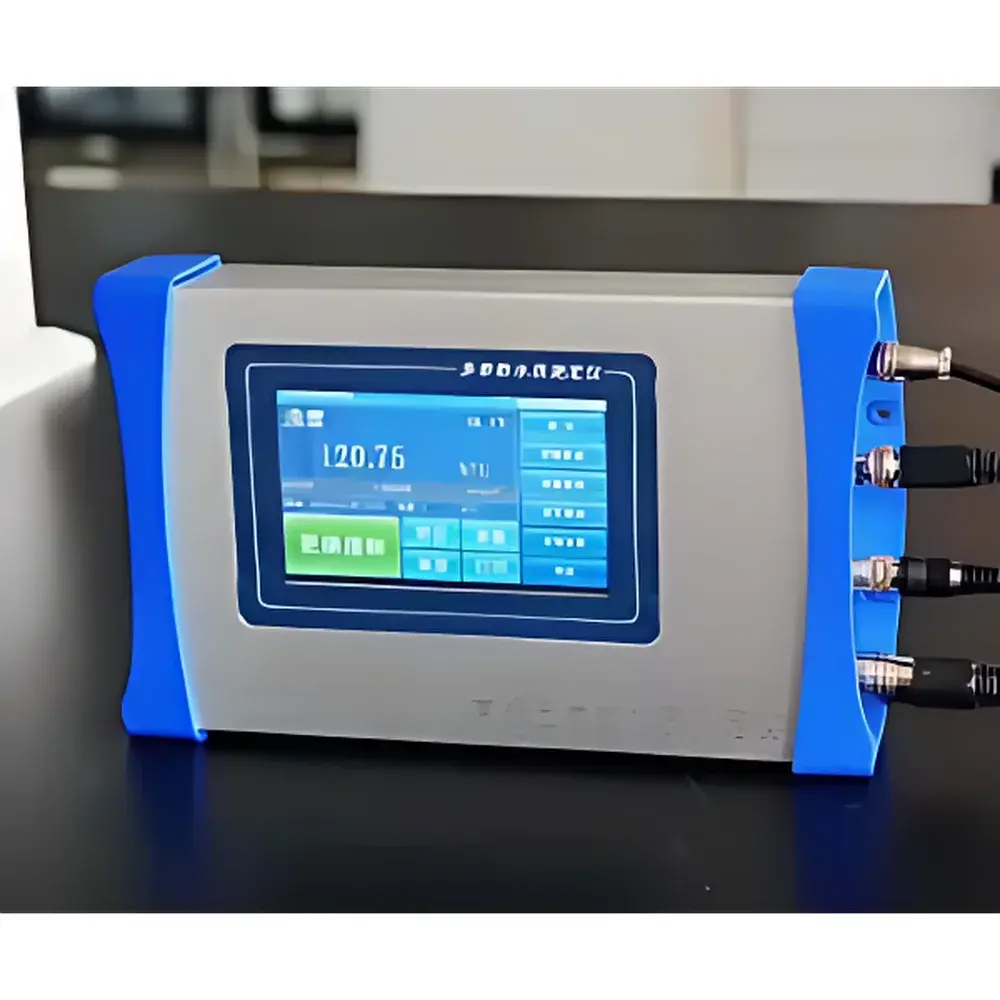
ZYKX PCD-2015 Portable 5-Parameter Water Quality Analyzer
| Brand | ZYKX |
|---|---|
| Origin | Beijing, China |
| Manufacturer Type | Authorized Distributor |
| Country of Manufacture | China |
| Model | PCD-2015 |
| Pricing | Upon Request |
| Display | 4.3" Color Touchscreen (Chinese UI) |
| Power | Rechargeable Li-ion Battery (24 h continuous operation) |
| Dimensions | 260 × 155 × 50 mm |
| Weight | 1.3 kg |
| Connectivity | USB 2.0, Bluetooth 4.2 (optional) |
| Data Storage | Internal memory for ≥10,000 measurement records |
| Enclosure | Anodized aluminum alloy, IP67-rated |
| Printer Support | Optional thermal printer module |
| Compliance | Meets technical requirements of HJ/T 96–2003, HJ/T 99–2003, and HJ 506–2009 (China EPA) |
Overview
The ZYKX PCD-2015 Portable 5-Parameter Water Quality Analyzer is an integrated field-deployable instrument engineered for simultaneous, real-time measurement of five fundamental water quality parameters: temperature, pH, dissolved oxygen (DO), electrical conductivity (EC), and turbidity. Designed in accordance with the Chinese Ministry of Ecology and Environment’s *Guideline for Development of Environmental Monitoring Instruments*, the PCD-2015 implements standardized electrochemical and optical detection principles—glass electrode potentiometry for pH, Clark-type polarographic membrane electrodes for DO, four-electrode conductivity cells for EC, and 90° scattered-light nephelometry (ISO 7027-compliant optical path) for turbidity. Its compact architecture supports rapid deployment across diverse aquatic environments—from rivers and lakes to wastewater treatment outfalls, aquaculture ponds, and municipal distribution networks—without requiring laboratory infrastructure or external calibration stations.
Key Features
- 4.3-inch high-resolution color touchscreen with intuitive Chinese-language interface; no keyboard required for navigation or parameter selection
- Rugged anodized aluminum housing rated IP67 for dust ingress protection and temporary submersion (up to 1 m for 30 min)
- Integrated rechargeable lithium-ion battery enabling up to 24 hours of continuous field operation on a single charge
- Modular sensor design allowing independent verification, cleaning, and replacement of individual probes without system recalibration
- On-device data logging capacity exceeding 10,000 timestamped records with automatic GPS tagging (when paired with external Bluetooth GNSS receiver)
- Dual-mode data export: direct USB mass-storage transfer to PC or wireless transmission via Bluetooth 4.2 to companion Android/iOS application (ZYKX AquaLink™)
- Optional integrated thermal printer module for immediate hard-copy generation of field reports including date, time, location (if available), and all five measured parameters
- Auto-compensation algorithms for temperature effects on pH, DO, and conductivity readings per ISO 17294-2 and ASTM D1293 standards
Sample Compatibility & Compliance
The PCD-2015 is validated for use with natural surface waters (rivers, reservoirs, estuaries), treated effluents, groundwater, recirculating aquaculture systems, and industrial process streams. It complies with national Chinese environmental monitoring method standards: pH measurement per HJ/T 96–2003 (equivalent to ISO 10523), DO per HJ 506–2009 (aligned with ISO 5814), conductivity per HJ/T 99–2003 (consistent with ISO 7888), and turbidity per HJ 1077–2019 (based on ISO 7027). While not certified for regulatory submission under US EPA or EU WFD frameworks, its metrological performance meets field-screening thresholds defined in ISO 5667-3 for routine surveillance. The device supports Good Laboratory Practice (GLP)-compatible workflows through audit-trail-enabled software logging and user-accessible calibration history.
Software & Data Management
The included AquaView Desktop Software (Windows 10/11 compatible) enables secure import, visualization, statistical analysis (mean, SD, min/max, trend plots), and export of datasets in CSV, Excel, and PDF formats. All data files contain embedded metadata: operator ID, instrument serial number, calibration timestamps, sensor status flags, and ambient conditions. The software enforces 21 CFR Part 11–style electronic signature capability for QA/QC sign-off. Bluetooth-enabled mobile synchronization preserves chain-of-custody integrity by appending geotagged metadata to each record. Data encryption (AES-128) is applied during wireless transmission and local storage to ensure confidentiality in multi-user deployments.
Applications
- Routine surveillance of ambient water bodies under national surface water quality assessment programs
- Pre- and post-treatment validation at municipal wastewater facilities and decentralized treatment units
- Real-time monitoring of dissolved oxygen saturation and pH stability in intensive fish farming operations
- Field verification of drinking water distribution system integrity (e.g., corrosion-induced conductivity shifts)
- Educational use in university environmental science laboratories for hands-on water chemistry instruction
- Emergency response assessments following chemical spills or algal bloom events where rapid parametric profiling is critical
FAQ
What calibration protocols does the PCD-2015 support?
It accepts manual single-point or two-point calibration for pH and conductivity using NIST-traceable standard solutions; DO calibration follows zero-oxygen (sodium sulfite) and saturated-air methods per ISO 5814; turbidity uses formazin or AMCO-AE standards.
Can the instrument operate in saline or brackish water?
Yes—the conductivity range extends to 200 mS/cm, and the DO sensor employs salinity compensation algorithms adjustable from 0 to 45 ppt.
Is firmware upgradeable in the field?
Yes, via USB-connected PC using AquaView Desktop; version history and checksum verification are logged automatically.
Does the device meet any international waterproofing standards?
Its IP67 rating conforms to IEC 60529 and provides equivalent protection to EN 60529 Class 67 devices.
How is measurement traceability maintained?
Each sensor contains a unique ID chip storing factory calibration coefficients; users may log field calibrations with operator ID and reference standard lot numbers within the onboard audit trail.







