
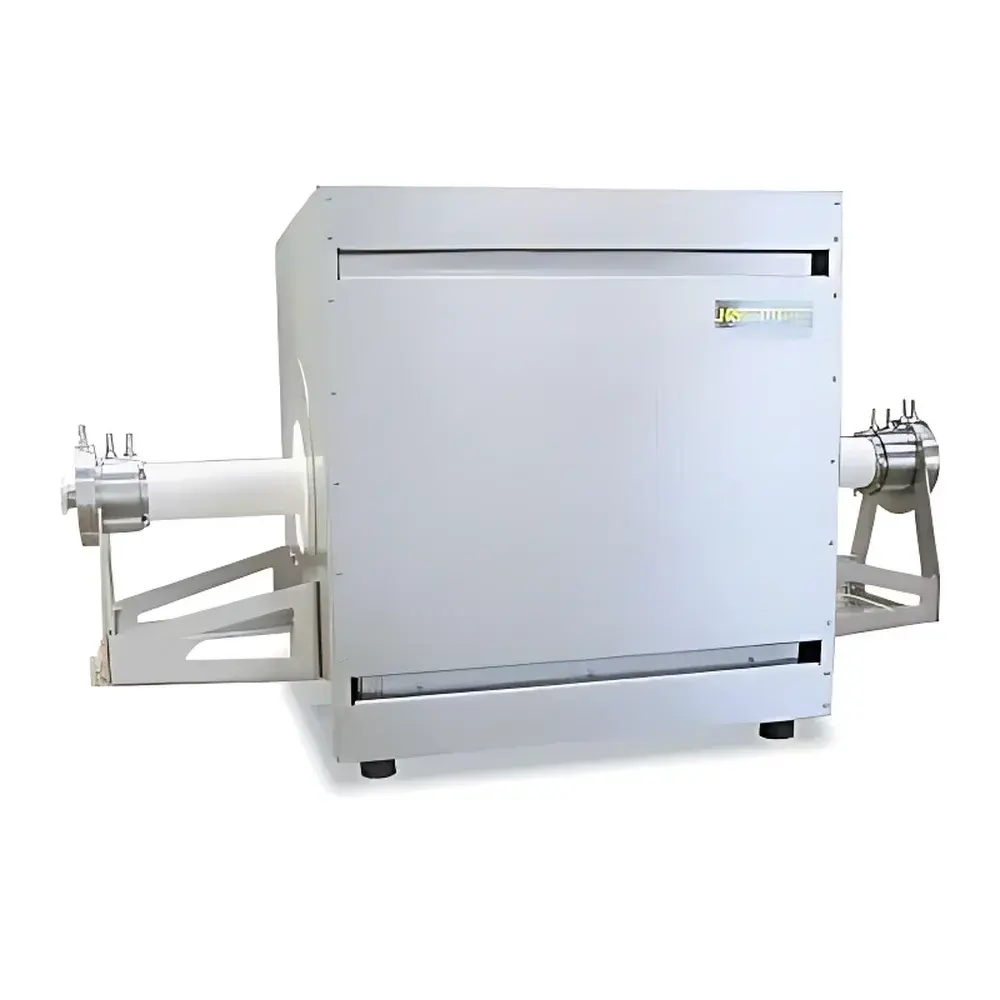
Nabertherm RHTH Series Horizontal High-Temperature Tube Furnace
| Brand | Nabertherm |
|---|---|
| Origin | Germany |
| Model | RHTH 120/150, RHTH 120/300, RHTH 120/600 |
| Max. Temp. | 1600 °C / 1700 °C / 1800 °C |
| Heating Zone Length | 150 mm / 300 mm / 600 mm |
| Tube ID | 50 mm / 80 mm / 120 mm |
| Uniformity (ΔT) | ±5 K over heating zone |
| Power Rating | 5.4 kW / 9.0 kW / 14.4 kW |
| Electrical Supply | 3-phase |
| Weight | 70 kg / 90 kg / 110 kg |
| Insulation | Vacuum-formed ceramic fiber board (low thermal mass, low conductivity) |
| Heating Element | Suspended MoSi₂ rods |
| Thermocouple | Type B (PtRh30/PtRh6) |
| Control Cabinet | Separate vertical enclosure with thyristor-based power controller and low-voltage transformer |
| Optional Features | Overtemperature protection (EN 60519-2 Class 2), multi-zone temperature cascade control, gas-tight flanges, manual/automated gas dosing systems, reversible vertical mounting kit |
Overview
The Nabertherm RHTH series represents a class of precision-engineered horizontal high-temperature tube furnaces designed for demanding laboratory and pilot-scale thermal processing applications. Operating on the principle of resistive heating via suspended molybdenum disilicide (MoSi₂) elements, these furnaces deliver stable, repeatable temperatures up to 1800 °C in inert, reducing, oxidizing, or vacuum atmospheres. Their horizontal configuration enables straightforward sample insertion and retrieval, while the optimized thermal architecture—comprising vacuum-formed ceramic fiber insulation and a thermally decoupled control cabinet—ensures rapid ramp rates, low standby heat loss, and exceptional long-term stability. The RHTH is not a general-purpose oven; it is a process-critical instrument engineered for applications requiring precise thermal profiles, reproducible atmosphere control, and compliance with international safety and performance standards including EN 60519-2 for industrial electroheating equipment.
Key Features
- Suspended MoSi₂ heating elements mounted outside the hot zone—enabling tool-free replacement without furnace disassembly or insulation disturbance
- Vacuum-formed ceramic fiber insulation (Ceramic Fiber Board C 799 grade) with ultra-low thermal conductivity (<0.12 W/m·K at 1000 °C) and minimal heat storage—reducing energy consumption by up to 35% versus conventional refractory-lined furnaces
- Modular three- or four-zone heating configuration, each independently controllable to achieve ±5 K temperature uniformity across the specified heating length (150–600 mm)
- Stainless steel housing with embossed surface finish and integrated convection cooling grooves—enhancing structural rigidity and passive heat dissipation
- Separate vertical control cabinet housing thyristor-based power regulation, low-voltage isolation transformer, and digital PID controller—minimizing electromagnetic interference and simplifying maintenance access
- Integrated Type B thermocouple (PtRh30/PtRh6) with dual-point monitoring capability—supporting both furnace wall and internal tube temperature measurement for cascade control implementation
Sample Compatibility & Compliance
The RHTH accommodates standard cylindrical ceramic work tubes (supplied as standard in C 799 alumina-rich material, Al₂O₃ ≥ 99.7%) with inner diameters ranging from 50 to 120 mm and lengths up to 1000 mm. Optional quartz, silicon carbide, or recrystallized alumina tubes are available for specialized chemical or thermal requirements. Gas-tight flange systems (ISO-KF or CF) support continuous purge, dynamic vacuum (down to 10⁻³ mbar with optional pump integration), or controlled reactive gas environments (e.g., H₂/N₂ mixtures). All configurations comply with EN 60519-2 Class 2 overtemperature protection requirements, incorporating redundant thermal cut-off devices calibrated to disconnect power if internal temperature exceeds preset thresholds by >15 K. The furnace design adheres to CE marking directives and supports GLP-compliant operation when paired with validated controllers featuring audit-trail logging (e.g., Nabertherm THERMOCOMFORT with 21 CFR Part 11-ready firmware).
Software & Data Management
While the base RHTH operates with analog or digital panel controllers (e.g., Nabertherm LMT 200), full data traceability is enabled via optional Nabertherm THERMOCOMFORT software suite. This Windows-based platform supports real-time multi-channel temperature logging (furnace wall, tube interior, exhaust), programmable ramp-soak cycles with up to 32 segments, and export to CSV or XML for integration into LIMS or MES environments. Controller firmware includes configurable event logging (power-on, alarm triggers, setpoint changes) with timestamped user identification—meeting documentation requirements under ISO/IEC 17025 and FDA 21 CFR Part 11 for regulated laboratories. Remote monitoring via Ethernet or RS485 is supported using Modbus TCP or RTU protocols, enabling centralized supervision in multi-furnace installations.
Applications
- High-temperature sintering of advanced ceramics (e.g., ZrO₂, Si₃N₄, SiC) under controlled partial pressures
- Thermal treatment of battery cathode materials (NMC, LFP) with precise oxygen stoichiometry control
- Graphitization and annealing of carbon nanomaterials under inert or reducing atmospheres
- Calibration of high-temperature reference standards (e.g., fixed points per ITS-90) in metrology labs
- Chemical vapor infiltration (CVI) preform densification in aerospace composite R&D
- Thermogravimetric analysis (TGA) coupling via integrated mass flow controllers and exhaust gas sampling ports
FAQ
What atmosphere types are supported by the RHTH series?
The RHTH supports air, inert gases (Ar, N₂), reducing atmospheres (H₂/N₂ blends), vacuum (with optional pumping system), and mildly corrosive environments—provided compatible work tube and sealing materials are selected.
Can the RHTH be operated vertically?
Yes—optional vertical mounting kits (including reinforced support frames and gravity-aligned tube retention hardware) allow conversion to vertical orientation, matching the RHTV series’ operational geometry.
Is the furnace suitable for GMP-regulated production environments?
When equipped with THERMOCOMFORT controllers, 21 CFR Part 11-compliant audit trails, and calibrated thermocouples traceable to national standards, the RHTH meets core instrumentation requirements for GMP thermal validation protocols.
How is temperature uniformity verified and maintained?
Uniformity is certified per ASTM E220 and ISO/IEC 17025 using multi-point sensor mapping across the heating zone; the three- or four-zone architecture allows dynamic compensation for axial thermal gradients during extended holds.
What maintenance intervals are recommended for MoSi₂ elements?
Under typical usage (≤1700 °C, air atmosphere), MoSi₂ elements exhibit service life exceeding 2000 hours; inspection is advised after 500 h at 1800 °C or following any thermal shock event involving rapid quenching.



