
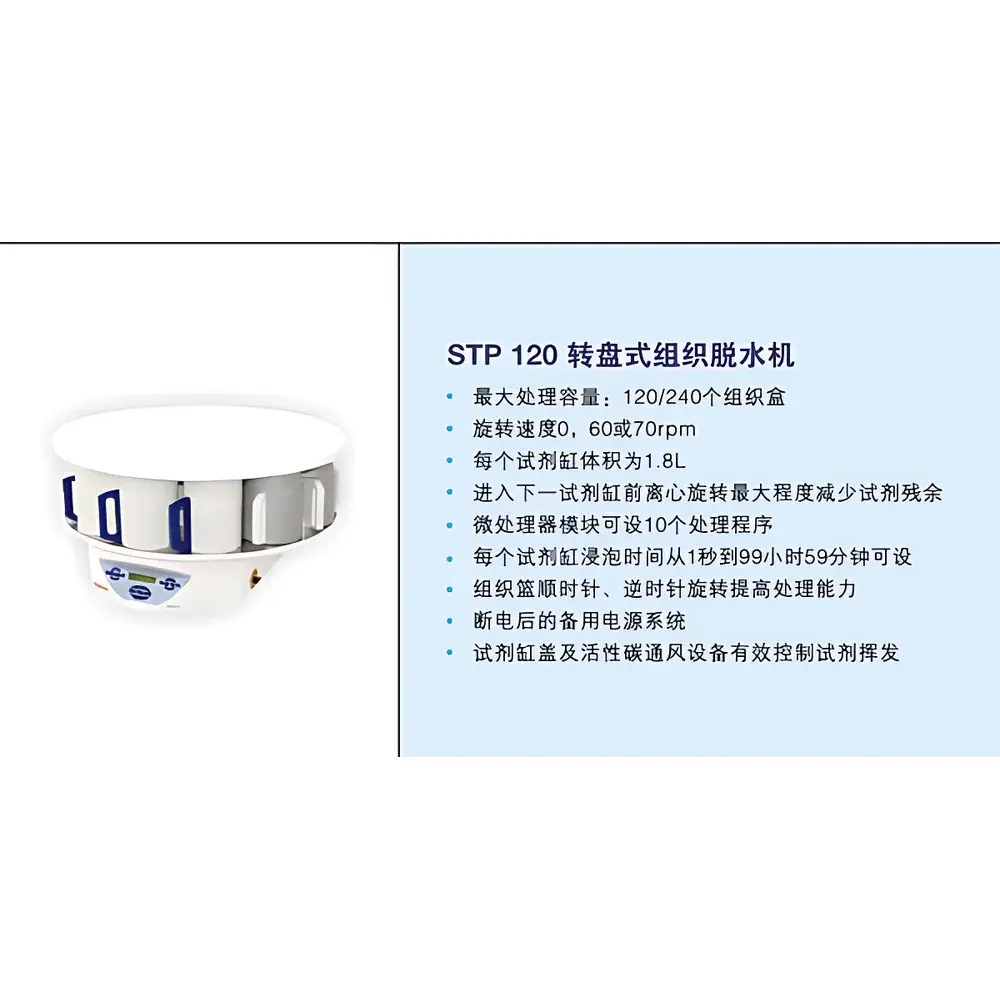
Thermo Fisher Scientific STP 120 Rotary Tissue Processor
| Brand | Thermo Fisher Scientific |
|---|---|
| Origin | United Kingdom |
| Model | STP 120 |
| Reagent Stations | 10 (9 when 3 paraffin stations configured) |
| Paraffin Stations | 2 (optional 3rd) |
| Station Volume | 1.8 L each |
| Voltage | 100–120 V / 220–240 V AC (±10%), 50–60 Hz |
| Temperature Range | 50–70 °C |
| Overtemperature Cutoff | 75 °C (±4 °C) |
| Cassette Basket Capacity | 120 cassettes (1 basket standard, optional 2nd) |
| Programmable Protocols | 10 stored methods |
| Dwell Time per Station | 1 sec – 99 hr 59 min |
| Rotation-Based Agitation | Enabled |
| Vertical Agitation | Optional |
| Centrifugal Drying | Optional |
| Delayed Start | Supported |
| Safety | Overheat protection with automatic power cutoff and integrated backup power circuit |
Overview
The Thermo Fisher Scientific STP 120 Rotary Tissue Processor is an automated, high-precision instrument engineered for consistent, reproducible tissue dehydration, clearing, and infiltration in histopathology laboratories. Based on a rotary carousel architecture, it employs controlled rotational motion to drive fluid exchange and mechanical agitation—minimizing carryover contamination between reagent stations while optimizing diffusion kinetics across tissue specimens. Unlike static or linear processors, the STP 120’s continuous rotation enables uniform exposure of tissue cassettes to solvents (e.g., ethanol, xylene) and molten paraffin, significantly reducing processing variability and enhancing morphological preservation. Designed for routine diagnostic workflows and research-grade histology, the system operates under programmable, temperature-regulated conditions compliant with established histotechnological standards including CAP accreditation requirements and ISO 15189–aligned laboratory quality management frameworks.
Key Features
- Patented centrifugal drying mode: Rotational force expels excess reagent from cassettes prior to station transfer, markedly reducing cross-contamination and solvent carryover—critical for maintaining reagent integrity over extended run cycles.
- Programmable rotational agitation: Adjustable speed and duration ensure homogeneous reagent penetration without mechanical trauma to delicate tissues such as neural or embryonic samples.
- Compact, mobile chassis with ergonomic casters: Footprint optimized for space-constrained pathology labs; integrated leveling feet and lockable wheels support stable operation and flexible benchtop repositioning.
- Intuitive front-panel interface: Backlit LCD display with tactile navigation buttons and contextual soft-keys simplifies protocol selection, parameter adjustment, and real-time status monitoring—even with gloved hands.
- Dual-voltage universal power supply: Auto-sensing 100–120 V / 220–240 V AC input eliminates need for external transformers and supports seamless deployment across global laboratory sites.
- Redundant thermal safety architecture: Primary thermostat plus independent overtemperature cutoff at 75 °C (±4 °C), coupled with fail-safe power interruption and onboard backup circuitry, ensures uninterrupted compliance with IEC 61010-1 electrical safety requirements.
Sample Compatibility & Compliance
The STP 120 accommodates standard histology cassettes (e.g., Leica, Sakura, Thermo Fisher formats) in batches of up to 120 units per cycle. Its 10-station carousel configuration supports full dehydration–clearing–infiltration protocols—including optional third paraffin station for high-throughput embedding preparation. All fluid-handling components are chemically resistant to common histological reagents (ethanol, isopropanol, chloroform, xylene, and paraffin wax). The system meets essential regulatory expectations for clinical laboratory instrumentation: design documentation aligns with ISO 13485 principles; software logic supports audit-trail-ready operation per FDA 21 CFR Part 11 when integrated with validated LIS/HIS platforms; and thermal control stability satisfies CLSI EP23-A guidelines for precision in automated tissue processors.
Software & Data Management
While the STP 120 operates via embedded firmware rather than PC-connected software, its controller retains 10 user-defined protocols with timestamped execution logs stored in non-volatile memory. Each protocol includes independently adjustable dwell times (1 second to 99 hours 59 minutes), temperature setpoints (50–70 °C), agitation modes (rotational, vertical, or centrifugal), and sequence order—enabling method customization for specialized applications such as decalcified bone or fatty tissue processing. Delayed start functionality allows overnight scheduling without manual intervention. Log exports require physical USB retrieval (not network-enabled), ensuring data sovereignty and compatibility with GLP/GMP environments where network isolation is mandated.
Applications
- Routine diagnostic histopathology: High-volume processing of surgical biopsies, resection specimens, and cytology cell blocks with minimal operator dependency.
- Research histology: Reproducible preparation of tissue sections for immunohistochemistry (IHC), in situ hybridization (ISH), and digital pathology scanning.
- Teaching laboratories: Standardized protocols facilitate trainee competency development in tissue processing fundamentals per ASCP Histotechnology Curriculum Guidelines.
- Specialized tissue types: Optimized handling of calcified, fibrous, or lipid-rich tissues through customizable agitation and extended dwell parameters.
FAQ
What is the maximum number of tissue cassettes the STP 120 can process simultaneously?
The system processes up to 120 standard-sized cassettes per cycle using a single cassette basket; a second basket is available as an optional upgrade.
Can the STP 120 be validated for use in a CAP-accredited laboratory?
Yes—the instrument’s thermal consistency, reagent station isolation, and programmable protocol repeatability support IQ/OQ/PQ validation per CAP Checklist GEN.40520 and CLIA requirements.
Is remote monitoring or network connectivity supported?
No. The STP 120 is a standalone unit with local control only; no Ethernet, Wi-Fi, or cloud interface is provided, preserving data security and regulatory alignment in regulated environments.
How does the centrifugal drying function reduce reagent carryover?
By rotating the cassette basket at controlled angular velocity prior to station advancement, residual solvent is mechanically expelled—lowering inter-station contamination risk and extending reagent service life.
Are replacement parts and service support available globally?
Thermo Fisher Scientific maintains authorized service centers in over 40 countries, with certified field engineers and genuine spare parts (e.g., heating elements, carousel motors, control boards) stocked regionally per ISO 13485 distribution protocols.





