
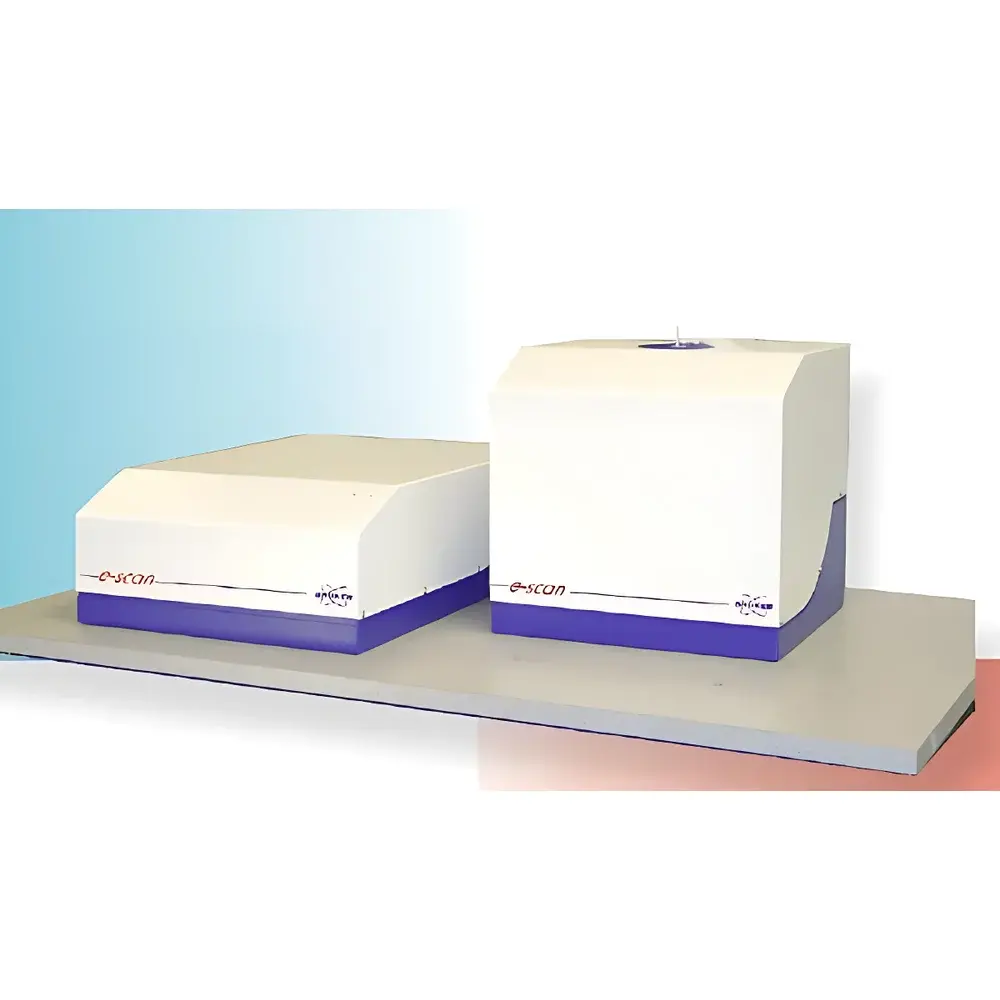
Bruker e-scan Benchtop Electron Spin Resonance (ESR) Spectrometer
| Brand | Bruker |
|---|---|
| Origin | Germany |
| Instrument Type | Continuous-Wave (CW) EPR |
| Magnet System | Permanent Magnet |
| Cooling | Air-Cooled (No Water Required) |
| Form Factor | Benchtop |
| Automation Level | Fully Automated Tuning, Data Acquisition & Analysis |
| Application-Specific Configurations | e-scan A (Radiation Dosimetry), e-scan B (Beer Freshness QC), e-scan F (Food Irradiation Verification), e-scan M (Stable Radical & Spin Adduct Detection, e.g., ROS/RNS) |
Overview
The Bruker e-scan is a compact, benchtop electron paramagnetic resonance (EPR) spectrometer engineered for high-sensitivity, continuous-wave (CW) detection of paramagnetic species—including stable free radicals, transient reactive oxygen/nitrogen species (ROS/RNS), spin adducts, and radiation-induced defects. Unlike conventional superconducting or electromagnet-based EPR systems, the e-scan employs a high-stability permanent magnet assembly, eliminating the need for cryogenic cooling or water recirculation infrastructure. Its integrated microwave bridge, low-noise detection electronics, and optimized resonator design deliver research-grade sensitivity (typical minimum detectable spin concentration < 1011 spins/Gauss) in a footprint under 0.5 m². The system operates at X-band (~9.7 GHz) and is calibrated to standard reference materials (e.g., DPPH, Mn2+ in MgO) traceable to NIST and ISO/IEC 17025-accredited laboratories. Designed for routine deployment outside dedicated magnetic resonance labs—such as quality control environments, food safety testing facilities, radiation processing centers, and environmental monitoring units—the e-scan meets the functional requirements of ASTM E2234 (standard practice for EPR dosimetry), ISO/IEC 17025 (general competence of testing labs), and EU Directive 1999/2/EC on food irradiation verification.
Key Features
- Benchtop architecture with integrated permanent magnet: No external power supply for magnet, no liquid nitrogen or chilled water required—reducing operational overhead and facility constraints.
- Fully automated frequency tuning and cavity matching: Real-time optimization ensures consistent signal-to-noise ratio across sample types without manual intervention.
- Dedicated application firmware suites: Pre-configured acquisition protocols and spectral analysis workflows for each variant (e-scan A/B/F/M), including dose-response curve fitting, kinetic decay modeling, and multi-component spectral deconvolution.
- Modular resonator options: Standard high-Q TE011 cylindrical cavity (for solid/liquid samples) and optional flat-cell or capillary holders for low-volume or heterogeneous specimens.
- Robust mechanical and thermal design: Vibration-damped chassis and temperature-stabilized RF electronics ensure measurement reproducibility over extended runs (RSD < 2% for repeated DPPH measurements over 8 h).
Sample Compatibility & Compliance
The e-scan accommodates a wide range of physical sample formats—including powders, lyophilized pellets, frozen aqueous solutions, thin films, and packaged food matrices—without requiring cryostat integration. Sample holders comply with ISO 22000 food safety management system requirements and are compatible with GLP-compliant documentation workflows. All e-scan variants support audit-trail-enabled operation per FDA 21 CFR Part 11 when paired with Bruker’s EPR software suite (Xepr). For radiation dosimetry applications (e-scan A), the system is validated against IAEA TRS-378 and ISO/ASTM 51275 standards; for food irradiation screening (e-scan F), it aligns with EN 1786 and Codex Alimentarius CXS 106-1983. Beer freshness analysis (e-scan B) implements a proprietary radical decay kinetics model compliant with ASBC Method Beers-30.
Software & Data Management
Controlled via Bruker’s Xepr software platform (v4.0+), the e-scan supports full instrument parameter scripting, batch processing, and metadata-enriched data export (NIST-compatible .DSC and HDF5 formats). Raw spectra include embedded calibration timestamps, operator ID, instrument configuration logs, and environmental sensor readings (ambient temperature, humidity). Data integrity is maintained through role-based access control, electronic signatures, and immutable audit trails meeting GMP Annex 11 and ISO 13485 requirements. Optional integration with LIMS platforms (e.g., LabVantage, Thermo Fisher SampleManager) enables automated result transfer and regulatory reporting.
Applications
- Radiation Processing Validation: Quantitative determination of radiation-induced cellulose radicals in dosimetric materials (e.g., alanine, sugar cubes) for medical device sterilization and food irradiation facilities.
- Food Quality Assurance: Rapid assessment of free radical accumulation in irradiated spices, herbs, and meat products; detection of irradiation history in compliance with EU labeling regulations.
- Beverage Stability Monitoring: Time-resolved measurement of radical-mediated oxidation pathways in beer during shelf-life studies—correlating EPR signal intensity and linewidth evolution with sensory degradation metrics.
- Oxidative Stress Biomarker Research: Identification and quantification of spin-trapped ROS/RNS adducts (e.g., DMPO-OH, DEPMPO-OOH) in biological tissues and cell lysates using e-scan M’s enhanced signal averaging and background subtraction algorithms.
- Materials Science: Characterization of defect states in semiconductors, catalysts, and battery electrode materials under ambient or controlled-atmosphere conditions.
FAQ
Is the e-scan suitable for quantitative analysis in regulated environments?
Yes—the system supports 21 CFR Part 11-compliant operation when deployed with Xepr software and configured with appropriate user access controls, electronic signatures, and audit trail generation.
Can the e-scan be used for kinetic studies of short-lived radicals?
While optimized for CW detection, the e-scan M variant includes rapid-scan capabilities (up to 100 scans/sec) and time-resolved triggering interfaces for monitoring radical formation/decay on second-to-minute timescales.
Does the permanent magnet require periodic recalibration?
No—the magnet is factory-stabilized and thermally compensated; field homogeneity remains within ±0.05 mT over 0–40 °C ambient range without active shimming.
What sample volume is required for typical measurements?
Standard cavity accepts 3–4 mm OD quartz tubes (200–500 µL); flat-cell holders support volumes as low as 20 µL for viscous or limited-availability samples.
How is compliance with international EPR standards verified?
Each instrument ships with a certificate of conformance referencing ISO/IEC 17025-accredited calibration reports for g-factor accuracy, field modulation linearity, and signal amplitude reproducibility.
Related Products





