
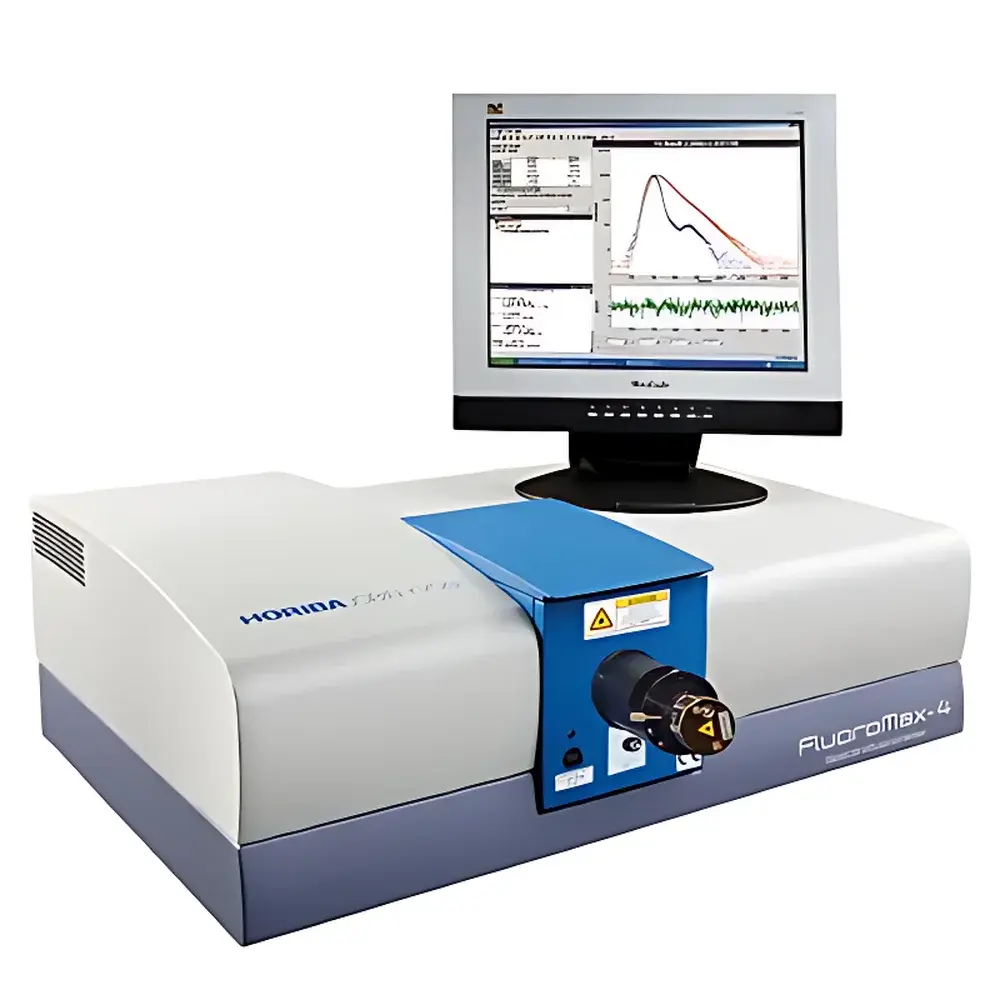
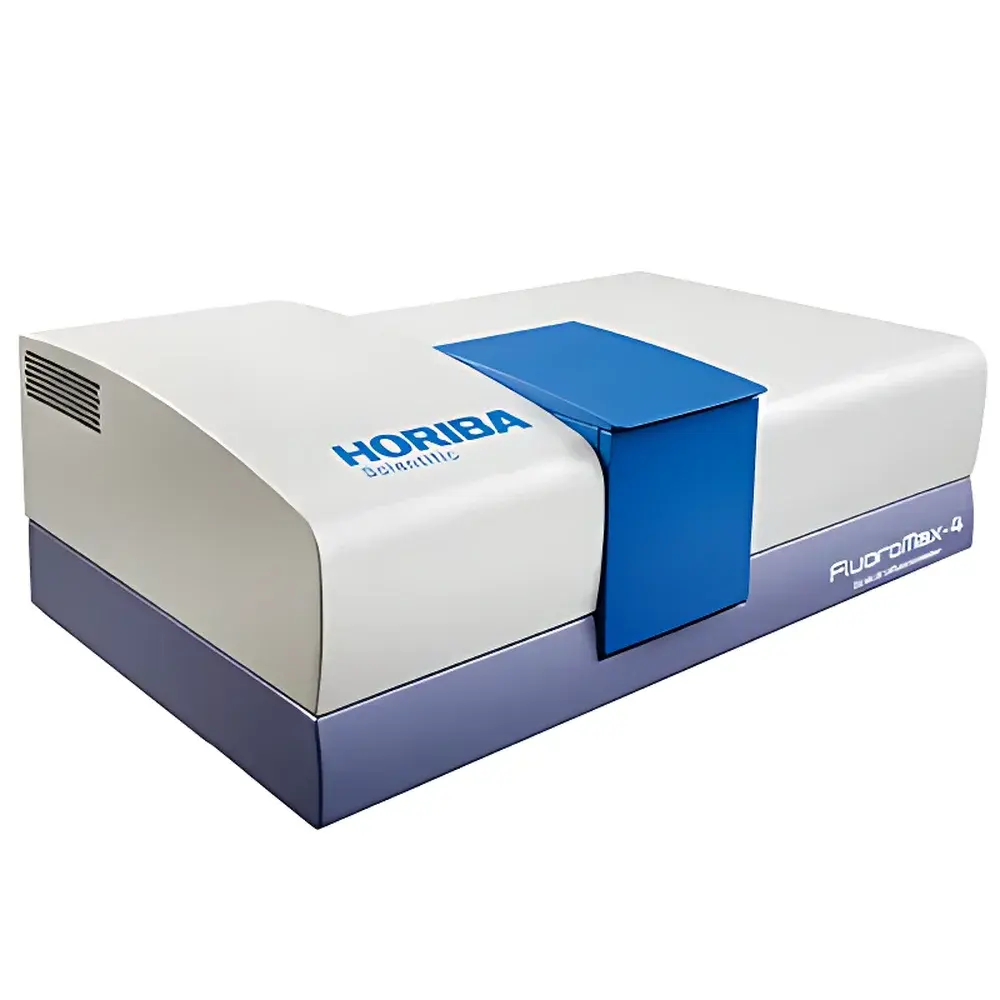
HORIBA FluoroMax Plus Integrated High-Sensitivity Molecular Fluorescence Spectrometer
| Brand | HORIBA |
|---|---|
| Origin | USA |
| Manufacturer Type | Original Equipment Manufacturer (OEM) |
| Import Status | Imported |
| Model | FluoroMax Plus |
| Dispersion Element | Holographic Grating |
| Instrument Type | Steady-State and Time-Resolved Fluorescence Spectrometer |
| Slit Width (Spectral Bandpass) | 0–30 nm, Motorized & Computer-Controlled |
| Sensitivity | >16,000:1 (RMS Method) |
| Wavelength Accuracy | ±0.5 nm |
| Optical Design | All-Reflective Czerny–Turner Monochromator |
| Excitation Source | 150 W Ozone-Free Xenon Arc Lamp (Vertically Mounted) |
| Reference Detector | Stabilized Silicon Photodiode |
| Detection Mode | Photon Counting PMT with Optional TCSPC Upgrade Capability |
Overview
The HORIBA FluoroMax Plus is an integrated, high-sensitivity molecular fluorescence spectrometer engineered for quantitative steady-state and time-resolved photoluminescence characterization across academic, pharmaceutical, and industrial R&D laboratories. Based on a fully reflective Czerny–Turner optical architecture, the system eliminates chromatic aberration inherent in refractive optics—ensuring spectral fidelity, photometric accuracy, and long-term signal stability. Its core measurement principle relies on wavelength-selective excitation and emission detection using photon-counting photomultiplier tube (PMT) technology, enabling sub-picomolar detection limits and robust signal-to-noise performance. The instrument supports both direct luminescence intensity quantification and advanced lifetime-resolved modalities—including phosphorescence decay analysis and optional time-correlated single-photon counting (TCSPC) upgrades—making it suitable for kinetics studies, quantum yield determination, and complex multi-exponential decay modeling.
Key Features
- All-reflective optical path: Eliminates dispersion-induced errors and maintains consistent throughput across UV–Vis–NIR range (typically 200–900 nm)
- Photon-counting detection architecture: Reduces dark current noise and enables high dynamic range (>6 decades) without gain saturation
- Motorized, continuously variable slit control (0–30 nm): Optimizes resolution vs. sensitivity trade-offs per experimental requirement
- Integrated reference photodiode: Enables real-time excitation beam monitoring and automatic intensity normalization
- Vertical 150 W ozone-free xenon lamp: Delivers stable broadband output with minimal thermal drift and no UV ozone generation
- Modular platform design: Supports seamless integration of TCSPC electronics, phosphorescence delay modules, and infrared-enhanced detectors
- Compact monolithic optical bench: Minimizes alignment sensitivity and enhances mechanical stability under ambient lab conditions
Sample Compatibility & Compliance
The FluoroMax Plus accommodates diverse sample formats—including cuvettes (1–250 µL), solid films, powders, microplates (via optional plate reader interface), and flow-through cells (HPLC, stopped-flow). Temperature-controlled stages (Peltier and liquid nitrogen-cooled) support measurements from –196 °C to +150 °C. All firmware and software comply with GLP/GMP data integrity requirements, including full audit trail logging, electronic signatures (21 CFR Part 11 compliant mode), and secure user access levels. Instrument validation documentation aligns with ISO/IEC 17025 and ASTM E2892–19 guidelines for fluorescence spectrometer performance verification.
Software & Data Management
Control and analysis are performed via HORIBA’s FluorEssence™ software—a modular, scriptable platform supporting automated method sequencing, kinetic acquisition, global lifetime fitting (e.g., multi-exponential decay convolution), absolute photoluminescence quantum yield (PLQY) calculation, and polarization anisotropy analysis. Raw data files adhere to HDF5 format for long-term archival and third-party interoperability (e.g., MATLAB, Python via h5py). All calibration files—including grating efficiency curves, lamp intensity profiles, and detector response functions—are embedded and auto-applied during acquisition. Software updates are delivered through HORIBA’s secure customer portal with version-controlled release notes and traceable patch history.
Applications
- Quantitative assay development and QC testing of fluorophore-labeled biomolecules (e.g., antibodies, oligonucleotides)
- Photophysical characterization of organic LEDs (OLEDs), perovskites, and quantum dots
- Binding affinity and conformational dynamics studies via fluorescence anisotropy and FRET
- Pharmaceutical solid-state analysis: polymorph identification, degradation kinetics, and excipient interactions
- Environmental monitoring: PAH detection in soil/water extracts, dissolved organic matter (DOM) fingerprinting
- Materials science: defect-state mapping in 2D semiconductors, triplet harvesting efficiency in TADF emitters
FAQ
Can the FluoroMax Plus perform absolute quantum yield measurements?
Yes—when equipped with the integrating sphere accessory and calibrated standards, FluorEssence™ calculates absolute PLQY per ASTM E2892–19 and IUPAC recommendations.
Is TCSPC functionality built-in or added as an external module?
TCSPC is an optional field-upgradable module; the base system includes hardware triggers and timing interfaces compatible with HORIBA’s DeltaHub or third-party TCSPC electronics.
What temperature ranges are supported with available accessories?
Standard Peltier stage: –30 °C to +150 °C; liquid nitrogen Dewar: down to –196 °C; cryostat-compatible mounting interfaces available upon request.
Does the system support compliance with FDA 21 CFR Part 11?
Yes—audit trail, electronic signature, and role-based access controls are enabled in validated software configuration mode.
Are spectral calibration files included and automatically applied?
Yes—all wavelength and intensity calibrations are factory-measured, embedded in firmware, and applied in real time without user intervention.






