
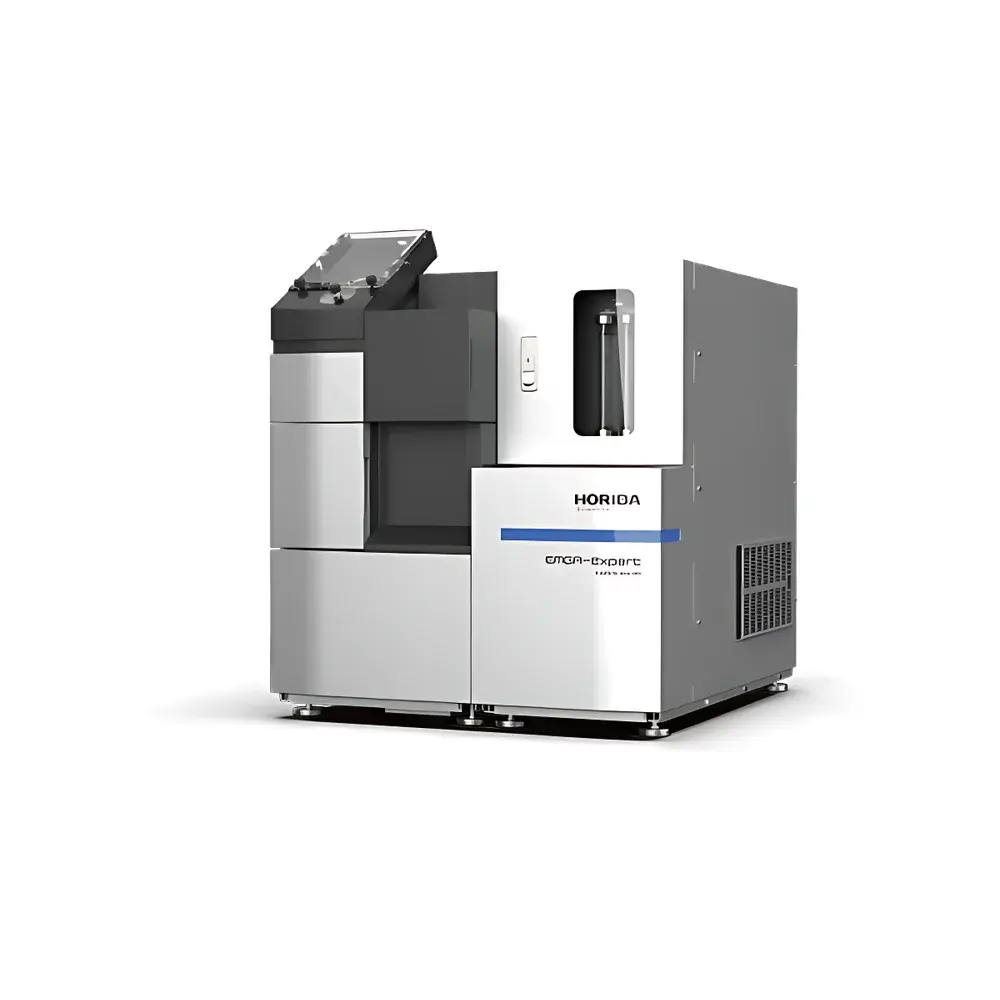
HORIBA EMGA-Expert Oxygen/Nitrogen/Hydrogen Analyzer
| Brand | HORIBA |
|---|---|
| Origin | Imported |
| Manufacturer | HORIBA, Ltd. |
| Model | EMGA-Expert |
| Detection Principle | Pulse Heating Extraction + NDIR (CO/CO₂, H₂O) & TCD (N₂) |
| Gas Detection Methods | Non-Dispersive Infrared (NDIR) for O and H |
| Automation Options | Auto-Sampler, Auto-Crucible Loader, Auto-Electrode Cleaner, Halogen Trap |
| Compliance Support | ASTM E1019, ISO 14284, ISO 22356, JIS G 1257, USP <233>, FDA 21 CFR Part 11 (audit trail enabled), GLP/GMP-ready software architecture |
Overview
The HORIBA EMGA-Expert is a high-performance inert gas fusion analyzer engineered for the simultaneous, quantitative determination of oxygen (O), nitrogen (N), and hydrogen (H) in metallic and ceramic materials. It employs pulse heating extraction under controlled helium or argon atmosphere: a graphite crucible containing the sample is rapidly heated to temperatures exceeding 3,000 °C via resistive Joule heating between upper and lower electrodes. Under these conditions, oxygen reacts with graphite to form CO; hydrogen is liberated as H₂ and subsequently oxidized to H₂O over a copper oxide catalyst; nitrogen is evolved as molecular N₂. The evolved gases are swept by carrier gas through a multi-stage conditioning path—comprising particulate filtration, catalytic oxidation, and moisture removal—before detection. Oxygen and hydrogen are quantified using proprietary, in-house manufactured non-dispersive infrared (NDIR) detectors optimized for CO/CO₂ and H₂O absorption bands, respectively; nitrogen is measured via a precision thermal conductivity detector (TCD). This dual-detection architecture ensures trace-level sensitivity (sub-ppm detection limits), high reproducibility (<1.5% RSD for certified reference materials), and long-term signal stability—critical for quality control in aerospace alloys, nuclear-grade steels, additive manufacturing powders, and semiconductor-grade sintered ceramics.
Key Features
- Pulse-heating fusion system with dual-electrode graphite furnace enabling rapid, complete decomposition of refractory matrices including Ti-based alloys, Nb, Zr, and SiC composites.
- Proprietary NDIR detectors designed and manufactured in-house by HORIBA: optimized optical path length, temperature-stabilized IR sources, and precision-calibrated reference cells ensure baseline stability over >10,000 analyses without recalibration.
- Dedicated TCD module with micro-machined thermal sensors and active temperature compensation delivers linear response across 0.1–5,000 ppm N range with <0.5% full-scale drift per month.
- Patented low-maintenance electrode design: lower electrode replacement requires only removal of a single cover plate and insertion of a pre-aligned electrode insert—reducing maintenance time to <2 minutes per service event.
- Extended-life dust filtration: patented membrane-based filter with integrated pressure monitoring enables ≥500 sample runs per filter change (vs. ~50 on legacy systems), minimizing downtime and consumable cost.
- Carrier gas optimization: intelligent flow management reduces helium consumption by 35%, extending 47-L cylinder life from ~1,400 to >2,300 analyses—validated per ISO 8573-1 Class 2 purity requirements.
Sample Compatibility & Compliance
The EMGA-Expert accommodates solid samples up to 1.0 g (standard) or 2.0 g (optional high-capacity crucible), including ferrous/non-ferrous metals, superalloys, carbides, nitrides, and oxide ceramics. Sample forms include chips, turnings, powders, and pressed pellets. Crucible options include standard graphite, high-purity graphite (low blank), and zirconia-coated variants for halogen-rich or sulfur-containing samples. The system complies with ASTM E1019 (standard test methods for determination of O/N/H in steel and iron), ISO 14284 (steel—determination of total oxygen content), ISO 22356 (titanium and titanium alloys), and JIS G 1257. Software includes full 21 CFR Part 11 compliance mode with electronic signatures, audit trails, user access levels, and data integrity logging. All calibration and verification procedures align with ISO/IEC 17025 requirements for accredited testing laboratories.
Software & Data Management
EMGA-Expert operates on HORIBA’s proprietary EMGA Control Suite—a Windows-based application built on .NET Framework with SQLite backend and optional SQL Server integration. The suite implements three embedded navigation modules: (1) Analysis Navigation recommends optimal heating parameters, gas flow rates, and detector gain settings based on sample type, mass, and expected concentration ranges; (2) Maintenance Navigation provides step-by-step video-guided instructions for electrode cleaning, filter replacement, leak testing, and valve actuation—with real-time counter tracking and automated service alerts; (3) Fault Analysis Navigation diagnoses hardware anomalies (e.g., pressure drop, detector saturation, furnace current deviation) and displays resolution workflows with annotated diagrams and video clips. Data export supports CSV, XML, and LIMS-compatible ASTM E1382 format. Raw spectral traces, calibration curves, and QC reports are archived with SHA-256 hash verification for forensic traceability.
Applications
- Quality assurance of vacuum-melted nickel-based superalloys (e.g., IN718, Waspaloy) for turbine disk forgings—monitoring interstitial O/N/H to prevent embrittlement.
- Process validation of electron-beam melted (EBM) and laser powder bed fusion (LPBF) metal AM feedstocks—ensuring hydrogen < 2 ppm to avoid porosity and cracking.
- Trace oxygen analysis in silicon carbide (SiC) wafers and sintered AlN substrates for power electronics packaging.
- Hydrogen content verification in zirconium cladding tubes for nuclear reactors per ASTM B941.
- Research-grade quantification of nitrogen solubility in austenitic stainless steels during heat treatment studies.
FAQ
What sample preparation is required prior to analysis?
Samples must be clean, dry, and free of surface oxides or oils. Metallic samples are typically machined into chips or drilled turnings; powders require homogenization and pressing into pellets (5–10 kN). No acid digestion or chemical pretreatment is needed.
Can the EMGA-Expert analyze boron- or fluorine-containing materials?
Yes—when equipped with the optional halogen trap unit, which captures HF, BF₃, and other corrosive volatiles upstream of the detectors, preventing sensor degradation and extending calibration intervals.
Is method validation support available for regulated industries?
HORIBA provides IQ/OQ documentation templates compliant with ISO 13485 and GMP Annex 11, plus on-site qualification support for pharmaceutical excipient and medical device metal component testing.
How is detector performance verified over time?
The system performs daily automatic zero/span checks using certified reference gases; long-term stability is tracked via built-in drift correction algorithms and verified quarterly using NIST-traceable CRM standards (e.g., NIST SRM 662a, 663b).
Does the software support remote diagnostics and firmware updates?
Yes—the EMGA Control Suite includes secure TLS 1.2-enabled remote access for HORIBA Field Application Engineers, allowing real-time troubleshooting and over-the-air firmware patches without onsite visits.



