
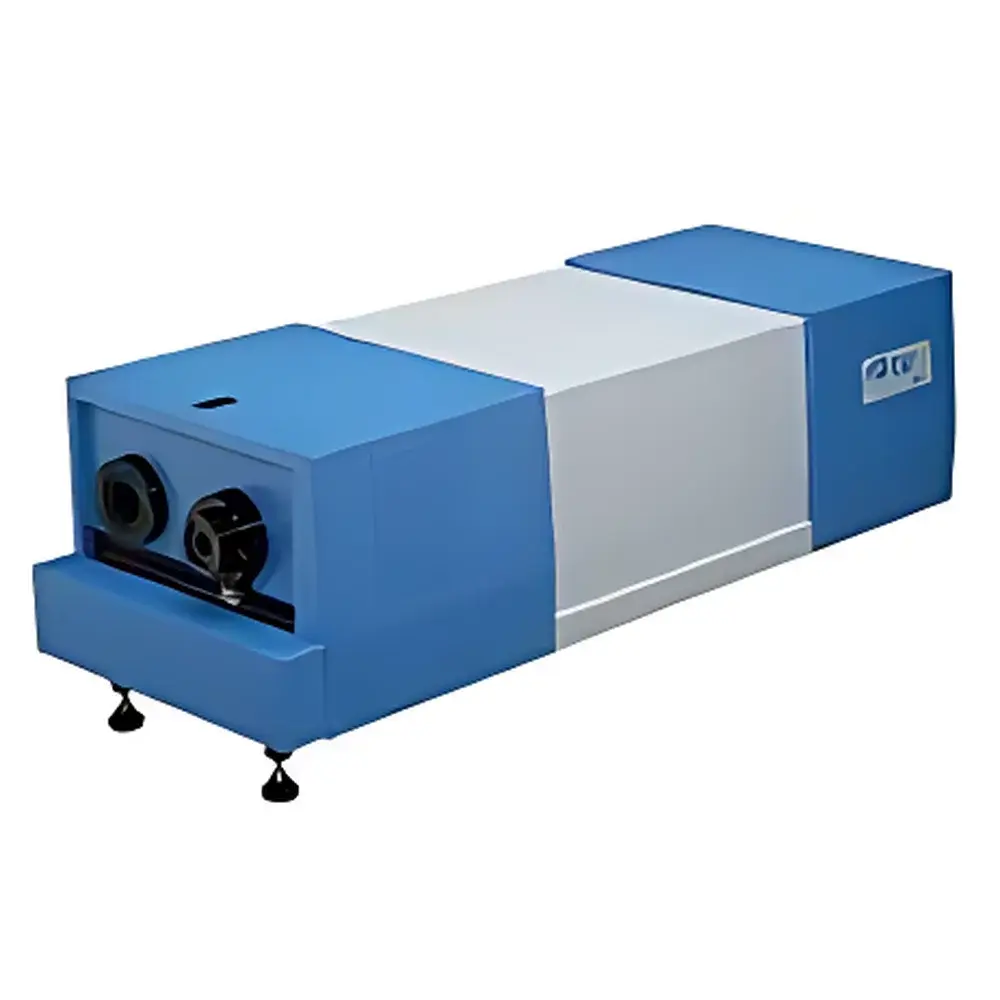
HORIBA FHR1000 High-Resolution Grating Spectrometer
| Brand | HORIBA |
|---|---|
| Origin | France |
| Manufacturer Type | Original Equipment Manufacturer (OEM) |
| Import Status | Imported |
| Model | FHR1000 |
| Application System | Universal |
| Grating Mount | Dual-Grating Turret |
| Spectral Resolution | 0.010 nm |
| Dispersion | 0.8 nm/mm |
| F-number | f/9.0 |
| Focal Length | 1000 mm |
| Wavelength Accuracy | ±0.05 nm |
| Wavelength Repeatability | ±0.015 nm |
| Maximum Scanning Speed | >300 nm/s |
| Grating Dimensions | Single grating: 110 mm × 110 mm |
| Dual-grating configuration | 80 mm × 110 mm each |
| Stray Light | <1×10⁻⁶ (typical, per ISO 14785) |
Overview
The HORIBA FHR1000 is a high-performance, long-focal-length Czerny–Turner grating spectrometer engineered for demanding spectroscopic applications requiring exceptional spectral resolution, wavelength stability, and scanning agility. Operating on the principle of angular dispersion via ruled or holographic diffraction gratings, the FHR1000 delivers sub-10 pm resolution across the UV–Vis–NIR range (typically 190–1100 nm, dependent on grating selection and detector configuration). Its monolithic aluminum alloy optical bench—precision-cast in a single piece—minimizes thermally induced mechanical drift, eliminating wavelength shift and signal degradation associated with multi-component mounts or bolted assemblies. This structural integrity ensures long-term calibration stability and reproducibility under variable ambient conditions, making the FHR1000 suitable for both laboratory-based research and regulated analytical environments where trace-level spectral fidelity is critical.
Key Features
- Monolithic optical base: One-piece cast aluminum construction suppresses thermal expansion effects, delivering intrinsic wavelength stability without active recalibration.
- High-speed scanning mechanism: Achieves >300 nm/s continuous scan velocity while maintaining optical alignment and spectral fidelity—enabling rapid kinetic studies and time-resolved spectroscopy.
- In-axis grating rotation: Ensures constant focal plane position and minimal aberration across the full spectral range, preserving resolution and photometric accuracy during wavelength sweeps.
- Dual-grating turret: Supports up to two large-format gratings (110 mm × 110 mm single or 80 mm × 110 mm dual), enabling seamless switching between high-resolution and high-throughput configurations without realignment.
- Dual-output port architecture: Simultaneous access to primary and secondary exit slits allows concurrent use of array detectors (e.g., CCD, CMOS, or InGaAs) and single-channel detectors (e.g., PMT) for hybrid detection schemes.
- Flexible mounting options: Configurable for horizontal, vertical, or side-flip orientation to accommodate space-constrained setups or integration with microscopes, cryostats, or vacuum chambers.
- Native compatibility: Fully interoperable with HORIBA Jobin Yvon’s ecosystem—including fluorescence, Raman, PL, and ellipsometry accessories—as well as third-party light sources, sample stages, and synchronization hardware via TTL and analog I/O interfaces.
Sample Compatibility & Compliance
The FHR1000 serves as a universal spectroscopic core module compatible with solid, liquid, gaseous, and thin-film samples when coupled with appropriate excitation and collection optics. Its robust mechanical design and low-stray-light performance (<1×10⁻⁶, compliant with ISO 14785 for stray light characterization) support quantitative measurements meeting ASTM E275, ISO 6327, and USP requirements for spectrophotometric validation. When integrated into GLP- or GMP-regulated workflows, the instrument supports audit-trail-capable software platforms compliant with FDA 21 CFR Part 11 (with appropriate configuration and validation documentation). No internal moving parts contact optical paths—ensuring contamination-free operation for ultra-high-purity or hazardous sample analysis.
Software & Data Management
Controlled via HORIBA’s Synapse™ or LabSpec® 6 software suites, the FHR1000 supports full remote operation, automated grating selection, slit width modulation, and synchronized detector triggering. All acquisition parameters—including grating identity, blaze angle, order, slit settings, and calibration coefficients—are embedded in metadata headers (NIST-compliant .spc or HDF5 formats). Software features include real-time background subtraction, spectral deconvolution, peak fitting using Voigt or Gaussian models, and batch processing with customizable export templates (CSV, ASCII, MATLAB .mat). Data provenance is preserved through timestamped acquisition logs, user authentication, and optional electronic signature workflows aligned with ALCOA+ principles.
Applications
- Atomic emission spectroscopy (AES) for elemental line profiling in plasma diagnostics and metallurgical analysis.
- High-resolution Raman spectroscopy of phonon modes in 2D materials (e.g., graphene, MoS₂) and quantum dots.
- Photoluminescence (PL) mapping of semiconductor heterostructures with sub-nanometer excitonic linewidth resolution.
- Laser-induced breakdown spectroscopy (LIBS) with simultaneous multi-element detection at ppm-level sensitivity.
- Calibration-grade wavelength reference systems for synchrotron beamlines and metrology labs.
- Time-resolved pump–probe experiments requiring sub-millisecond spectral acquisition windows.
FAQ
What wavelength ranges are supported by the FHR1000?
The operational range depends on grating groove density, coating, and detector response—typically spanning 190–1100 nm. Custom UV-enhanced or NIR-optimized gratings extend coverage to 130 nm or 2500 nm, respectively.
Is the FHR1000 compatible with vacuum or purged environments?
Yes—the optical bench can be sealed and evacuated to ≤10⁻³ mbar or purged with N₂ or Ar to eliminate atmospheric absorption bands (e.g., O₂, H₂O) in deep-UV or far-NIR measurements.
Can the instrument be validated for regulatory compliance?
Absolutely. Full IQ/OQ/PQ protocols, calibration certificates traceable to NIST standards, and 21 CFR Part 11–ready software packages are available upon request.
How is wavelength calibration performed?
Using internal Hg/Ar or Ne lamp references, or external laser lines (e.g., HeNe, diode lasers); polynomial calibration functions are stored per grating and automatically applied during acquisition.
Does the FHR1000 support motorized entrance/exit slits?
Yes—optional automated slit drives enable programmable bandwidth control and dynamic resolution adjustment during acquisition sequences.



