
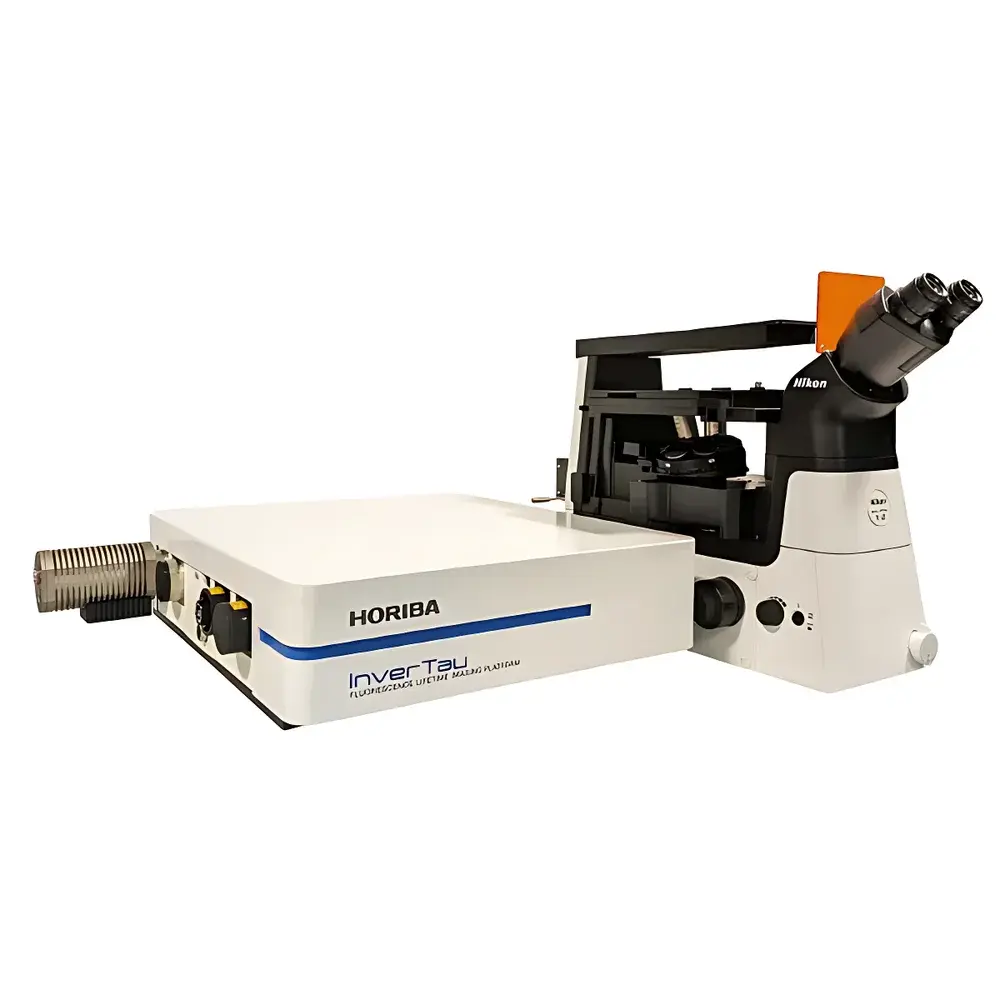
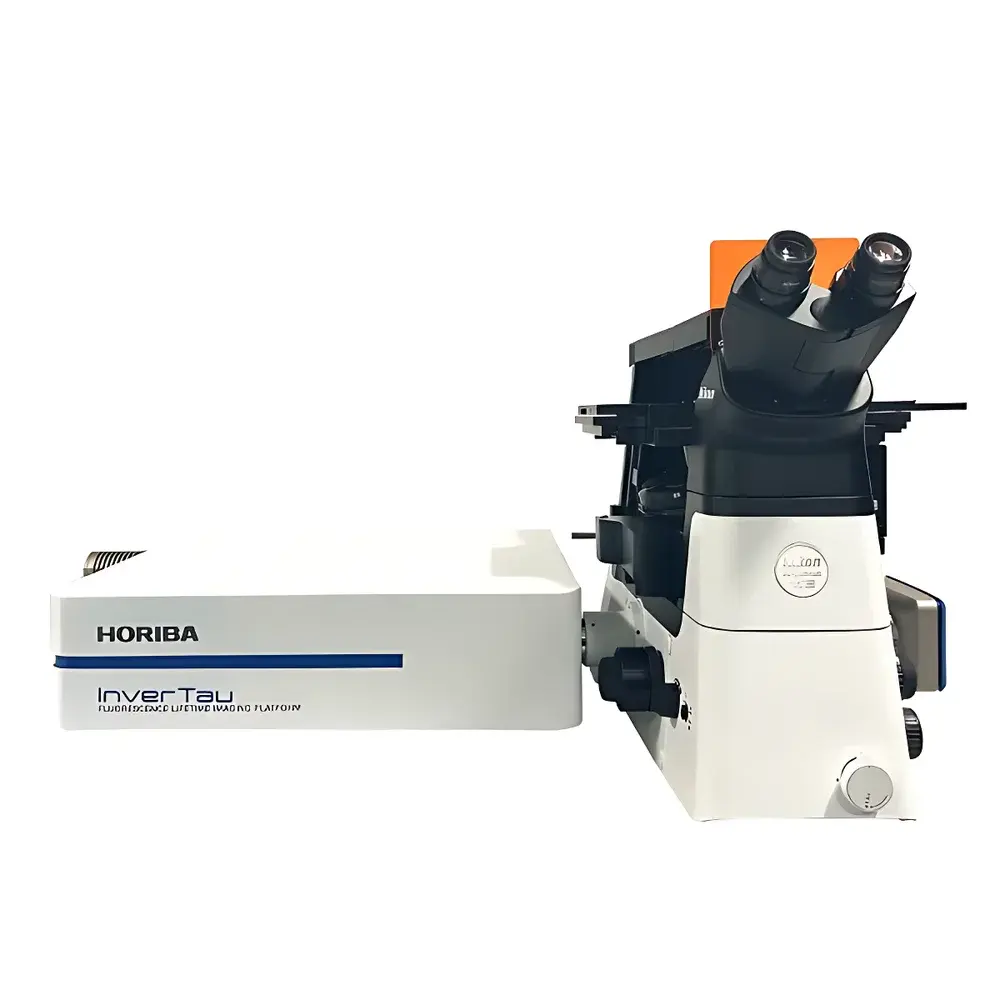
InverTau™ Confocal Fluorescence Lifetime Imaging Microscopy (FLIM) System
| Brand | HORIBA |
|---|---|
| Origin | USA |
| Manufacturer Type | Manufacturer |
| Import Status | Imported |
| Model | InverTau |
| Pricing | Upon Request |
| Dispersive Element | Filter-Based |
| Resolution | 4096 × 4096 |
Overview
The InverTau™ Confocal Fluorescence Lifetime Imaging Microscopy (FLIM) System is a high-performance, TCSPC-based (Time-Correlated Single Photon Counting) laser scanning platform engineered for quantitative, spatially resolved fluorescence lifetime measurement across biological, materials, and pharmaceutical research domains. Unlike intensity-based fluorescence imaging—susceptible to photobleaching, concentration artifacts, and excitation inhomogeneity—FLIM measures the nanosecond-to-second decay kinetics of fluorophore emission, delivering intrinsic, quantitative readouts of molecular conformation, local polarity, pH, ion concentration, and protein–protein interactions. The InverTau™ system leverages HORIBA’s proprietary FiPho timing electronics and integrates seamlessly with inverted microscopes including the Nikon® Ti2-U platform, enabling rigorous confocal FLIM with subcellular spatial fidelity and picosecond temporal resolution down to 50 ps—extending reliably into multi-second regimes for slow-decaying probes.
Key Features
- TCSPC architecture based on HORIBA’s FiPho high-precision timing unit, delivering <15 ps instrument response function (IRF) stability and <1% timing jitter under continuous operation
- Native 4096 × 4096 pixel resolution imaging capability, supporting diffraction-limited spatial sampling and high-fidelity lifetime histogram binning without interpolation artifacts
- Three configurable scan modes: point-scanning (high SNR), resonant scanning (up to 30 fps real-time FLIM with FLIMera™ camera), and hybrid line-scan mode for balanced speed and photon efficiency
- Digital zoom functionality preserving full photon arrival time metadata—enabling lossless region-of-interest (ROI) re-binning and lifetime re-analysis without data reacquisition
- Modular optical coupling design compatible with standard C-mount and infinity-corrected tube lens interfaces; supports integration of pulsed diode lasers (e.g., 405–640 nm), supercontinuum sources, and single-photon avalanche diode (SPAD) or hybrid photodetectors
- EzTime™ touchscreen software with real-time phasor plot rendering, multi-exponential decay fitting (χ²-guided model selection), and batch processing pipelines compliant with FAIR data principles
Sample Compatibility & Compliance
The InverTau™ system accommodates live-cell monolayers, 3D organoids, tissue cryosections, polymer thin films, and quantum dot dispersions—provided samples exhibit measurable fluorescence quantum yield (>1%) and are mounted in low-autofluorescence media. Its optical path complies with ISO 10934-1 (fluorescence microscopy terminology) and supports GLP/GMP-aligned workflows through audit-trail-enabled EzTime™ session logging, user-access controls, and electronic signature support per FDA 21 CFR Part 11. All hardware timing modules undergo annual traceable calibration against NIST-traceable pulsed LED standards, ensuring longitudinal reproducibility across multi-site collaborations.
Software & Data Management
EzTime™ provides an integrated environment for acquisition, visualization, and quantification—including time-gated intensity projection, τ-mean/τ-median mapping, amplitude-weighted lifetime histograms, and phasor trajectory analysis for FRET or metabolic state discrimination. Export formats include HDF5 (with embedded metadata schema), TIFF stacks with lifetime-encoded channels, and CSV-compatible decay curve matrices. Batch processing supports parallelized global fitting across hundreds of ROIs using GPU-accelerated Levenberg–Marquardt algorithms. Raw TCSPC datasets retain full photon timestamp information (time-bin index + x/y coordinate + detector ID), enabling retrospective re-analysis with updated models or calibration parameters.
Applications
- Quantitative monitoring of NAD(P)H and FAD autofluorescence lifetimes in live mitochondria to infer redox ratio and metabolic flux
- Protein interaction mapping via FLIM-FRET using labeled antibodies or nanobodies in fixed and permeabilized tissues
- Characterization of phosphorescent oxygen sensors in 3D hydrogel scaffolds for tissue engineering
- Time-resolved photoluminescence studies of perovskite nanocrystals and conjugated polymers in optoelectronic device development
- Pharmacokinetic profiling of fluorescent drug conjugates in tumor spheroids using dual-channel lifetime unmixing
FAQ
What lifetime range does the InverTau™ system support?
The system measures fluorescence decays from 50 picoseconds up to several seconds, depending on detector choice, laser repetition rate, and acquisition dwell time configuration.
Can I use my existing microscope with InverTau™?
Yes—the system is designed for modular integration with major inverted platforms (Nikon Ti2-U, Olympus IX83, Zeiss Axio Observer) via standardized optical ports and motorized filter turrets.
Does EzTime™ support automated multi-field-of-view (mFOV) FLIM acquisition?
Yes—EzTime™ includes stage-control scripting, autofocus synchronization, and mosaic stitching with lifetime-aware registration to preserve decay integrity across tiles.
Is TCSPC data export compatible with third-party analysis tools like MATLAB or Python?
All raw and processed data export in open, documented formats (HDF5, CSV, TIFF) with complete metadata headers, enabling direct ingestion into SciPy, Lifetimes.jl, or custom TCSPC analysis frameworks.
How often does the system require recalibration?
Annual calibration is recommended; however, built-in reference pulse diagnostics and drift-compensated timing alignment allow for daily verification without external equipment.
Related Products





