
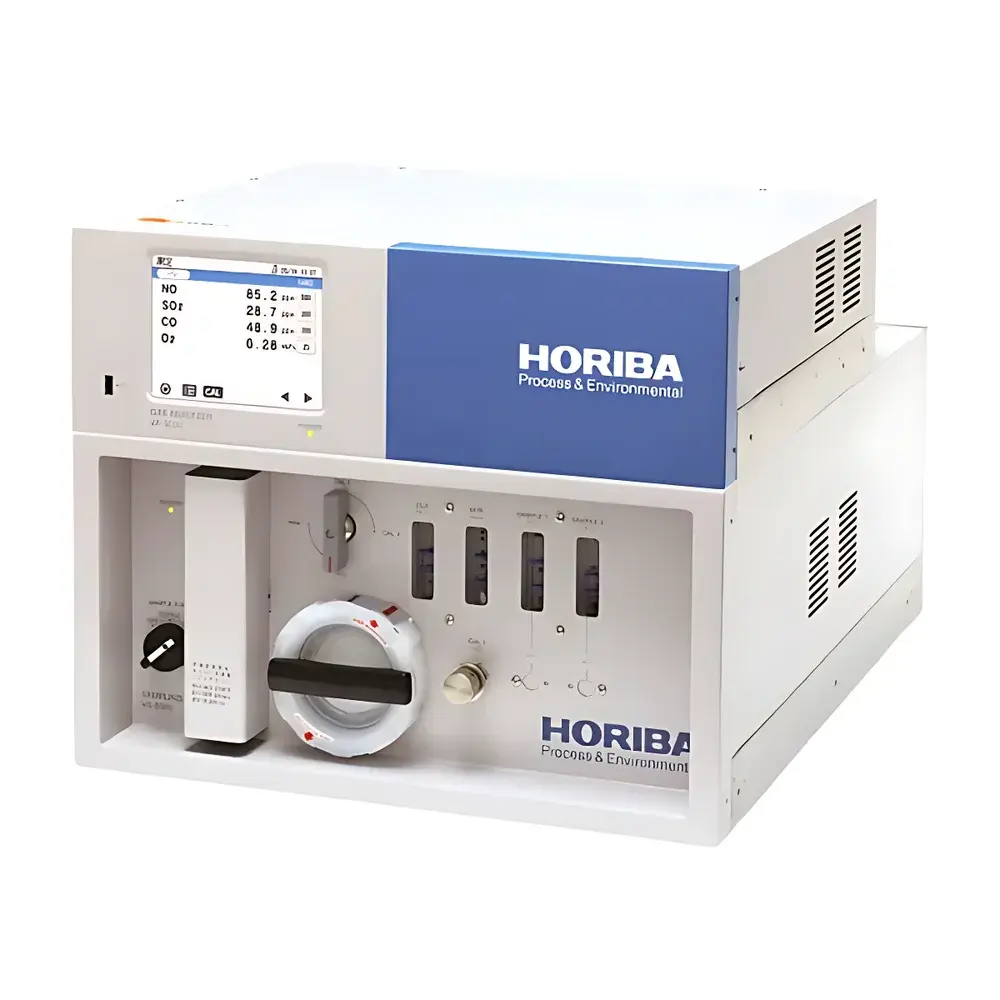
HORIBA VA-5000 Multicomponent Gas Analyzer
| Brand | HORIBA |
|---|---|
| Origin | Japan |
| Manufacturer Type | Original Equipment Manufacturer (OEM) |
| Product Origin | Imported |
| Model | VA-5000 |
| Detection Range | CO, CO₂, NOₓ, SO₂, CH₄, C₂H₄, N₂O, O₂ |
| Repeatability | ±1.0% F.S. |
Overview
The HORIBA VA-5000 Multicomponent Gas Analyzer is a modular, high-flexibility benchtop gas analysis system engineered for precise, simultaneous quantification of up to five gaseous components in complex sample streams. Utilizing a combination of validated physical measurement principles—including Non-Dispersive Infrared (NDIR), Chemiluminescence Analysis (CLA), Magnetic Paramagnetic Analysis (MPA), electrochemical (galvanic cell), and zirconia-based oxygen sensing—the VA-5000 delivers trace-to-percent level detection across an exceptionally broad dynamic range. Its architecture supports application-specific configuration: users select from interchangeable analytical modules tailored to target analytes, concentration ranges, and regulatory requirements. This design enables deployment in demanding environments such as continuous emissions monitoring systems (CEMS), laboratory-scale greenhouse gas research, fuel cell development, biogas process control, and combustion efficiency optimization—where multi-analyte fidelity, long-term stability, and method traceability are critical.
Key Features
- Modular platform supporting up to five concurrently measured components, including mandatory O₂ integration when selecting four additional gases
- Multi-principle detection architecture: NDIR (for CO, CO₂, CH₄, N₂O, SO₂, C₂H₄, etc.), CLA (for sub-ppb NOₓ), MPA (for O₂), electrochemical (for CO, O₂), and zirconia (for high-temperature O₂)
- Wide dynamic range coverage: from low-ppb (e.g., CLA for NOₓ down to 0.1 ppb) to high-% (e.g., NDIR for CO₂ up to 100%)—achievable via programmable multi-range scaling within each module
- High metrological performance: repeatability ≤ ±1.0% F.S., linearity ≤ ±1.0% F.S., zero drift ≤ ±2.0% F.S./week under controlled operating conditions
- Configurable gas conditioning: optional catalyst converter for N₂O measurement in CO-rich streams; integrated moisture and particulate filtration compatible with VS-5000 sampling subsystem
- Robust mechanical design compliant with IEC 61000-6-2 (EMC immunity) and IEC 61000-6-3 (EMC emission) standards
Sample Compatibility & Compliance
The VA-5000 is designed for use with dry, particle-free gas samples at ambient or moderately elevated temperatures (up to 60°C inlet). For applications involving reducing gases (e.g., H₂, CO), zirconia O₂ modules require co-presence of H₂O and/or O₂ to maintain sensor integrity per manufacturer-specified stoichiometric constraints (H₂ + reducing gas < H₂O + O₂). NDIR modules exhibit cross-sensitivity mitigation through spectral filtering and reference channel compensation; CLA modules incorporate ozone generation and reaction chamber optimization to minimize NO₂ interference in NO measurement. The system meets ISO 14064-1 requirements for GHG quantification when configured with certified calibration protocols and traceable standards. It supports audit-ready operation under GLP and GMP frameworks through optional data integrity features aligned with FDA 21 CFR Part 11 requirements (when paired with HORIBA’s certified software suite).
Software & Data Management
Instrument control, real-time visualization, and data logging are managed via HORIBA’s proprietary VA-Link software, compatible with Windows-based host PCs. The software provides configurable alarm thresholds, automatic zero/span verification scheduling, and dual-channel analog output (4–20 mA or 0–10 V) per measured component. All raw signal data, calibration logs, and operator actions are timestamped and stored with SHA-256 hash integrity verification. Export formats include CSV, XML, and PDF reports compliant with EN 15267-3 CEMS validation documentation. Remote diagnostics and firmware updates are supported over Ethernet (TCP/IP) or RS-232 interfaces. Optional cloud connectivity enables secure, encrypted telemetry for centralized fleet monitoring in multi-site environmental compliance programs.
Applications
- Fuel cell R&D: Real-time monitoring of CO (catalyst poison), CO₂ (reforming byproduct), and CH₄ (impurity) in hydrogen feed streams
- Greenhouse gas flux studies: Quantification of N₂O and CH₄ emissions from agricultural soils, wastewater treatment, and landfill gas collection systems
- Combustion optimization: Simultaneous measurement of O₂, CO, NOₓ, and SO₂ in boiler flue gas to calculate excess air ratio and NOₓ/SO₂ conversion efficiency
- Biogas upgrading: Monitoring CH₄ purity, CO₂ removal efficiency, and trace contaminants (e.g., H₂S—via optional add-on sensor) during amine scrubbing or membrane separation
- Regulatory CEMS: Certified configuration for continuous stack monitoring per EPA Method 3A, EN 15267, and JIS B 7982 standards
- Hydrogen-blended natural gas characterization: Detection of CO, CO₂, and O₂ impurities affecting combustion safety and turbine compatibility
FAQ
What is the maximum number of gases the VA-5000 can measure simultaneously?
Up to five components—including O₂ as one required channel—with flexible selection from CO, CO₂, NOₓ, SO₂, CH₄, C₂H₄, N₂O, and O₂.
Can the VA-5000 measure NH₃?
NH₃ is not supported natively; dedicated thermal conductivity or tunable diode laser (TDLAS) modules are recommended—consult HORIBA Application Engineering for integration options.
Is calibration traceable to NIST or other national standards?
Yes—calibration gases used must be certified to ISO 6141 or ISO 6142, and full traceability documentation is provided with each certified calibration kit.
How does the system handle cross-interference between CO and N₂O in the same sample?
When CO exceeds 10 ppm in N₂O measurement mode, a catalytic converter module (VA-CAT) is required upstream to oxidize CO and prevent spectral overlap in the NDIR detector.
What maintenance intervals are recommended for long-term stability?
Filter replacement every 3 months; zero/span verification weekly; full optical alignment and detector sensitivity check annually—or per ISO/IEC 17025 accredited laboratory schedule.
Related Products







