
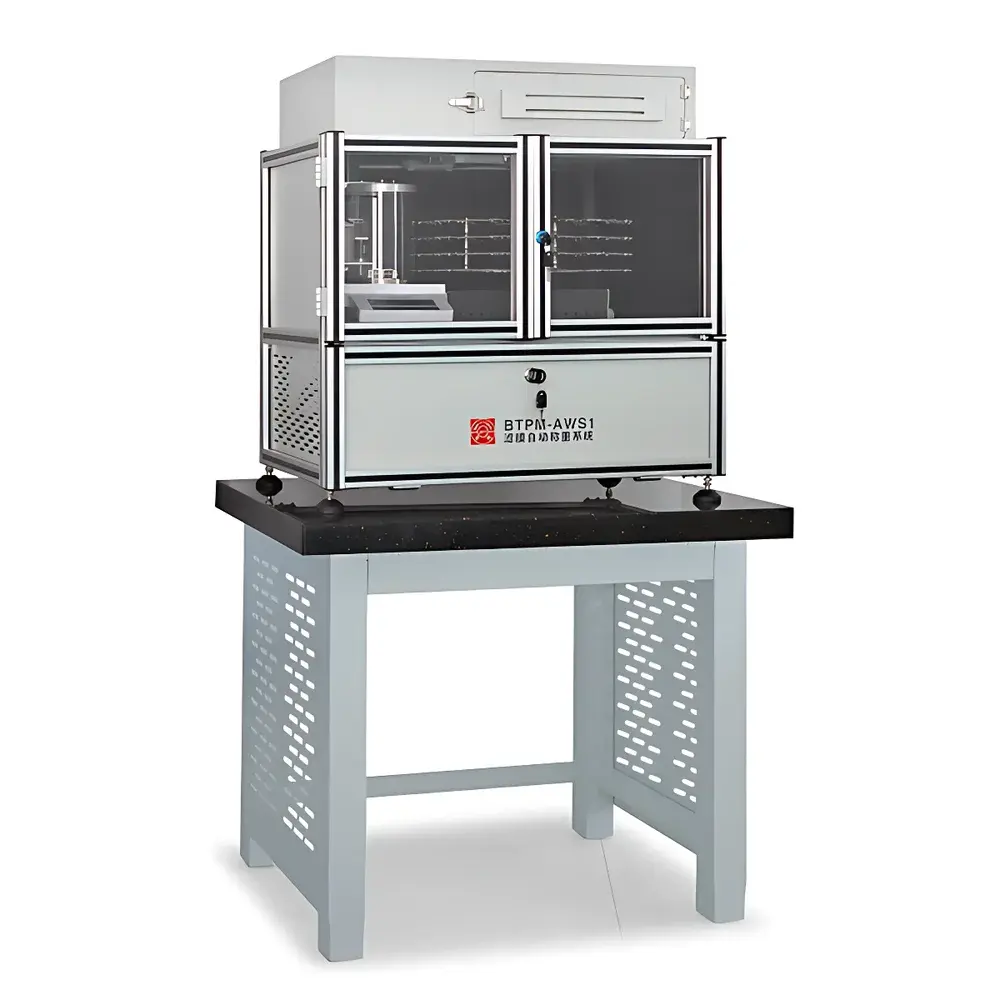
Bettersize BTPM-AWS1 Automated Filter Weighing System for PM2.5/PM10 Gravimetric Analysis
| Brand | Bettersize |
|---|---|
| Origin | Liaoning, China |
| Manufacturer | Bettersize Instrument Co., Ltd. |
| Model | BTPM-AWS1 |
| Measurement Method | Gravimetric Filter Weighing |
| Measured Parameters | PM10, PM2.5 |
| Measurement Range | 0–52 mg/m³ (as mass loading on filter) |
| Sampling Duration | 24 h per cycle |
| Sampling Flow Rate | 1.05 m³/h (±2% accuracy) |
| LOD | 1 µg/m³ (based on 24-h sampling at 1.05 m³/h and 47 mm filter) |
| Flow Stability | ±0.5% over 24 h |
| Balance Resolution | 0.01 mg (10⁻⁵ g) |
| Temperature Control | 25 ± 1 °C |
| Humidity Control | 50 ± 3 %RH |
| Anti-static System | Integrated ionizing neutralization |
| Vibration Isolation | 4-stage active/passive damping platform |
| Max. Batch Capacity | 80 filters (20 for simultaneous weighing + 40 pre-conditioning) |
| Filter Format | 47 mm diameter, any material (glass fiber, quartz, PTFE, cellulose ester) |
| Enclosure | Sealed laminar-flow chamber with HEPA-filtered air |
| Imaging | Built-in CCD camera (1920×1080, timestamped, metadata-embedded) |
| Noise Level | ≤15 dB(A) |
| Power Supply | AC 220 V / 50 Hz, 2000 W |
Overview
The Bettersize BTPM-AWS1 Automated Filter Weighing System is a purpose-built gravimetric instrument engineered for high-precision, trace-level mass determination of atmospheric particulate matter collected on 47 mm diameter filters. It implements the reference-weight method defined in regulatory standards including HJ 656–2013, US EPA Methods IO-3.2 and 40 CFR Part 50 Appendix L, and EN 12341:2014. The system integrates a Class I microbalance (0.01 mg resolution), climate-controlled weighing chamber (25 ± 1 °C, 50 ± 3 %RH), multi-stage vibration isolation, and real-time electrostatic neutralization—functioning as a self-contained, ISO/IEC 17025-compliant weighing environment. Unlike manual or semi-automated workflows, the BTPM-AWS1 eliminates operator-induced variability by performing full-cycle conditioning (pre- and post-sampling equilibration), automated weighing, data logging, and report generation without human intervention. Its sealed architecture prevents ambient contamination during handling, ensuring metrological integrity throughout the entire gravimetric chain—from filter insertion to final mass difference calculation.
Key Features
- Integrated 0.01 mg resolution analytical balance compliant with OIML R76-1 Class I requirements
- Simultaneous processing of up to 20 filters per weighing cycle; concurrent pre-conditioning of up to 40 additional filters
- Active temperature and humidity control meeting HJ 656–2013 specifications (25 ± 1 °C / 50 ± 3 %RH)
- Four-stage mechanical and pneumatic vibration isolation system, validated to meet ASTM E178-22 criteria for balance stability
- Onboard ionizing anti-static module eliminating surface charge effects on all filter substrates (glass fiber, quartz, PTFE, nylon)
- HEPA-filtered laminar airflow enclosure with internal pressure differential to prevent ingress of ambient aerosols
- High-resolution CCD imaging system (1920 × 1080 px) capturing timestamped, geotagged filter images with embedded metadata (mass, RH, T, duration)
- Automated gravimetric workflow: auto-load → pre-equilibrate → weigh → post-equilibrate → calculate Δmass → export CSV/PDF
- Low-noise operation (≤15 dB[A]) enabling installation in shared laboratory spaces without acoustic interference
Sample Compatibility & Compliance
The BTPM-AWS1 accepts standard 47 mm circular filters of any commercially available substrate—including borosilicate glass fiber (e.g., Whatman GF/F), quartz fiber (e.g., Pallflex Tissuquartz), polytetrafluoroethylene (PTFE), and mixed cellulose ester (MCE). No substrate-specific calibration is required due to its direct mass-difference methodology. The system fully satisfies the environmental control, procedural traceability, and uncertainty reporting requirements of HJ 656–2013, US EPA 40 CFR Part 50 Appendix L (for PM2.5 reference methods), and EN 12341:2014 (ambient air quality — measurement of PM10 and PM2.5). All weighing events are time-stamped, logged with environmental parameters, and stored with audit-trail capability compliant with GLP and ISO/IEC 17025 data integrity clauses. Optional 21 CFR Part 11-compliant software modules support electronic signatures and role-based access control for regulated laboratories.
Software & Data Management
The embedded Windows-based control software provides full lifecycle management of filter metadata, environmental logs, balance diagnostics, and gravimetric results. Each filter is assigned a unique ID linked to its sampling campaign, location, date, flow rate, and duration. Raw mass values (pre- and post-sampling), equilibrium duration, chamber conditions, and image thumbnails are stored in an encrypted SQLite database with automatic daily backup. Export formats include ANSI X12-compliant CSV for integration with LIMS, PDF reports with digital signature fields, and XML schemas aligned with ISO 19115 geospatial metadata standards. Audit trails record every user action—including parameter changes, filter re-weighing, and manual overrides—with immutable timestamps and operator IDs. Remote monitoring via secure HTTPS interface enables real-time status checks and alarm notifications (e.g., humidity excursion, door open, balance drift >0.02 mg).
Applications
- Regulatory compliance monitoring for national and regional air quality networks requiring HJ 656–2013 or EPA-equivalent gravimetric validation
- Source apportionment studies requiring high-reproducibility mass loading data across large filter cohorts (e.g., receptor modeling inputs)
- Method validation and inter-laboratory comparison exercises under CNAS or ILAC-MRA frameworks
- Long-term trend analysis of PM2.5/PM10 concentrations where sub-µg repeatability is critical for detecting decadal-scale changes
- Research into filter artifact correction (e.g., volatilization losses, hygroscopic uptake) using synchronized pre/post imaging and climate-log correlation
- Training platforms in environmental science programs where standardized, hands-off gravimetry demonstrates metrological best practices
FAQ
Does the BTPM-AWS1 comply with U.S. EPA equivalency requirements for reference method certification?
Yes—the system meets the environmental control, balance performance, and procedural documentation criteria outlined in 40 CFR Part 53.33 and Appendix L, and has been deployed in EPA-contracted monitoring networks for method verification.
Can the system handle quartz filters without thermal degradation during extended equilibration?
Yes—temperature is strictly maintained at 25 ± 1 °C with no heating elements; quartz filters remain thermally stable throughout 0–48 h conditioning cycles.
Is raw balance data accessible for independent uncertainty propagation calculations?
Yes—all unprocessed mass readings (including tare, gross, and net values), along with full environmental logs and balance diagnostics, are exported in machine-readable format.
How is filter identification managed during high-throughput operation?
Each filter slot is encoded with a QR code; optional RFID tag integration supports automated batch tracking in LIMS-integrated deployments.
What maintenance intervals are recommended for long-term metrological stability?
Annual calibration of the integrated balance per ISO/IEC 17025, quarterly verification of RH/T sensors against NIST-traceable references, and biannual HEPA filter replacement per manufacturer protocol.







