
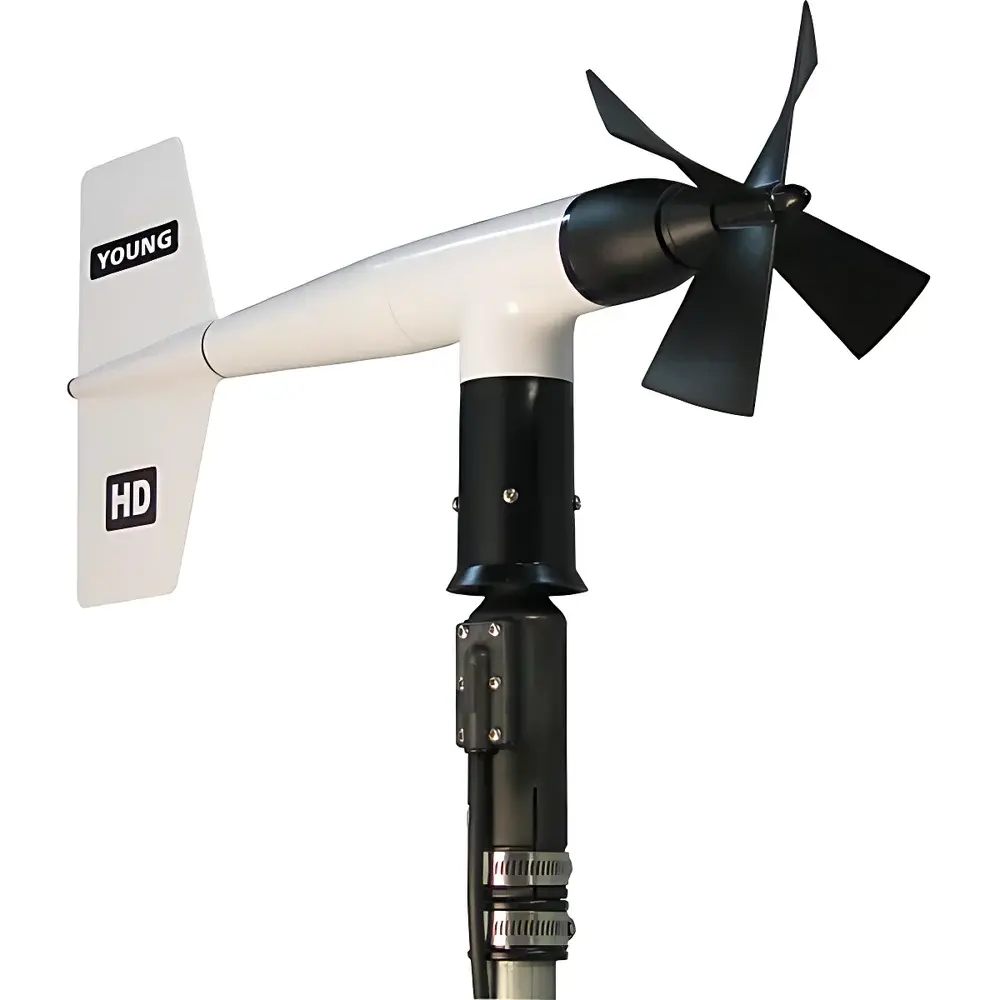
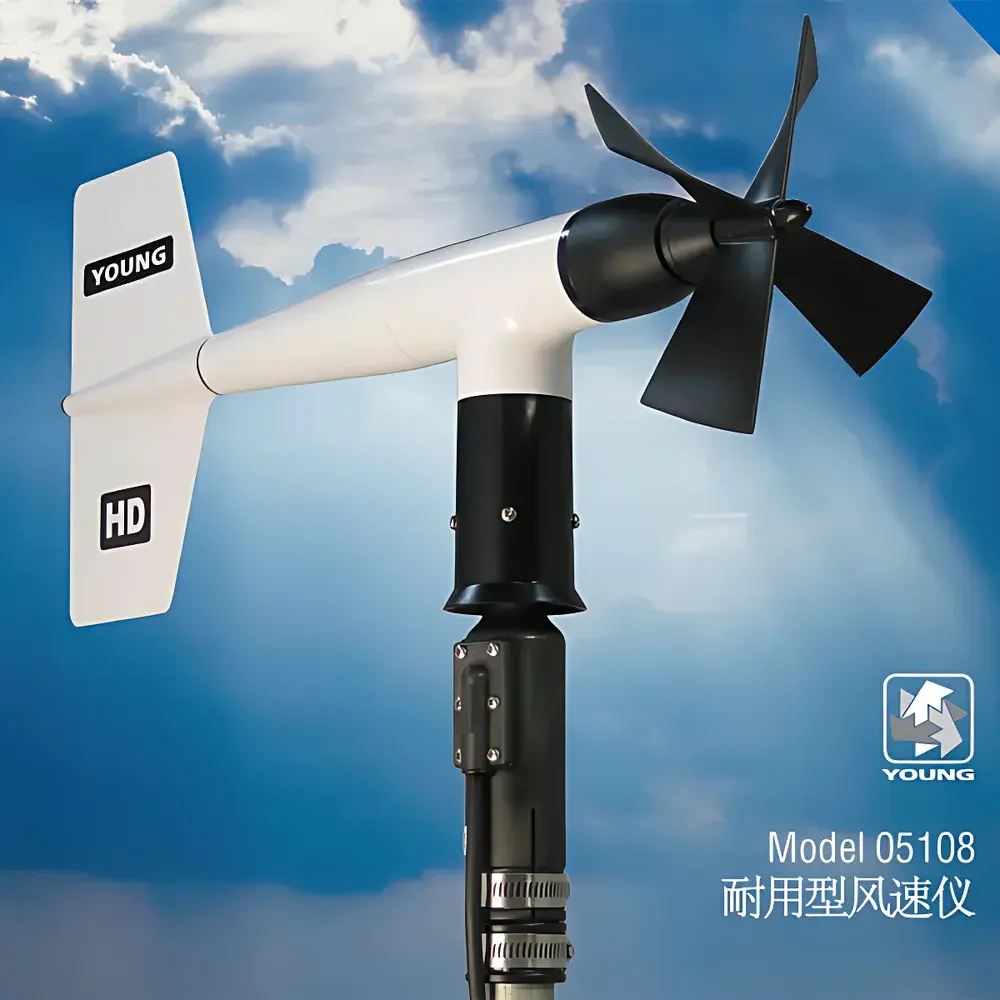
R.M. Young 05108 Heavy-Duty Propeller Anemometer
| Brand | R.M. Young |
|---|---|
| Origin | USA |
| Model | 05108 |
| Instrument Type | Propeller Anemometer |
| Resolution | 0.1 m/s |
| Measurement Range | 0–100 m/s |
| Accuracy | ±3% of reading |
| Operating Temperature | −50°C to +60°C |
| Operating Humidity | 0–100% RH |
| Bearing Material | Ultra-durable ceramic |
| Output | Magnetic pulse (3 pulses/rev, 1 rev = 0.5 m air travel) |
| Propeller Diameter | 18 cm |
| Sensor Height | 40 cm |
| Total Length | 57 cm |
| Mounting Tube Diameter | 34 mm (1-inch standard pipe) |
| Weight | 1.0 kg |
Overview
The R.M. Young 05108 Heavy-Duty Propeller Anemometer is an engineered solution for long-term, high-reliability wind speed measurement in demanding environmental and industrial monitoring applications. Based on the proven Couette-flow-derived rotational principle—where wind-induced rotation of a calibrated propeller generates a proportional frequency signal—the 05108 delivers traceable, mechanically robust performance across extreme ambient conditions. Unlike conventional anemometers susceptible to bearing degradation, this model integrates a proprietary oversized ceramic bearing assembly, eliminating the primary failure mode observed in stainless-steel alternatives. Its design adheres to fundamental meteorological instrumentation standards—including ISO 16622:2019 (wind sensor performance requirements) and WMO Guide to Meteorological Instruments and Methods of Observation (CIMO Guide, Chapter 12)—ensuring compatibility with national weather networks, atmospheric research stations, and industrial stack monitoring systems.
Key Features
- Ultra-long-life ceramic bearing system—resistant to corrosion, thermal cycling, and particulate abrasion; rated for >50 million rotations under continuous operation
- Oversized propeller shaft and high-pitch aerodynamic propeller geometry—optimized for low-startup-threshold response (1.0 m/s) and minimal stalling at turbulent or low-wind conditions
- Locking propeller nut assembly—prevents torque-induced loosening during sustained high-wind exposure
- Modular signal interface compatibility—supports direct pulse output (05108 variants) or analog conversion via optional external modules (05608C for 0–5 VDC; 05638C for 4–20 mA)
- IP65-rated housing and UV-stabilized polymer components—validated for continuous outdoor deployment across arctic (-50°C) and desert (+60°C) environments
- Standard 1-inch NPT-compatible mounting interface—enables rapid integration into existing mast, tower, or rooftop infrastructure
Sample Compatibility & Compliance
The 05108 is suitable for open-air atmospheric sampling, boundary-layer profiling, emissions stack monitoring, wind resource assessment, and HVAC duct airflow verification. It complies with IEC 61260-1:2014 (class 1 octave-band filter requirements for auxiliary sensing), and its mechanical construction meets ASTM D5096-20 (Standard Practice for Calibration of Anemometers). When paired with the 05608C or 05638C interface units, the full system supports data acquisition architectures compliant with FDA 21 CFR Part 11 (electronic records/signatures) when deployed in regulated environmental QA/QC workflows. All variants are CE-marked and RoHS-compliant; no hazardous substances are used in sensor coil windings or bearing lubrication.
Software & Data Management
The 05108 operates as a passive transducer and does not include embedded firmware or onboard memory. Pulse output (3 pulses per revolution, 1 revolution = 0.5 m linear air displacement) is directly compatible with industry-standard data loggers—including Campbell Scientific CR series, Onset HOBO RX3000, and Delta-T DL2e—without signal conditioning. When interfaced via the 05608C (0–5 VDC) or 05638C (4–20 mA), the system supports time-synchronized wind speed and direction acquisition at up to 10 Hz sampling rates. Calibration coefficients (linear slope and offset) are supplied with NIST-traceable documentation and can be imported into SCADA platforms (e.g., Ignition, WinCC) or Python-based processing pipelines using standard Modbus RTU or analog input drivers. Audit trails for calibration events and sensor replacement logs are maintained externally per GLP/GMP-aligned data governance protocols.
Applications
- Long-term climatological monitoring at NOAA, EEA, and national meteorological service stations
- Wind turbine site assessment and post-installation performance validation
- Industrial stack emission compliance reporting (EPA Method 2F, EN 15259)
- Boundary-layer turbulence studies in atmospheric boundary layer (ABL) wind tunnels
- Fire weather index calculation in wildland fire management systems
- Validation of CFD simulations requiring field-measured velocity profiles
FAQ
What is the minimum detectable wind speed for the 05108?
The propeller starts rotating reliably at 1.0 m/s; resolution remains 0.1 m/s across the full 0–100 m/s range.
Can the 05108 measure wind direction?
No—the 05108 is a uniaxial wind speed sensor only. For simultaneous wind speed and direction, pair it with the R.M. Young 05103 wind vane or use the integrated 05608C/05638C interface modules that accept co-located vane inputs.
Is the ceramic bearing serviceable in the field?
No—bearing replacement requires factory recalibration and dynamic balancing; the design eliminates scheduled maintenance for typical 5–10 year deployments.
Does the 05108 require external power?
Only when used with optional interface modules (05608C or 05638C); the base 05108 sensor itself is self-generating and requires no excitation.
How is calibration traceability maintained?
Each unit ships with a certificate referencing NIST-traceable wind tunnel calibration at three points (5, 25, and 75 m/s), conforming to ISO/IEC 17025:2017 accredited laboratory practices.







