
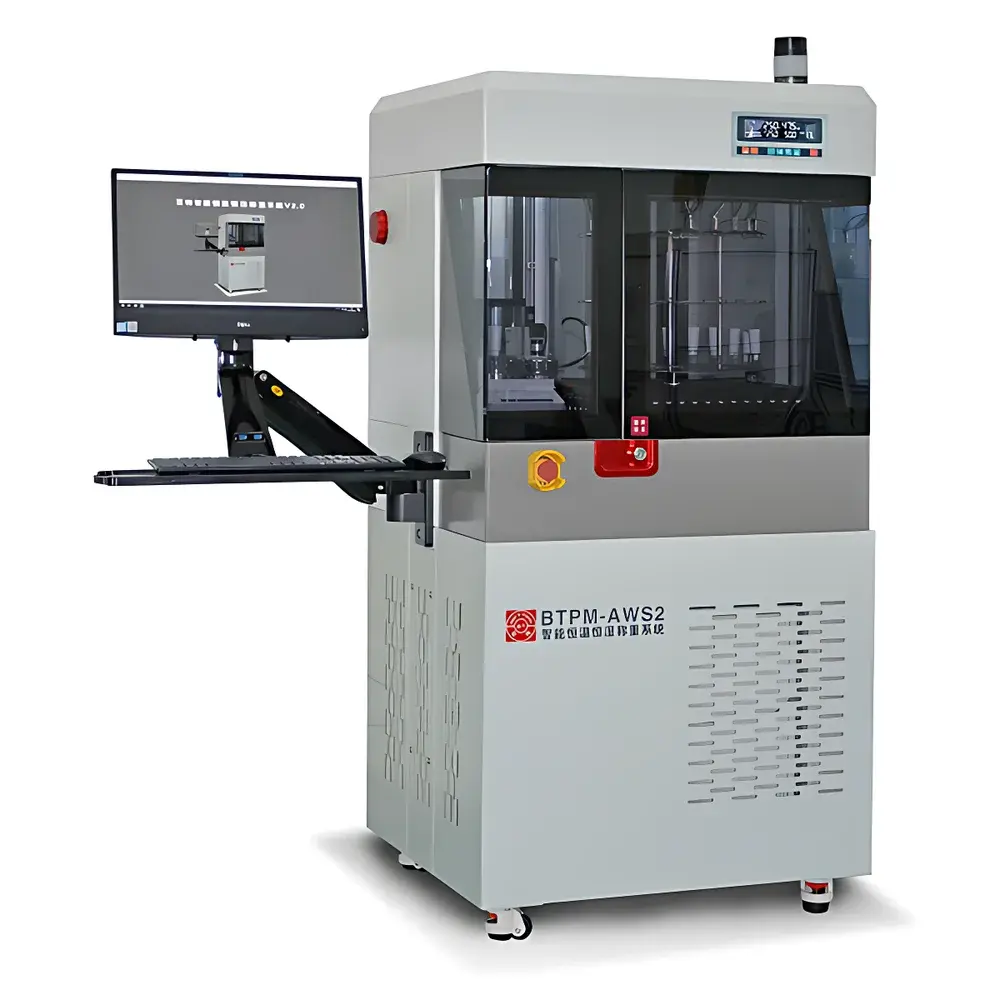
Bettersize BTPM-AWS2 Automated Gravimetric Weighing System for PM10/PM2.5 Filter Analysis
| Brand | Bettersize |
|---|---|
| Origin | Liaoning, China |
| Manufacturer | Bettersize Instrument Co., Ltd. |
| Model | BTPM-AWS2 |
| Measurement Method | Membrane Gravimetry |
| Measured Parameters | PM10, PM2.5 |
| Measurement Range | 0–52 mg/m³ |
| Sampling Cycle | 24 h |
| Sampling Flow Rate | 1.05 L/min ±2% |
| LOD | 1 µg/m³ |
| Flow Stability | ≤±1% over 24 h |
| Balance Resolution | 0.01 mg (10 µg) or optional 0.001 mg (1 µg) |
| Temperature Control Range | 15–30 °C (adjustable, ±0.1 °C stability) |
| Humidity Control Range | 40–60 %RH (adjustable, ±3 %RH stability) |
| Vibration Isolation | Dual-Stage Quadruple-Level Isolation (4-level balance + 4-level chassis) |
| Electrostatic Neutralization | Ionizing air bar (non-radioactive, CE-compliant) |
| Sample Capacity (per cycle) | 200 × 47 mm filters / 100 × 90 mm filters / 60 × filter tips or quartz/ceramic filter tubes |
| Identification Systems | RFID (47/90 mm filters), QR Code (47/90 mm), Barcode (filter tips/tubes), Binary-coded positional encoding |
| Conditioning Time | 0–48 h programmable |
| Water Replenishment Interval | ≤30 days (closed-loop humidification system) |
| Power Supply | AC 220 V / 50 Hz, 2000 W |
| Compliance | HJ 618–2011, HJ 656–2013, HJ 836–2017, ISO 12103-1, ASTM D1856, USP <661>, GLP-aligned audit trail logging |
Overview
The Bettersize BTPM-AWS2 is an automated gravimetric weighing system engineered specifically for regulatory-compliant mass determination of atmospheric particulate matter collected on filter media. It implements standardized weight-based quantification per the U.S. EPA Reference Method IO-3.3 and Chinese environmental standards HJ 618–2011, HJ 656–2013, and HJ 836–2017. The system integrates high-precision microbalance metrology with tightly controlled thermal-hygrometric conditioning and multi-layer mechanical isolation to eliminate environmental interference during ultra-low-mass measurement. Unlike manual or semi-automated setups, the BTPM-AWS2 performs full-cycle gravimetric analysis—including desiccation conditioning, electrostatic neutralization, tare stabilization, net mass acquisition, and uncertainty-aware data annotation—within a sealed, class-100 clean chamber. Its architecture conforms to the physical requirements of a certified analytical balance room: temperature stability ≤±0.1 °C, humidity control within ±3 %RH, and vibration transmission attenuation exceeding 99.99% across 0.5–100 Hz via independent dual-quadruple passive damping stages.
Key Features
- Four-tiered identification architecture: RFID encoding for reusable 47/90 mm filters; QR code scanning for disposable membranes; barcode recognition for filter tips and rigid sampling tubes; and binary positional encoding for unmarked substrates—enabling traceable, mix-compatible batch processing.
- Dual-quadruple vibration isolation: Independent four-stage damping systems applied separately to the analytical balance and main chassis, achieving >120 dB insertion loss at resonant frequencies typical of HVAC and floor-borne disturbances.
- Electrostatic mitigation using non-ionizing, CE-certified ionizing air bars—eliminating surface charge without radioactive sources or ozone generation, critical for low-mass (<100 µg) PM2.5 filter analysis.
- Programmable conditioning protocol: Adjustable equilibration duration (0–48 h), temperature setpoint (15–30 °C), and relative humidity range (40–60 %RH), all logged with timestamped environmental telemetry.
- Modular sample handling: Supports simultaneous loading of up to 200 pieces of 47 mm filters, 100 pieces of 90 mm filters, or 60 units of filter tips/tubes—with automatic gripper calibration and collision-avoidance path planning.
- Traceable data governance: All weighings generate ISO/IEC 17025-aligned metadata—including balance serial number, calibration certificate ID, operator ID, ambient conditions, and digital signature—stored in encrypted SQLite database with export to CSV, Excel, and XML formats compliant with EPA Compendium Method TO-17 and EU Directive 2008/50/EC Annex II.
Sample Compatibility & Compliance
The BTPM-AWS2 accommodates all standard filter media used in ambient and stack emission monitoring, including glass fiber (GF/F, GF/D), quartz (QMA, QMB), polytetrafluoroethylene (PTFE), and nylon membranes—regardless of hydrophobicity, thickness, or thermal history. Each filter type undergoes material-specific conditioning profiles validated per HJ 656–2013 Annex A. The system meets the procedural and instrumental requirements of multiple international regulatory frameworks: it satisfies the “controlled environment” definition in USP , supports 21 CFR Part 11-compliant electronic records when paired with optional audit-trail software module, and provides documented evidence for GLP and ISO/IEC 17025 laboratory accreditation audits. All hardware components—including the microbalance, humidity generator, and RFID reader—are factory-calibrated with NIST-traceable certificates, and recalibration intervals are tracked automatically.
Software & Data Management
The embedded Windows-based control software (v4.2+) features role-based access control, configurable workflow templates, real-time environmental monitoring dashboard, and automated report generation per HJ 656–2013 Table 3. Raw weighing data—including gross mass, tare mass, net mass, standard deviation, and coefficient of variation—is stored with full metadata provenance. Audit logs record every user action, parameter change, and hardware event with cryptographic hashing. Export functions support direct integration with LIMS platforms via ODBC and HL7 interfaces. Optional cloud synchronization enables remote QA/QC review and cross-laboratory method validation studies. All data files are digitally signed using SHA-256 and retain immutable timestamps synchronized to GPS-disciplined NTP servers.
Applications
- Regulatory compliance monitoring at national and provincial environmental monitoring stations performing PM10 and PM2.5 reference method analysis.
- Source apportionment studies requiring high-throughput, inter-laboratory comparable gravimetric datasets from receptor modeling inputs.
- Stack testing laboratories conducting low-concentration particulate measurements per HJ 836–2017 for coal-fired, cement, and waste incineration facilities.
- Academic and governmental research institutes engaged in aerosol chemistry, long-range transport modeling, and health impact assessment where measurement uncertainty budgets must be rigorously defined.
- Meteorological observatories implementing standardized filter exchange protocols across regional monitoring networks under WMO GAW guidelines.
FAQ
Does the BTPM-AWS2 meet U.S. EPA equivalency requirements for PM2.5 monitoring?
Yes—the system fulfills the instrumental specifications outlined in EPA Reference Method IO-3.3 for automated gravimetric analysis, including temperature/humidity control, balance resolution (≤0.01 mg), and environmental isolation criteria.
Can the system handle quartz filters without thermal degradation during conditioning?
Yes—quartz filters are processed using non-thermal desiccation protocols with humidity-controlled equilibration only; no heating elements contact filter media.
Is remote diagnostics and firmware update supported?
Yes—via secure TLS-encrypted SSH tunnel and optional cellular backup module; updates require dual-signature authentication.
What documentation is provided for ISO/IEC 17025 accreditation?
Full traceability package includes uncertainty budget calculation worksheets, calibration certificates with CMC statements, installation qualification (IQ) and operational qualification (OQ) protocols, and preventive maintenance log templates.
How is data integrity ensured during power interruption?
The system employs UPS-backed non-volatile RAM and journaling file system; all ongoing weighings resume from last stable checkpoint without data loss.
Related Products







