
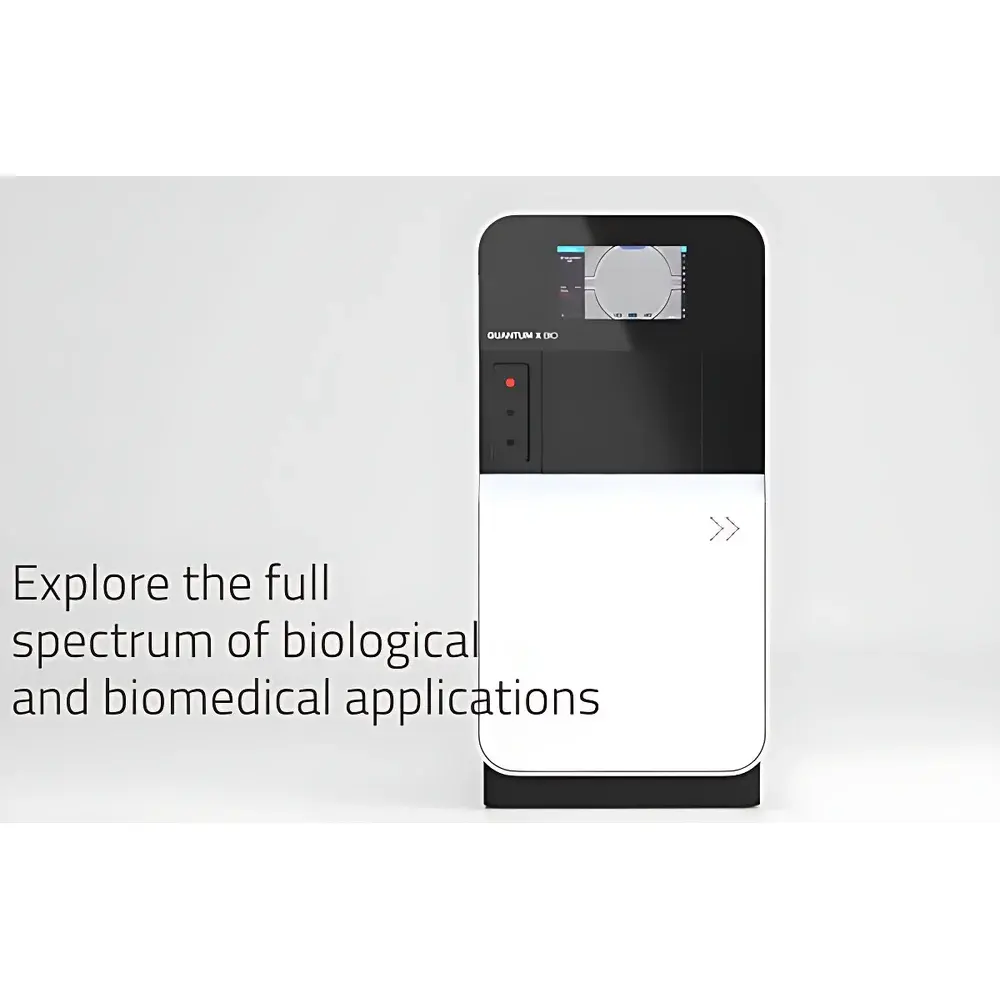
Nanoscribe Quantum X bio Biological 3D Printer
| Brand | Nanoscribe |
|---|---|
| Origin | Germany |
| Model | QX |
| Printing Technology | Two-Photon Polymerization (2PP) with Two-Photon Grayscale Lithography (2GL®) |
| Maximum Print Area | 50 × 50 mm² |
| Substrate Compatibility | Microscope slides (76 × 26 mm), MatTek dishes (35 mm / 50 mm), up to 150 mm wafers, glass, silicon, transparent & opaque materials |
| Biocompatible Resins | IP-S, GP-Silica, Advanced BioMatrix hydrogels, Xpect Inx bioinks, user-defined formulations |
| Sterility | HEPA-filtered laminar airflow, autoclavable components, sterile consumables |
| Temperature Control | Integrated thermostatic substrate stage |
| Laser Wavelength | 780 nm (cell-compatible femtosecond pulsed laser) |
| Cell Viability | >90% at 1 h post-printing (calcein-AM/ethidium homodimer-1 assay) |
| Software | Nanoscribe UX optimized for biological workflows, validated STL bioprint library, real-time sensor & video monitoring, touchscreen + remote operation support |
| Compliance | Designed for GLP-compliant environments |
Overview
The Nanoscribe Quantum X bio is a high-precision, research-grade biological 3D printer engineered for microscale fabrication in life science laboratories. It employs two-photon polymerization (2PP), a nonlinear optical lithography technique that enables true 3D structuring with sub-micrometer resolution—down to <500 nm lateral and <700 nm axial feature sizes—without layer-by-layer constraints. Unlike conventional extrusion-based bioprinters, the Quantum X bio uses focused femtosecond near-infrared laser pulses (780 nm) to induce localized photopolymerization within photosensitive bioresins, minimizing phototoxicity and enabling direct printing inside cell culture vessels. Its proprietary Two-Photon Grayscale Lithography (2GL®) technology allows dynamic voxel modulation during writing, facilitating continuous grayscale control over mechanical stiffness, porosity, and topography—critical parameters for mimicking native extracellular matrix (ECM) cues. The system is purpose-built for applications demanding strict sterility, temperature stability, and cellular viability, including scaffold-guided tissue morphogenesis, organ-on-chip device fabrication, and functional biomimetic microenvironments.
Key Features
- True 3D microfabrication via two-photon polymerization (2PP) with sub-500 nm resolution and depth-independent focusing
- Two-Photon Grayscale Lithography (2GL®) for spatially resolved mechanical property tuning across single printed structures
- Integrated HEPA-filtered laminar airflow enclosure and autoclavable optical components to maintain ISO Class 5 cleanroom-equivalent conditions
- Thermostatically controlled substrate stage (ambient to 40 °C) for temperature-sensitive hydrogel processing and live-cell compatibility
- Direct printing onto standard labware: microscope slides (76 × 26 mm), MatTek culture dishes (35 mm / 50 mm), and up to 150 mm wafers
- Open-material platform supporting IP-S, GP-Silica, Advanced BioMatrix hydrogels, Xpect Inx bioinks, and user-formulated resins
- Real-time process monitoring via synchronized high-resolution camera feed and in-situ sensor feedback (laser power, galvo position, stage temperature)
- Touchscreen-enabled Nanoscribe UX software with pre-validated STL bioprint library, drag-and-drop workflow, and remote job submission via secure HTTPS interface
Sample Compatibility & Compliance
The Quantum X bio accommodates a broad spectrum of substrates—including glass, silicon, PDMS, and polymer films—as well as biologically relevant materials such as methacrylated gelatin (GelMA), hyaluronic acid derivatives, and peptide-conjugated PEGDA. All contact surfaces are compatible with ethanol, isopropanol, and plasma sterilization protocols. The system meets essential requirements for Good Laboratory Practice (GLP) environments: electronic logbooks, timestamped operation records, and role-based access control align with data integrity expectations under FDA 21 CFR Part 11 when deployed alongside qualified laboratory information management systems (LIMS). While not certified as medical device manufacturing equipment, its design adheres to ISO 13485-aligned engineering principles for reproducible, traceable microfabrication processes used in preclinical biomaterial development.
Software & Data Management
Nanoscribe UX is a dedicated, Windows-based software suite optimized for biological 3D printing workflows. It includes automated calibration routines for substrate flatness and laser focus correction, adaptive slicing algorithms for complex STL imports, and batch-processing capabilities for multi-sample experiments. The software integrates native support for common biomedical file formats (STL, OBJ, 3MF) and provides export options for TIFF stacks, CSV-based voxel metadata, and JSON-structured print logs. All print jobs generate immutable digital records—including laser exposure maps, galvanometer trajectories, and environmental sensor timestamps—that can be archived for regulatory review. Remote operation is enabled through encrypted WebSocket connections, allowing users to monitor progress, pause/resume jobs, and adjust parameters mid-print from off-site locations without compromising network security.
Applications
- Tissue engineering scaffolds with controlled pore architecture, gradient stiffness, and biochemical patterning for stem cell differentiation studies
- Microfluidic chips with embedded 3D valves, mixers, and perfusable vascular networks for organ-on-chip platforms
- High-aspect-ratio microneedle arrays for transdermal drug delivery and immunomodulation
- Topographically defined substrates to investigate cell migration, mechanotransduction, and collective behavior under defined ECM geometries
- Biosensor interfaces with nanostructured conductive or plasmonic elements fabricated directly on electrode surfaces
- Functionalized microcarriers for 3D cell culture, bioreactor seeding, and exosome harvesting
- Vascular mimicry models incorporating hierarchical branching, anastomosis sites, and endothelializable luminal coatings
FAQ
What sterilization methods are supported for the Quantum X bio hardware?
The system’s optical path components, sample holders, and chamber interior are designed for autoclaving (121 °C, 2 bar, 20 min) or plasma treatment. HEPA filtration ensures continuous particulate-free air circulation during printing.
Can I use my own bioink formulations with this system?
Yes—the Quantum X bio is an open-platform instrument. Users may load custom photosensitive hydrogels, provided they exhibit two-photon absorption cross-sections >10 GM at 780 nm and appropriate viscosity (<100 mPa·s) for meniscus-free meniscus control.
Is live-cell printing possible during the fabrication process?
While the system supports post-print cell seeding with >90% viability, in situ printing of encapsulated cells requires additional protocol optimization (e.g., oxygen-scavenging additives, reduced laser dwell time) and is validated on a case-by-case basis per resin formulation.
How does the system ensure print fidelity across large-area substrates (e.g., 150 mm wafers)?
Automated substrate flatness mapping and dynamic focus compensation correct for thermal drift and mechanical warpage, maintaining Z-position accuracy within ±200 nm over 50 × 50 mm² fields.
Does Nanoscribe provide application-specific validation data for regulatory submissions?
Nanoscribe delivers technical documentation packages—including IQ/OQ protocols, uncertainty budgets, and material compatibility reports—that serve as foundational evidence for internal quality audits and pre-submission consultations with regulatory bodies (e.g., EMA, PMDA).



