
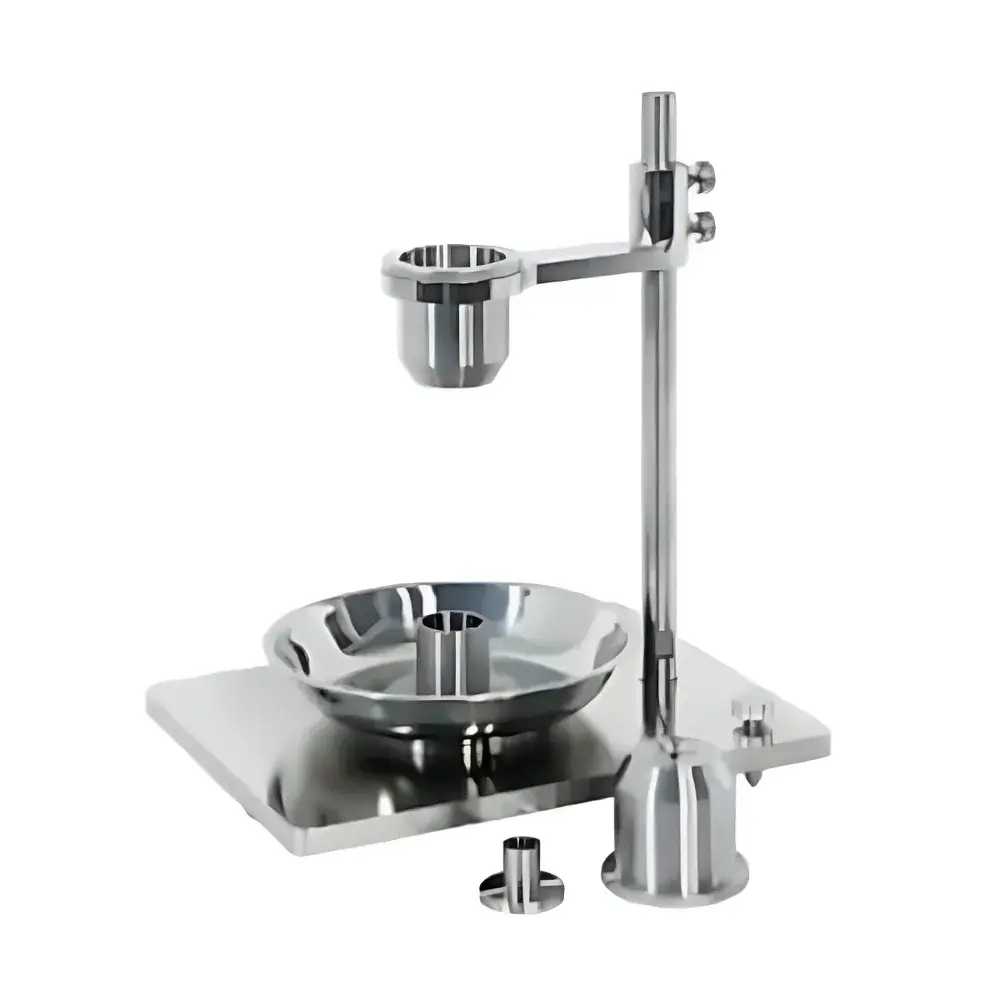
Bettersize BT-102 Hall Flowmeter for Metal Powders
| Brand | Bettersize |
|---|---|
| Origin | Liaoning, China |
| Manufacturer | Bettersize Instrument Co., Ltd. |
| Model | BT-102 |
| Instrument Type | Powder Flowability Tester |
| Compliance | ASTM B213, ASTM B527, ISO 4490, ISO 3953 |
| Funnel Orifice Options | 2.5 mm and 5.0 mm |
| Standard Cup Material | Stainless Steel (304) |
| Cup Volume | 25 mL |
| Timing Resolution | 0.1 s |
| Mass Measurement Accuracy | ±0.05 g |
| Density Reporting Precision | ±0.01 g/cm³ |
Overview
The Bettersize BT-102 Hall Flowmeter is a precision-engineered instrument designed specifically for the standardized measurement of flowability and apparent (bulk) density of free-flowing metal powders. It operates on the principle of gravitational flow through calibrated orifices—primarily adhering to the Hall Flow Test method defined in ASTM B213 and ISO 4490—and the bulk density determination procedure specified in ASTM B527 and ISO 3953. The device provides objective, repeatable metrics critical for powder metallurgy, additive manufacturing feedstock qualification, and quality control in sintered component production. Its mechanical architecture eliminates electronic dependencies during flow timing, ensuring compliance with regulatory audit requirements where traceable manual operation is mandated.
Key Features
- Two interchangeable stainless-steel funnels with precisely machined orifices (2.5 mm and 5.0 mm diameter), enabling sequential testing per ASTM B213 tiered protocol when 2.5 mm flow fails
- Standardized 25 mL volumetric cup fabricated from corrosion-resistant AISI 304 stainless steel, certified for dimensional stability and surface finish consistency
- Integrated height定位 block (25 mm ± 0.1 mm) ensures reproducible funnel-to-cup vertical spacing—critical for eliminating aerodynamic interference and maintaining laminar powder fall
- Mechanically actuated gate valve with tactile feedback and zero-slip engagement, minimizing operator-induced variability in orifice opening initiation
- Universal mounting platform with bubble-level vial and adjustable leveling feet, guaranteeing horizontal alignment within ±0.2° across diverse laboratory surfaces
- No embedded firmware or software dependency—fully compliant with GLP environments requiring deterministic, non-programmable instrumentation
Sample Compatibility & Compliance
The BT-102 is validated for use with spherical, irregular, and dendritic metal powders including but not limited to stainless steel (e.g., SS316L, SS17-4PH), titanium alloys (Ti-6Al-4V), aluminum alloys (AlSi10Mg), nickel-based superalloys (Inconel 625, 718), and tungsten carbide composites. It excludes cohesive, hygroscopic, or electrostatically charged powders unless preconditioned per ASTM B964. Regulatory alignment includes full traceability to ASTM B213 (Hall Flow Rate), ASTM B527 (Bulk Density), ISO 4490 (Metallic Powders — Determination of Flow Rate Using the Hall Flowmeter), and ISO 3953 (Metallic Powders — Determination of Apparent Density). Device geometry and material specifications are documented in accordance with ISO/IEC 17025 calibration evidence requirements for accredited testing laboratories.
Software & Data Management
The BT-102 is a stand-alone mechanical instrument with no integrated digital interface. All measurements are recorded manually into laboratory notebooks or LIMS-compatible spreadsheets. This design supports strict adherence to FDA 21 CFR Part 11 Annex 11 and EU GMP Annex 11 requirements for instruments where data integrity relies on procedural controls rather than electronic audit trails. Users may employ external timing devices (e.g., NIST-traceable stopwatch with 0.1 s resolution) and analytical balances compliant with USP repeatability criteria. Raw data—including individual trial durations (t₁, t₂, t₃), mass values (m₁, m₂, m₃), and calculated flow rate (g/s) and bulk density (g/cm³)—must be retained for minimum 10 years per ISO 15189 retention mandates.
Applications
- Pre-process qualification of AM feedstock powders prior to laser powder bed fusion (LPBF) or electron beam melting (EBM)
- In-process monitoring of gas-atomized powder batches in metallurgical production lines
- Comparative assessment of surface passivation or lubricant coating efficacy on flow enhancement
- Root-cause analysis of sintering defects linked to inconsistent green density distribution
- Regulatory submission support for medical device manufacturers under ISO 13485 and ASTM F3049
- Method validation studies in contract testing laboratories seeking ISO/IEC 17025 accreditation
FAQ
What standards does the BT-102 directly support?
ASTM B213, ASTM B527, ISO 4490, and ISO 3953 — all test procedures are implemented via fixed mechanical geometry and documented operational sequence.
Can the BT-102 be used for non-metallic powders?
It is not recommended for ceramics, polymers, or pharmaceuticals unless validated per ICH Q5E comparability protocols; flow dynamics differ significantly due to interparticle force dominance.
Is calibration certification included with purchase?
Yes — each unit ships with a factory-issued dimensional verification report covering orifice diameter (±0.02 mm), cup volume (±0.05 mL), and height block tolerance (±0.1 mm), traceable to CNAS-accredited metrology labs.
How many replicate tests are required per standard?
Three independent trials are mandatory for both flow time and bulk density; outliers exceeding ±1% of mean must be reported alongside final average per ASTM B527 Section 9.2.
Does the instrument require periodic recalibration?
No scheduled recalibration is needed; however, users must perform daily visual inspection of orifice edges and cup interior for wear or residue accumulation per SOP-FLW-003.



