
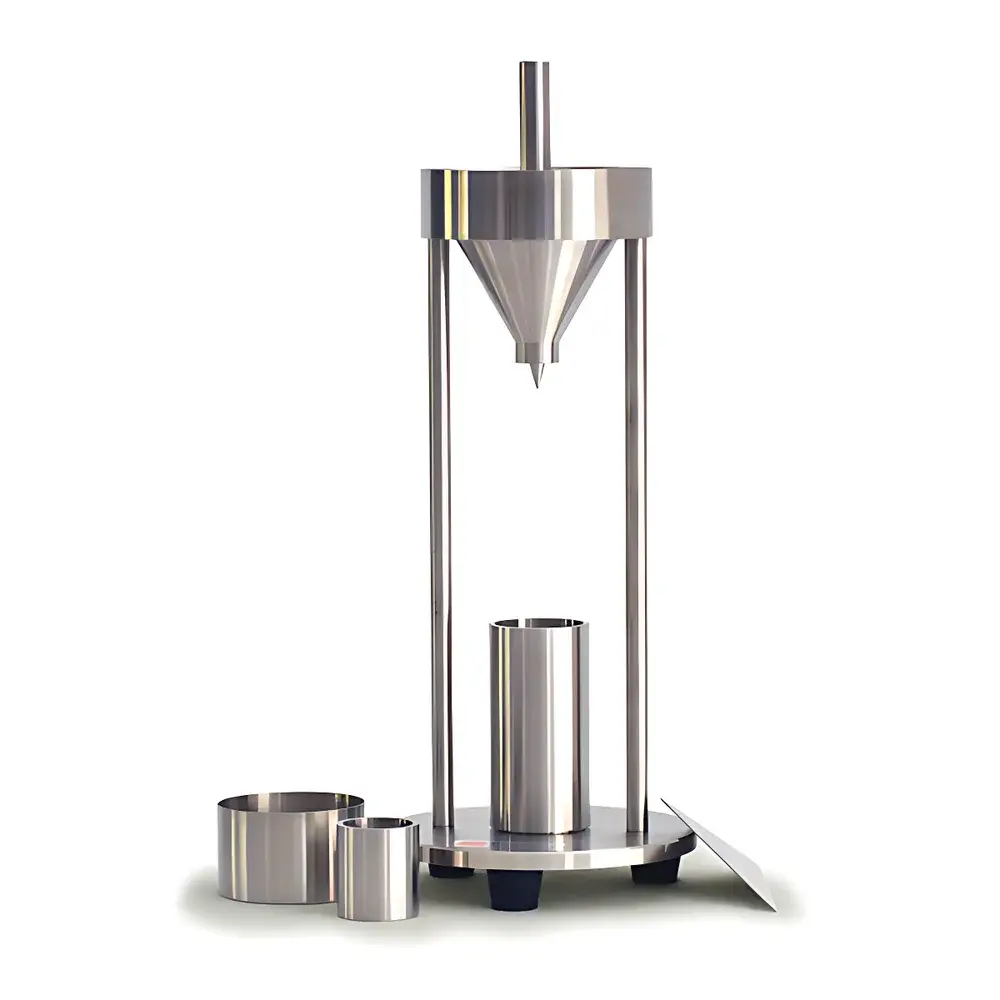
Bettersize BT-100 Bulk Density Tester
| Brand | Bettersize |
|---|---|
| Origin | Liaoning, China |
| Manufacturer Type | Direct Manufacturer |
| Instrument Type | Bulk Density Tester |
| Model | BT-100 |
| Compliance | GB/T 16913–2008 |
Overview
The Bettersize BT-100 Bulk Density Tester is a precision-engineered instrument designed for the standardized determination of bulk density (also referred to as apparent density or loose density) of free-flowing and moderately cohesive powders, granules, and particulate solids. It operates on the principle of gravitational flow under controlled geometry—specifically, the standardized funnel-and-cup method defined in GB/T 16913–2008, which aligns closely with international methodologies such as ASTM D1473, ISO 3953, and USP <616>. The device consists of a calibrated stainless-steel funnel with fixed orifice geometry, a vertically aligned stopper rod, a precision-machined cylindrical measuring cup (typically 100 mL nominal volume), and a dedicated support platform compatible with external analytical balances (not included). Bulk density is calculated as the ratio of the mass of powder that freely fills the cup under gravity to the geometric volume of the cup—yielding results in g/cm³ or kg/m³. This parameter is critical for characterizing powder behavior during storage, conveying, blending, and dosing operations, particularly in silo design, hopper discharge analysis, and process validation.
Key Features
- Compliant mechanical architecture engineered to meet the dimensional tolerances and procedural requirements of GB/T 16913–2008, including funnel angle, orifice diameter, cup inner diameter and height, and vertical alignment specifications.
- Corrosion-resistant stainless-steel construction for long-term dimensional stability and resistance to abrasive or mildly reactive powders.
- Integrated stopper rod mechanism enabling precise, repeatable initiation of powder flow without manual disturbance—minimizing operator-induced variability.
- Modular platform design accommodates standard 100 mL volumetric cups (ISO 3953-compliant dimensions) and integrates seamlessly with Class I or II analytical balances (0.001 g readability recommended).
- No electrical components or software dependency—ensuring operational simplicity, intrinsic safety in explosive dust environments (ATEX-compliant when used with appropriate balance enclosures), and minimal maintenance requirements.
- Designed for high reproducibility across operators and laboratories when SOPs—including sample conditioning (e.g., drying at 105 °C per GB/T 16913), particle size screening (e.g., 80-mesh sieve), and triple replicate measurement—are rigorously followed.
Sample Compatibility & Compliance
The BT-100 is validated for use with dry, non-agglomerating, and moderately cohesive powders ranging from ~10 µm to >1 mm in median particle size. It is routinely applied to pharmaceutical excipients (e.g., lactose, microcrystalline cellulose), food powders (e.g., flour, sugar, milk powder), battery cathode/anode materials (e.g., NMC, graphite), catalysts, metal powders (e.g., Al, Ti alloys), and ceramic precursors. Moisture-sensitive samples must be conditioned per GB/T 16913–2008 (drying at 105 °C ± 2 °C for ≥2 h, then cooled in a desiccator). Particulate contamination is removed using an 80-mesh (177 µm) sieve prior to testing. The instrument supports GLP- and GMP-aligned workflows when paired with auditable balance systems featuring 21 CFR Part 11–compliant electronic records and audit trails.
Software & Data Management
The BT-100 is a hardware-only, manual-operated instrument with no embedded firmware or proprietary software. Data acquisition and calculation are performed externally via laboratory balance interfaces (e.g., RS-232/USB output to LIMS or Excel-based templates). Users are advised to implement standardized calculation worksheets that enforce the GB/T 16913–2008 requirement: three consecutive measurements must yield a maximum–minimum mass difference ≤1.0 g; otherwise, retesting is mandatory. When integrated into regulated environments, laboratories typically document test parameters—including ambient temperature/humidity, balance calibration status, sieve lot number, drying duration, and operator ID—in paper or electronic batch records traceable to QA/QC procedures.
Applications
- Pharmaceutical manufacturing: Qualification of blend uniformity, tablet compression feasibility, and hopper flow modeling.
- Food & nutraceutical production: Monitoring consistency of dry mix formulations and packaging fill-volume prediction.
- Battery material R&D: Correlating bulk density with electrode coating density, slurry rheology, and calendering response.
- Chemical & polymer additive processing: Assessing flowability changes induced by surface treatment or humidity exposure.
- Academic research & standards laboratories: Reference method validation, inter-laboratory comparison studies, and teaching of powder characterization fundamentals.
- Quality control in raw material receipt: Fast verification of supplier-spec compliance for bulk density limits.
FAQ
What standards does the BT-100 comply with?
It is fully compliant with GB/T 16913–2008 and functionally equivalent to ASTM D1473, ISO 3953, and USP <616> for bulk density determination.
Is the measuring cup included with the instrument?
Yes—a precision-machined 100 mL stainless-steel cup conforming to GB/T 16913–2008 dimensional tolerances is supplied as standard equipment.
Can the BT-100 measure tapped density?
No. The BT-100 is specifically configured for *loose* (untapped) bulk density. Tapped density requires a separate tap density tester (e.g., BT-301 series) per GB/T 5162 or ISO 3953 Annex A.
What balance specifications are recommended?
A Class I or II analytical balance with ≥0.001 g readability, internal calibration, and stable platform is required; balance uncertainty should be ≤0.5% of the expected sample mass.
How often should the funnel orifice be inspected?
Visual inspection for wear or debris is recommended before each test series; dimensional verification using gauge pins should occur quarterly or after 500 tests.



