
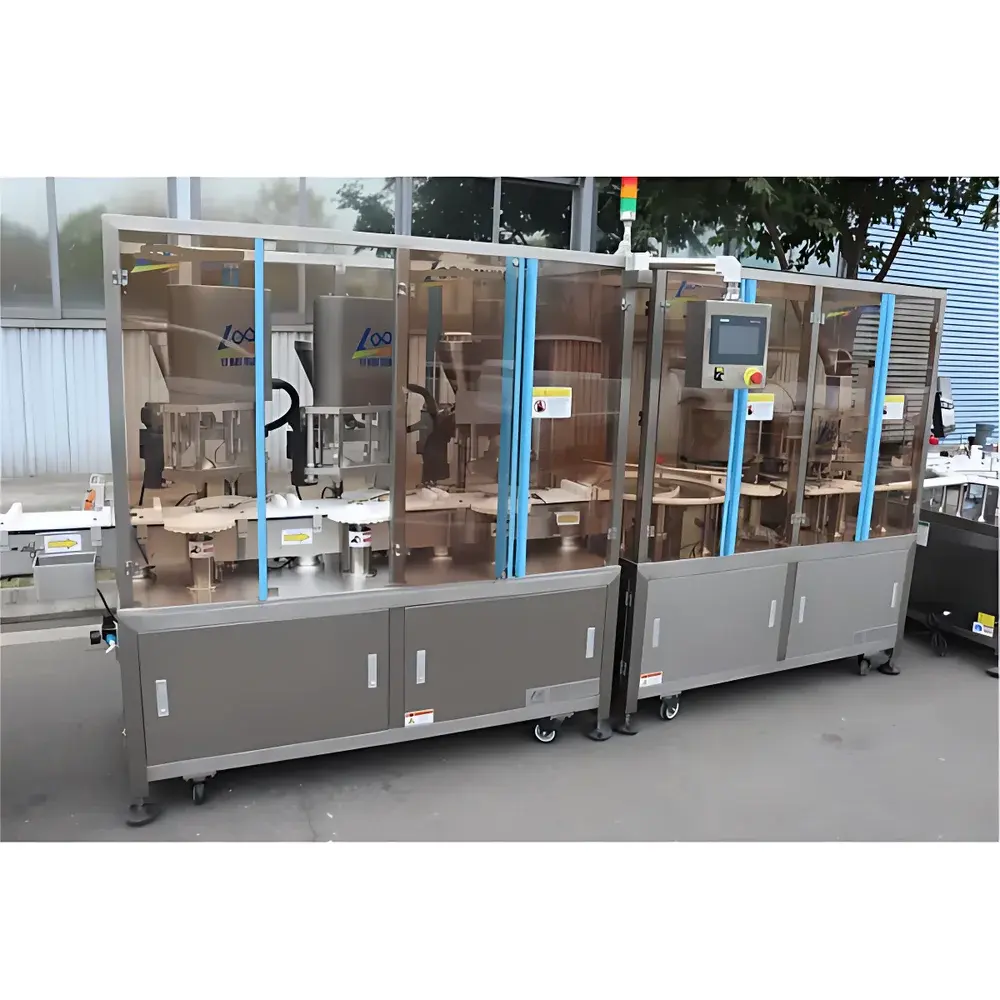
AA OPTO Electronic Freeze-Dried Powder High-Speed Filling Machine
| Brand | AA OPTO Electronic |
|---|---|
| Origin | China |
| Manufacturer Type | Authorized Distributor |
| Model | Freeze-Dried Powder High-Speed Filling Machine |
| Filling Volume Range | 10–30 mL, 30–60 mL, 50–120 mL, 100–250 mL (customizable) |
| Bottle Compatibility | Round, Oval, and Irregular-Shaped Vials |
| Filling Nozzles | 4, 6, 8, 12, 16, 18, 20 (configurable) |
| Filling Principle Options | Piston (316L stainless steel or ceramic), Peristaltic Pump, Vacuum-Assisted, Gravity-Flow, Weighing-Based, Flowmeter-Controlled |
| Filling Accuracy | ≤ ±1% |
| Capping Stations | 1, 2, 4, 6, 8, 12, 16, 20, or 24 heads (configurable) |
| Compliance | Designed to meet current Good Manufacturing Practice (cGMP) requirements per Annex 1 (EU) and US FDA 21 CFR Part 211 |
Overview
The AA OPTO Electronic Freeze-Dried Powder High-Speed Filling Machine is an integrated, modular aseptic filling system engineered specifically for post-lyophilization powder handling in regulated pharmaceutical manufacturing environments. Unlike general-purpose powder fillers, this machine addresses the unique physical challenges of freeze-dried cake reconstitution residuals—low bulk density, high electrostatic charge, poor flowability, and sensitivity to mechanical shear. It operates on a closed-loop, isolator-compatible architecture with validated air-handling units (AHUs) delivering ISO Class 5 (Class 100) laminar airflow over critical zones. The core filling principle is selectable based on product rheology and regulatory risk profile: piston-based dispensing provides gravimetric repeatability for high-value biologics; ceramic-tipped 316L stainless steel plungers ensure chemical inertness and cleanability; while vacuum-assisted and weighing-based variants support dose uniformity verification per ICH Q5C and USP . All material contact surfaces comply with ASME BPE-2022 surface finish standards (Ra ≤ 0.4 µm), and weld maps are fully documented for audit readiness.
Key Features
- Modular linear configuration enabling seamless integration with upstream lyophilizers and downstream depyrogenation tunnels or stoppering stations.
- Multi-stage vial preparation: automated orientation (via vision-guided bowl feeder), HEPA-filtered compressed-air washing (validated particle removal ≥99.997% for ≥0.3 µm), and pre-filling vacuum purge to eliminate residual moisture and oxygen.
- Configurable filling head arrays (4–20 nozzles) with independent servo-driven actuation, enabling synchronized fill cycles across heterogeneous vial formats without mechanical cam interference.
- Capping module supports both aluminum crimp-sealing and flip-off cap application, with torque control traceable to NIST-traceable calibration standards.
- Integrated foil induction sealer meeting ASTM F2096 bubble leak test specifications for hermeticity validation.
- PLC-controlled HMI with password-protected user roles (Operator, Technician, QA), electronic batch record (EBR) export, and optional 21 CFR Part 11 compliance package including digital signatures and audit trail logging.
Sample Compatibility & Compliance
The system accommodates standard ISO 8362-compliant glass vials (10–50 mL), as well as custom-shaped containers used in cell and gene therapy applications—including polymer-based cyclic olefin copolymer (COC) vials. Fill weight ranges from 10 mg to 2.5 g per unit dose, supporting both single-dose and multi-dose configurations. All wetted materials conform to USP and biological reactivity testing. Design documentation includes full DQ/IQ/OQ/PQ protocols aligned with EU Annex 1 (2022), PIC/S PI 007-6, and FDA Guidance for Industry: Sterile Drug Products Produced by Aseptic Processing (2004). Equipment qualification packages include filter integrity test records (forward flow and water intrusion), airflow visualization studies (smoke tracing), and media fill simulation reports.
Software & Data Management
The embedded control system runs on a deterministic real-time OS with dual-redundant Ethernet/IP communication. Process data—including fill weight deviation per vial, capping torque variance, foil seal temperature profiles, and environmental monitoring (differential pressure, particle counts, RH)—are logged at 100 Hz and stored in encrypted SQLite databases compliant with ALCOA+ principles. Data export supports CSV, PDF e-signature-ready batch summaries, and direct integration with MES platforms via OPC UA 1.04. Optional add-ons include predictive maintenance analytics (vibration signature analysis of piston actuators) and AI-assisted anomaly detection trained on historical fill weight distributions.
Applications
- Final dosage filling of monoclonal antibodies, vaccines, and recombinant proteins after lyophilization.
- Stable powder formulation of mRNA-LNPs requiring low-shear, inert-gas-purged handling.
- High-potency oncology compounds where containment and operator exposure limits (OELs) demand closed-system transfer.
- Nutritional supplement manufacturing under NSF/ANSI 173 and cGMP for dietary supplements (21 CFR Part 111).
- Contract development and manufacturing organizations (CDMOs) performing tech transfer of lyo-fill processes from clinical to commercial scale.
FAQ
Is the machine suitable for sterile filling under Grade A conditions?
Yes—it is designed for integration into RABS or isolator environments and meets ISO 14644-1 Class 5 airborne particulate limits when operated with certified AHUs.
Can it handle hygroscopic or electrostatic-prone powders?
Yes—optional nitrogen purging, static-dissipative tubing, and low-velocity filling nozzles mitigate moisture uptake and agglomeration.
What validation support is provided?
AA OPTO Electronic supplies full URS, FDS, and FAT documentation; IQ/OQ protocols; and commissioning assistance by qualified engineers with >10 years’ experience in sterile process validation.
Is remote diagnostics supported?
Yes—via secure TLS 1.3 VPN tunnel with role-based access; diagnostic logs include real-time servo error codes and predictive failure indicators.
Does the system support change control per GMP?
Yes—software versioning, configuration item tracking, and impact assessment templates are included in the baseline GxP compliance package.



